Penny Rides and Merry New Year!
Let’s not forget, from 8 pm until 6 am tonight and tomorrow morning, all rides on the CTA are a penny.
Have a happy new year. We’re with you. We’re surrounded by children. My sister is here. I have a cold, but fuck it, I’m gonna drink anyway! We’re pleased to know you. I have a resolution but I’m not telling. Have you been outside today? It smells like April- that moist smell of earth. Why must winter tease us so? We’re hopeful. We’re sad. We want to capture this time, put it away somewhere, pull it out later and marvel.
Friday, December 31, 2004

Thursday, December 30, 2004
It’s the $
Check out this article from today’s Post- it’s one of the first I’ve read to actually give a credible and comprehensive summary of this year’s presidential election and the tactics used by each side. Key quote:
In a $2.2 billion election, two relatively small expenditures by Bush and his allies stand out for their impact: the $546,000 ad buy by Swift Boat Veterans for Truth and the Bush campaign's $3.25 million contract with the firm TargetPoint Consulting. The first portrayed Kerry in unrelentingly negative terms, permanently damaging him, while the second produced dramatic innovations in direct mail and voter technology, enabling Bush to identify and target potential voters with pinpoint precision.
Check out this article from today’s Post- it’s one of the first I’ve read to actually give a credible and comprehensive summary of this year’s presidential election and the tactics used by each side. Key quote:
In a $2.2 billion election, two relatively small expenditures by Bush and his allies stand out for their impact: the $546,000 ad buy by Swift Boat Veterans for Truth and the Bush campaign's $3.25 million contract with the firm TargetPoint Consulting. The first portrayed Kerry in unrelentingly negative terms, permanently damaging him, while the second produced dramatic innovations in direct mail and voter technology, enabling Bush to identify and target potential voters with pinpoint precision.
“I had so many admirations: there was so much to admire.”
A decade now, back in the early 90’s, disenchanted with the various dull syllabi representative of my undergraduate degree and intuiting that there were far more exciting things to learn about if I simply stepped away from the cramped quarters of prescribed curriculum and took a look, I dropped out of college and quietly lit out for the territories. What I may have lacked in discipline (there was a gleefully haphazard quality to my intellectual pursuits during this time) I more than made up for in curiosity and appetite. If anything, my time away from school was a kind of self-inflicted therapy- a way to recharge my batteries and remind myself that learning was, in and of itself, noble and luxuriant with a sense of fun and play. Learning made life necessary.
Having the space to pursue whatever impulse or whimsy my curiosity mandated led me to many teachers. One of my favorites was Susan Sontag. Sontag died yesterday at the age of 71 after a long battle with cancer. My copy of Against Interpretation and Other Essays (which includes the immortal Notes on “Camp” and is, as Sontag warily admitted, one of the quintessential texts of the Sixties) is never far from reach and just this Christmas my sister-in-law gave me On Photography. Which is to say that Sontag has long held a very cherished place in my own, albeit far lesser, intellectual development and that, if only out of greed, I had hoped she would be around a while longer.
Back in those heady cloistered days of the early 90’s I first read many of Sontag’s earliest essays, written in the early Sixties when she was living in New York. Reflecting on these formative essays in 1996, Sontag wrote, “I was filled with evangelical zeal.” Having the opportunity to wallow in Sontag’s insights, to delight in their urgency and sense of possibility- to experience that sublime moment when her words and the ideas they gave flight to suddenly soared upwards and bumped against something consummate of my own fervency and interests gave me perhaps all the reason I needed whenever I questioned my decision to pause my undergraduate career.
And it wasn’t just Sontag’s intelligence and the succinct eloquence with which she espoused her ideas- it was the incredible, humbling range of her erudition that was stunning. She was a true renaissance mind- interested in everything and fearlessly advocating her positions in essays that I still am unable to read without being sidetracked by the sheer avalanche of new ideas they generate. In fact, reading a Sontag essay is one of the best cures for aesthetic/intellectual laziness I can think of. To read her is to be reunited to the architecture of our ideas and how we might be more alive to their cultivation.
A decade now, back in the early 90’s, disenchanted with the various dull syllabi representative of my undergraduate degree and intuiting that there were far more exciting things to learn about if I simply stepped away from the cramped quarters of prescribed curriculum and took a look, I dropped out of college and quietly lit out for the territories. What I may have lacked in discipline (there was a gleefully haphazard quality to my intellectual pursuits during this time) I more than made up for in curiosity and appetite. If anything, my time away from school was a kind of self-inflicted therapy- a way to recharge my batteries and remind myself that learning was, in and of itself, noble and luxuriant with a sense of fun and play. Learning made life necessary.
Having the space to pursue whatever impulse or whimsy my curiosity mandated led me to many teachers. One of my favorites was Susan Sontag. Sontag died yesterday at the age of 71 after a long battle with cancer. My copy of Against Interpretation and Other Essays (which includes the immortal Notes on “Camp” and is, as Sontag warily admitted, one of the quintessential texts of the Sixties) is never far from reach and just this Christmas my sister-in-law gave me On Photography. Which is to say that Sontag has long held a very cherished place in my own, albeit far lesser, intellectual development and that, if only out of greed, I had hoped she would be around a while longer.
Back in those heady cloistered days of the early 90’s I first read many of Sontag’s earliest essays, written in the early Sixties when she was living in New York. Reflecting on these formative essays in 1996, Sontag wrote, “I was filled with evangelical zeal.” Having the opportunity to wallow in Sontag’s insights, to delight in their urgency and sense of possibility- to experience that sublime moment when her words and the ideas they gave flight to suddenly soared upwards and bumped against something consummate of my own fervency and interests gave me perhaps all the reason I needed whenever I questioned my decision to pause my undergraduate career.
And it wasn’t just Sontag’s intelligence and the succinct eloquence with which she espoused her ideas- it was the incredible, humbling range of her erudition that was stunning. She was a true renaissance mind- interested in everything and fearlessly advocating her positions in essays that I still am unable to read without being sidetracked by the sheer avalanche of new ideas they generate. In fact, reading a Sontag essay is one of the best cures for aesthetic/intellectual laziness I can think of. To read her is to be reunited to the architecture of our ideas and how we might be more alive to their cultivation.
Friday, December 24, 2004
Baby, It's Cold Outside
According to the Tribune weather page it's -2 outside. That's cold, folks- damn cold! Coldest, we're told, since 1983. But we're keeping it warm today. Hope you are as well. Happy Holidays and all that good stuff. We're thinking about each and every one of you!

Friday, December 17, 2004
Jammin’ On The One!
My friends, Joe, Pieter and I have begun a MP3 blog, Akwaaba Sound System, officially launched only yesterday when Joe posted a couple fantastic tracks from Francis Bebey’s 1984 album, Akwaaba. I’m hoping to post something on Saturday while Pieter, on the other hand, is presently on the cusp of fatherhood- so it might be a bit.
Thousands of MP3 blogs have appeared on these here so-called internets over the last year- usually hosted by music enthusiasts who post various songs from their collections accompanied by prefatory blurbs. It’s the dorm room equivalent of playing a friend some tracks off your favorite albums, only now all the limitations of your collection’s relationship to time and space have gone and radically been altered- you can just go and post the track on-line and anybody with decent internet access and some speakers can check it out.
More later...
My friends, Joe, Pieter and I have begun a MP3 blog, Akwaaba Sound System, officially launched only yesterday when Joe posted a couple fantastic tracks from Francis Bebey’s 1984 album, Akwaaba. I’m hoping to post something on Saturday while Pieter, on the other hand, is presently on the cusp of fatherhood- so it might be a bit.
Thousands of MP3 blogs have appeared on these here so-called internets over the last year- usually hosted by music enthusiasts who post various songs from their collections accompanied by prefatory blurbs. It’s the dorm room equivalent of playing a friend some tracks off your favorite albums, only now all the limitations of your collection’s relationship to time and space have gone and radically been altered- you can just go and post the track on-line and anybody with decent internet access and some speakers can check it out.
More later...
Thursday, December 16, 2004
Some Fries With Your Bypass?
From yesterday's Washington Post:
"I can't tell you how many patients found this repulsive," said cardiology chairman Eric Topol. "How can the Cleveland Clinic, which prides itself on promoting health, have the audacity to have a McDonald's in the main lobby?"
From yesterday's Washington Post:
"I can't tell you how many patients found this repulsive," said cardiology chairman Eric Topol. "How can the Cleveland Clinic, which prides itself on promoting health, have the audacity to have a McDonald's in the main lobby?"
Friday, December 10, 2004
The Halo Effect
I probably stopped eating regularly at McDonalds somewhere back in 1998. Before then I ate way too much of it even though I knew I shouldn’t. At the beginning of 1999 my friend Juana and I decided to go cold turkey and not eat at McDonalds (which was, of course, conveniently located, as it still is, just a few blocks from where we were working) for 6 months. And we didn’t. Come June, we made our way over, ordered lunch, consumed, and thought, “Boy, that kinda sucked!”
If that wasn’t enough, Schlosser’s Fast Food Nation went a long way toward presenting me with a bounty of reasons I had formally been nagged and troubled by but hadn’t yet gathered into a cogent thesis with enough power to wallop me over the head in such a way as to make me appreciate, beyond a doubt, that eating at McDonalds was not only bad for my health- but that it was also part of a fast-food industry that perpetuates and sustains numerous unfortunates- particularly its treatment of workers all along the chain and its predatory youth marketing. That Ronald McDonald is one insidious evil clown mother-fucker and Schlosser’s book does a swell job telling us why.
Still, because of its global reach and iconic status, I’ll always be interested in what McDonald’s is up to. I knew they had been struggling over the last few years, especially in 2002 when they chalked up their first quarterly loss since 1954. According to a recent Economist article, however, McDonald’s has come roaring back, with sales up 13% for the first half of this year and net profits up 38% compared to this time last year.
How are they doing it? Well, first off they’re making things even more efficient. According to the article:
Every McDonald’s has a “travel path” along which a member of staff must walk- sometimes every 30 minutes- to ensure that all is well. The company is now testing small hand-held devices, which can be used like electronic clipboards by those making the rounds. Failures to check, say, the temperature inside a refrigerator (the devices are fitted with a probe) or to scan a location barcode (they have a scanner too) when checking the play area, will be recorded. If too many incomplete checks build up, the device can automatically alert the local manager by ringing his mobile phone.
At which point, I presume, the local manager will call his staff and threaten to boil all of them in a vat of McNugget cooking oil.
What’s really interesting (or depressing) is the other explanation for the big turnaround. Wary of the victories scored against Big Tobacco and the recent onslaught of obesity lawsuits McDonald’s has introduced healthier menu items. So are those hefty profit margins being driven by salads? Not quite.
McDonald’s officials insist their salads are priced to be profitable, arguing that if they were not its franchisees would not want to sell them. But then, by some measures, supermarket loss-leaders are also profitable because they bring in customers who buy other products. Nevertheless, salads are sending a message to millions of customers: that it is now acceptable to eat at McDonald’s again because the menu is “healthier”- even though the vast majority still order a burger and fries.
“There is no question that we make more money from selling hamburgers and cheeseburgers,” says Matthew Paull, McDonald’s chief financial officer. Sales growth is, he says, being driven by the “halo effect” of healthier food appearing on the menu.
Weird, huh? By being in the vicinity of salads and other lighter options, the McDonald’s customer fuelling their recent growth feels more at ease eating a Big Mac. It’s as though the very presence of salads and healthier foods creates new equivalencies- that somehow eating a Big Mac is analogous to eating some iceberg with tomatoes.
I probably stopped eating regularly at McDonalds somewhere back in 1998. Before then I ate way too much of it even though I knew I shouldn’t. At the beginning of 1999 my friend Juana and I decided to go cold turkey and not eat at McDonalds (which was, of course, conveniently located, as it still is, just a few blocks from where we were working) for 6 months. And we didn’t. Come June, we made our way over, ordered lunch, consumed, and thought, “Boy, that kinda sucked!”
If that wasn’t enough, Schlosser’s Fast Food Nation went a long way toward presenting me with a bounty of reasons I had formally been nagged and troubled by but hadn’t yet gathered into a cogent thesis with enough power to wallop me over the head in such a way as to make me appreciate, beyond a doubt, that eating at McDonalds was not only bad for my health- but that it was also part of a fast-food industry that perpetuates and sustains numerous unfortunates- particularly its treatment of workers all along the chain and its predatory youth marketing. That Ronald McDonald is one insidious evil clown mother-fucker and Schlosser’s book does a swell job telling us why.
Still, because of its global reach and iconic status, I’ll always be interested in what McDonald’s is up to. I knew they had been struggling over the last few years, especially in 2002 when they chalked up their first quarterly loss since 1954. According to a recent Economist article, however, McDonald’s has come roaring back, with sales up 13% for the first half of this year and net profits up 38% compared to this time last year.
How are they doing it? Well, first off they’re making things even more efficient. According to the article:
Every McDonald’s has a “travel path” along which a member of staff must walk- sometimes every 30 minutes- to ensure that all is well. The company is now testing small hand-held devices, which can be used like electronic clipboards by those making the rounds. Failures to check, say, the temperature inside a refrigerator (the devices are fitted with a probe) or to scan a location barcode (they have a scanner too) when checking the play area, will be recorded. If too many incomplete checks build up, the device can automatically alert the local manager by ringing his mobile phone.
At which point, I presume, the local manager will call his staff and threaten to boil all of them in a vat of McNugget cooking oil.
What’s really interesting (or depressing) is the other explanation for the big turnaround. Wary of the victories scored against Big Tobacco and the recent onslaught of obesity lawsuits McDonald’s has introduced healthier menu items. So are those hefty profit margins being driven by salads? Not quite.
McDonald’s officials insist their salads are priced to be profitable, arguing that if they were not its franchisees would not want to sell them. But then, by some measures, supermarket loss-leaders are also profitable because they bring in customers who buy other products. Nevertheless, salads are sending a message to millions of customers: that it is now acceptable to eat at McDonald’s again because the menu is “healthier”- even though the vast majority still order a burger and fries.
“There is no question that we make more money from selling hamburgers and cheeseburgers,” says Matthew Paull, McDonald’s chief financial officer. Sales growth is, he says, being driven by the “halo effect” of healthier food appearing on the menu.
Weird, huh? By being in the vicinity of salads and other lighter options, the McDonald’s customer fuelling their recent growth feels more at ease eating a Big Mac. It’s as though the very presence of salads and healthier foods creates new equivalencies- that somehow eating a Big Mac is analogous to eating some iceberg with tomatoes.
Saturday, December 04, 2004
Then and Now
An artist in Cape Cod, right? At least I think so. My mom had her (or him?) do portraits of all us kids back in the 70's and they've been hanging in the house ever since. But this Thanksgiving I couldn't help but notice that my sister's portrait seems to be the only one to have survived my mom's recent and ambitious fit of redecorating!
In any case, one of the things we've all found peculiar about these particular renderings is how the artist gave each of us little elongated O's for mouths. We all look slightly spooked.
Here Robin does her best imitation
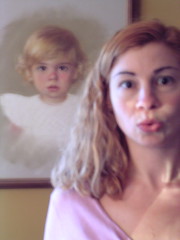
In any case, one of the things we've all found peculiar about these particular renderings is how the artist gave each of us little elongated O's for mouths. We all look slightly spooked.
Here Robin does her best imitation
The Lifting of Negatives
Hello. We’ve been feeling way too apathetic this past week. I’m not usually prone to heavy fits of depression but for the better part of this past week a blue funk had me coiled deep into its groove. And the worst thing about it is how nebulous it makes me feel, as though all my best laid plans were carted off in the middle of the night to some remote, unobtainable location. I awake in the morning, not quite a husk of my former self, but definitely lacking in the essentials that allow anybody to approach the day with the curiosity necessary to enable adventure, delight, satisfaction and all the other requisite ingredients that add up to what you might call, after a luxurious sip of red wine, a good day.
The word for this is blah. Blah. It’s low-grade neurosis. It’s psychodrama. It’s personality deflating or personae with a limp. And it happens and what I probably dislike most about it is that I don’t feel much like playing while it’s running its moronic course. No catching fireflies or building of forts and definitely, most definitely no after dinner puppet shows! Nope, none of that. Just moping and big thick clouds of sullen resting between the eyes. Blah.
There are solutions for a case of the blahs and they don’t include pharmaceuticals but they do include alcohol. Not immediate cure-all’s or anything- just a bunch of moments when the clouds lifted and levity was introduced. Little things, too. Eggs with bacon, for instance. Putting the blinds up. Eating a Nutrageous. Climbing 9 flights of stairs. Sharing a beer with Cathy. Hearing Baba O’Riley played live and loud. Those decorative snowmen lining Broadway (just north of Bryn Mawr) especially, all sordidly brackish from accumulated holidays spent hanging on the light polls- I especially like these- how they’re anything but white- how they resist the purity associated with the holidays- how their original snow-whiteness has gone and mutated into something vaguely sleazy from the splash of gingerbread slush and car exhaust. Maybe I saw something emblematic in them- their state and mine. Sweet context. Laughter nevertheless.
Presently there is a thaw and a lifting of negatives. I’m hoping this current sticks around.
Hello. We’ve been feeling way too apathetic this past week. I’m not usually prone to heavy fits of depression but for the better part of this past week a blue funk had me coiled deep into its groove. And the worst thing about it is how nebulous it makes me feel, as though all my best laid plans were carted off in the middle of the night to some remote, unobtainable location. I awake in the morning, not quite a husk of my former self, but definitely lacking in the essentials that allow anybody to approach the day with the curiosity necessary to enable adventure, delight, satisfaction and all the other requisite ingredients that add up to what you might call, after a luxurious sip of red wine, a good day.
The word for this is blah. Blah. It’s low-grade neurosis. It’s psychodrama. It’s personality deflating or personae with a limp. And it happens and what I probably dislike most about it is that I don’t feel much like playing while it’s running its moronic course. No catching fireflies or building of forts and definitely, most definitely no after dinner puppet shows! Nope, none of that. Just moping and big thick clouds of sullen resting between the eyes. Blah.
There are solutions for a case of the blahs and they don’t include pharmaceuticals but they do include alcohol. Not immediate cure-all’s or anything- just a bunch of moments when the clouds lifted and levity was introduced. Little things, too. Eggs with bacon, for instance. Putting the blinds up. Eating a Nutrageous. Climbing 9 flights of stairs. Sharing a beer with Cathy. Hearing Baba O’Riley played live and loud. Those decorative snowmen lining Broadway (just north of Bryn Mawr) especially, all sordidly brackish from accumulated holidays spent hanging on the light polls- I especially like these- how they’re anything but white- how they resist the purity associated with the holidays- how their original snow-whiteness has gone and mutated into something vaguely sleazy from the splash of gingerbread slush and car exhaust. Maybe I saw something emblematic in them- their state and mine. Sweet context. Laughter nevertheless.
Presently there is a thaw and a lifting of negatives. I’m hoping this current sticks around.
Tuesday, November 30, 2004
When I'm An Uncle
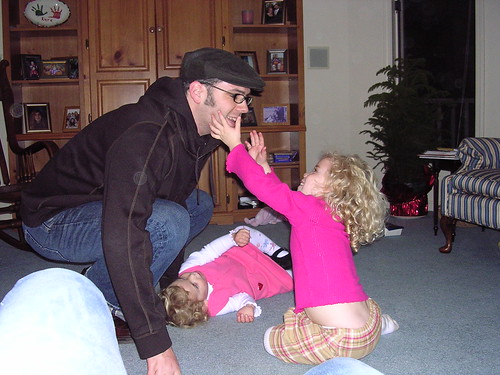
My nieces, Lucy and Mia (laying on the floor) after some post Thanksgiving meal dancing.
Sunday, November 21, 2004
Heavy Weightlessness
John Huston’s The Misfits (1961) was the last film Marilyn Monroe ever made. She starred alongside Clark Gable(his last film as well- he died just weeks after its completion) and an intense Montgomery Clift in a film haunted by the turmoil and real-life demise of its stars.
The film, written by Arthur Miller, is (quite possibly) a suspended meditation on isolation - or at least people people going whacky because of it. The characters all inhabit the same geographic space but they never entirely connect either. They move around each other seeking something none of them can give to the other- though what it is they're seeking is never really all that clear. They're all drifters- either running away from something or desperately trying to find something they lost long ago.
It’s hard to disengage from the strong undercurrents of cultural mythology these actors still exhibit. (Clift, it’s true, is oddly ignored when it comes to the pantheon of great actors-even though his dramatic gifts were just as good, if not better, then that of a peer like Marlon Brando.) These cultural traces (or wakes) act alongside what we know about the films own history in the trajectory of its stars lives (Monroe’s marriage to Miller falling apart, her own suicide less then two years away, Gable to die just weeks after the films completion, Clift to die just a few years later of a heart attack at 45) to create an elegiac strain it probably didn’t possess when originally released in 1961.
It’s an uneven film, burdened at times by Miller’s compulsion to shade everything with meaning (everybody has Willy Loman baggage), but Huston was a terribly competent director, and with the caveat of knowing little about him and his methods, or having seen anywhere near his entire body of work, what films I have seen reveal a director with an acute sense of realism- starker, grittier and more organic then most of the Hollywood fare being produced in his heyday throughout the 40’s, 50’s and 60’s. There is nothing escapist about this film- it’s a brooding reflection on human interaction and our abilities and failings to connect or disengage, feel compassion for or contempt- and Huston keeps things from being lacquered on too thickly but, and here’s the catch- Miller’s script can’t keep up. Huston does a swell job keeping things humming along, and it’s fun watching Monroe (whose bordering chubby but still looking amazing) and wondering what drug she was on when she filmed a particular scene- and Clift is acting on another level altogether- all method acting intensity- while Gable is stately and crisp- but after a while you think- “Well, so what?"
The last half hour or so, with everybody up in the mountains hunting down wild horses for the glue factory is supposed to bring it all home for us. Monroe’s character, realizing that the freedom loving wild horses are being tied down and left to be slaughtered, freaks out. Really. She runs through the desert and screams and shouts and we see horses tied up, tipped over and left behind like useless clumps. And somehow this transforms the men. But why? Bosley Crowther, reviewing the film for the New York Times, wrote, “It has something to do with her sense of freedom. What, we wouldn’t know.” Huston’s direction is never any less then assured and frequently stunning. It’s Miller’s script that keeps grinding the gears.
It’s a paradox- so heavy it’s weightless.
John Huston’s The Misfits (1961) was the last film Marilyn Monroe ever made. She starred alongside Clark Gable(his last film as well- he died just weeks after its completion) and an intense Montgomery Clift in a film haunted by the turmoil and real-life demise of its stars.
The film, written by Arthur Miller, is (quite possibly) a suspended meditation on isolation - or at least people people going whacky because of it. The characters all inhabit the same geographic space but they never entirely connect either. They move around each other seeking something none of them can give to the other- though what it is they're seeking is never really all that clear. They're all drifters- either running away from something or desperately trying to find something they lost long ago.
It’s hard to disengage from the strong undercurrents of cultural mythology these actors still exhibit. (Clift, it’s true, is oddly ignored when it comes to the pantheon of great actors-even though his dramatic gifts were just as good, if not better, then that of a peer like Marlon Brando.) These cultural traces (or wakes) act alongside what we know about the films own history in the trajectory of its stars lives (Monroe’s marriage to Miller falling apart, her own suicide less then two years away, Gable to die just weeks after the films completion, Clift to die just a few years later of a heart attack at 45) to create an elegiac strain it probably didn’t possess when originally released in 1961.
It’s an uneven film, burdened at times by Miller’s compulsion to shade everything with meaning (everybody has Willy Loman baggage), but Huston was a terribly competent director, and with the caveat of knowing little about him and his methods, or having seen anywhere near his entire body of work, what films I have seen reveal a director with an acute sense of realism- starker, grittier and more organic then most of the Hollywood fare being produced in his heyday throughout the 40’s, 50’s and 60’s. There is nothing escapist about this film- it’s a brooding reflection on human interaction and our abilities and failings to connect or disengage, feel compassion for or contempt- and Huston keeps things from being lacquered on too thickly but, and here’s the catch- Miller’s script can’t keep up. Huston does a swell job keeping things humming along, and it’s fun watching Monroe (whose bordering chubby but still looking amazing) and wondering what drug she was on when she filmed a particular scene- and Clift is acting on another level altogether- all method acting intensity- while Gable is stately and crisp- but after a while you think- “Well, so what?"
The last half hour or so, with everybody up in the mountains hunting down wild horses for the glue factory is supposed to bring it all home for us. Monroe’s character, realizing that the freedom loving wild horses are being tied down and left to be slaughtered, freaks out. Really. She runs through the desert and screams and shouts and we see horses tied up, tipped over and left behind like useless clumps. And somehow this transforms the men. But why? Bosley Crowther, reviewing the film for the New York Times, wrote, “It has something to do with her sense of freedom. What, we wouldn’t know.” Huston’s direction is never any less then assured and frequently stunning. It’s Miller’s script that keeps grinding the gears.
It’s a paradox- so heavy it’s weightless.
Saturday, November 20, 2004
The Cartography of Smell
Yesterday afternoon when I was trying to describe the smells of the books I'm currently reading, I remembered the passage from Diane Ackerman's beautiful book, A Natural History of the Senses where she laments the fact that we have so few words to describe certain smells. Here's the passage:
If there are words for all the pastels in a hue- the lavenders, muaves, fuchsias, plums, and lilacs- who will name the tones and tints of smell? It's as if we were hypnotized en masse and told to selectively forget. If may be, too, that smells move us so profoundly, in part because we cannot utter their names. In a world sayable and lush, where marvels offer themselves up readily for verbal dissection, smells are often right on the tip of our tongues- but no closer- and it gives them a kind of magical distance, a mystery, a power without a name, a sacredness.
What is the smell of the seasons? The other day, walking to work, I caught a hint of the freshly cut pine being used to decorate the flower beds along the Magnificent Mile and found myself suddenly transported. But where's the word for it, something succinct, that descibes this? It's a smell bound to all sorts of heady associations, an accumulation of intimate memories. The smell of December, of Christmas is bound up in the smell of pine- and when I smell it I'm suddenly 5 years old and lost in the idiot glee of gift opening- or I'm in my early 20's sitting in my parents living room with no other lights on then those on the tree- or its the present and I'm standing on a street corner where all the hustle and bustle seems to suddenly ebb and I'm lost in reminiscence. Ackerman calls these "aromatic memories." I like that.
Yesterday afternoon when I was trying to describe the smells of the books I'm currently reading, I remembered the passage from Diane Ackerman's beautiful book, A Natural History of the Senses where she laments the fact that we have so few words to describe certain smells. Here's the passage:
If there are words for all the pastels in a hue- the lavenders, muaves, fuchsias, plums, and lilacs- who will name the tones and tints of smell? It's as if we were hypnotized en masse and told to selectively forget. If may be, too, that smells move us so profoundly, in part because we cannot utter their names. In a world sayable and lush, where marvels offer themselves up readily for verbal dissection, smells are often right on the tip of our tongues- but no closer- and it gives them a kind of magical distance, a mystery, a power without a name, a sacredness.
What is the smell of the seasons? The other day, walking to work, I caught a hint of the freshly cut pine being used to decorate the flower beds along the Magnificent Mile and found myself suddenly transported. But where's the word for it, something succinct, that descibes this? It's a smell bound to all sorts of heady associations, an accumulation of intimate memories. The smell of December, of Christmas is bound up in the smell of pine- and when I smell it I'm suddenly 5 years old and lost in the idiot glee of gift opening- or I'm in my early 20's sitting in my parents living room with no other lights on then those on the tree- or its the present and I'm standing on a street corner where all the hustle and bustle seems to suddenly ebb and I'm lost in reminiscence. Ackerman calls these "aromatic memories." I like that.
Friday, November 19, 2004
Book Drop
Absolutely American: Four Years At West Point: David Lipsky- Lipsky was the first reporter to be allowed unfettered access to the nation’s premier military academy, hanging out with plebes (freshmen), yearlings (sophomores), cows (juniors), and firsties (seniors) and soaking up the culture of huah. Huah, according to Lipsky, “is an all-purpose expression. Want to describe a cadet who’s very gung-ho, you call him huah. Understand instructions, say huah. Agree with what anther cadet just said, murmur huah. Impressed by someone else’s accomplishment, a soft, reflective huah.” Remember Al Pacino hamming it up in Scent of a Woman, whisper huah.
It reads like candy, but what I like most about it so far are the insights Lipsky offers into a culture so radically different from my own. Many of the young men and women who graduated from this academy are, no doubt, currently leading, fighting and paying the ultimate price in Iraq. What did they learn at West Point and how did they apply it? How do tradition, patriotism and nationalism interact at the academy? What do these students ultimately think they're protecting? What lessons do they learn about the fine art of diplomacy?
Lipsky offers a nice, highly readable portrait of the modern military’s indoctrination of some of the nation’s most promising youth into a culture of kill or be killed.
On the grounds of West Point there’s a statue of MacArthur inscribed with his own sage advice to its cadets: “Your mission is to win our wars. All other public purposes will find others for their accomplishments. Yours is the profession of arms, the will to win, the sure knowledge that in war there is no substitute for victory, and the obsession of your public service must be duty, honor, country.”
And how does this book smell? It’s subtle, a hint of something peppery or musty and levels off into something aseptic. Oh, it’s very clean smell, this one.
Who The Devil Made It: Conversations With Legendary Film Directors: Peter Bogdanovich- Besides playing Dr. Melfi’s psychologist over the last few seasons in The Sopranos and directing a trio of the best American films from the early 70’s (The Last Picture Show, What’s Up, Doc? and, my favorite, Paper Moon) Bogdanovich has been one of film’s greatest archivists, befriending and interviewing dozens of directors (born in 1939, he’s been fortunate enough to have known some of the great silent directors like Charlie Chaplin and Fritz Lang, golden-age greats like John Ford, Howard Hawks and Alfred Hitchcock and current filmmakers like Richard Linklater and Wes Anderson) and acting as an elder statesmen for cinema.
So Conversations With Legendary Film Directors is exactly that- Bogdanovich sitting down at the table in the late 60’s and early 70’s with his chunky reel to reel and microphone and interviewing many of the men (the only women present manifest themselves through anecdote) responsible for some of the finest films ever made. My favorite interview so far has been with Allan Dwans. Dwan was one of the first commercial film directors in the United States, directing his first film, Rattlesnakes and Gunpowder, in 1911. What made this conversation so captivating to read was not only realizing, with even greater clarity, just how young this art form still is (as compared to say, painting or music) but how wonderfully Dwan, who was in his 80's when Bogdanovich interviewed him, spins a yarn. The interview is packed with some of the most engrossing eyewitness accounts of early film I’ve yet to read. During the making of silent films, for example, Dwan and other directors would frequently call on musicians, usually a small combo, to play from the sidelines when they were filming a scene- to play for the mood or something the actor could respond to. Like many of the great early directors, Dwan had a hand in creating some of the tools of the trade still being used today- parabolic camera movement ("Put an elevator on a railroad track. Go backward and upward at the same time.”), crane shots (“What I really wanted to do was go from the ground up to a balcony where some people were watching whatever was happening on the ground.”), and mounting a camera on the hood of a car (“Well, somebody had to start it.”)
And how does this book smell? Even more subtle then the last one! There’s a hint of something almost earthy or claylike about it. Yep, definitely shades of earthenware.
The Best Music Writing 2004: Micky Heart, Guest Editor- Wherein Micky Heart is handed roughly 100 music articles as chosen by Paul Bresnick, the series editor, and whittles them down to an inspired 33. (I’m still waiting for a truly independent guest editor, one who, on their own accord, has already read well over 100 pieces of music based writing and has opinions about them that have been stewing throughout the year.) I’ve only read the first 5, all worthy of checking out, but the one I liked most was Geoff Boucher’s Beat at Their Own Game, his too brief look at the great Los Angeles session drummers of the 60’s and early 70’s and the consequences the drum machine and the “synthesized age,” have had on their profession. One of the drummer’s profiled, Hal Blaine, played drums on California Dreamin’, Good Vibrations, Mrs. Robinson and I Got You Babe. Now he lives off his pension. Another session drummer, Jimmy Bralower, adapted and became one of the industries most in demand drum machine programmers, doing session work for Peter Gabriel’s So and Steve Winwood’s Back in the Highlife.”
(A Quick Aside On Reading Before Bed) I like to read just before bed. Some people like a little nightcap, a quick nip of something strong and warm to send them off to sleep- me? I’m fond (Cathy might say fanatically so) of giving reading the opportunity to usher me into slumber. I’ve only fallen asleep one time with a book in my hand. (And I wasn’t asleep for long- the book I had been holding collapsed and bounced off my chin.). Usually I read until the paragraph or sentence I’ve just completed looses all meaning, its content eroded by the swift approach of something heavy and non-linear. I might try and rally, shuffle about gently in bed and check to see how many pages until the chapter ends- but usually I sluggishly bookmark the page, lay the book down on my night table (oh, magic table of the night!) and give myself over to the sweet inexorableness and imperatives of sleep.
And how does this book smell? Heartier! Of woodchip and glue. There’s a suggestion of hamster cage.
Harry Potter and the Order of the Phoenix: J.K. Rowling- This one, the 5th in the series (Rowling has said she’ll write two more) doesn’t begin nearly as strongly as the last, but at 239 odd pages in I’m thankful that, as in the 4th book, we’ve avoided the yoke of Quidditch. If there is one awful strain of tedium that runs through the series, it’s Quidditch. But we don’t want to dwell on that now. Rowling has fine-tuned Harry for this outing, making him less heroic and more human complete with a teenager’s sense of entitlement, histrionics and orneriness. This new and improved Harry Potter represents the traditional teenager, with all his typical insecurities, raging hormones (Rowling isn’t Judy Blume, so don’t expect to hear about Harry’s first wet-dream) and nascent contempt for authority. Harry gets downright saucy! But it’s handled nicely. Hermione, the daring and brainy Nancy Drew like compass of common sense, knows when to step forward and gently but firmly chastise Harry when he unjustly lashes out at his friends. Rowling handles Harry’s reactions in these scenes nicely- he’s suddenly overwhelmed with shame, startled to be upbraided and ultimately disgusted after he reflects on the inappropriateness of whatever he’s just said or done.
It stands at present that the best thing to have come from this series is Alfonso Cuarón’s beautiful and darkly enchanted film adaptation of the 3rd book in the series, Harry Potter and the Prisoner of Azkaban.
And how does this book smell? The best of the bunch. Heavy with pulp and nostalgia. It smells like a Book Fair, like the earliest books I ever read. There’s something innocent about it. Tales of a Fourth Grade Nothing-like.
Absolutely American: Four Years At West Point: David Lipsky- Lipsky was the first reporter to be allowed unfettered access to the nation’s premier military academy, hanging out with plebes (freshmen), yearlings (sophomores), cows (juniors), and firsties (seniors) and soaking up the culture of huah. Huah, according to Lipsky, “is an all-purpose expression. Want to describe a cadet who’s very gung-ho, you call him huah. Understand instructions, say huah. Agree with what anther cadet just said, murmur huah. Impressed by someone else’s accomplishment, a soft, reflective huah.” Remember Al Pacino hamming it up in Scent of a Woman, whisper huah.
It reads like candy, but what I like most about it so far are the insights Lipsky offers into a culture so radically different from my own. Many of the young men and women who graduated from this academy are, no doubt, currently leading, fighting and paying the ultimate price in Iraq. What did they learn at West Point and how did they apply it? How do tradition, patriotism and nationalism interact at the academy? What do these students ultimately think they're protecting? What lessons do they learn about the fine art of diplomacy?
Lipsky offers a nice, highly readable portrait of the modern military’s indoctrination of some of the nation’s most promising youth into a culture of kill or be killed.
On the grounds of West Point there’s a statue of MacArthur inscribed with his own sage advice to its cadets: “Your mission is to win our wars. All other public purposes will find others for their accomplishments. Yours is the profession of arms, the will to win, the sure knowledge that in war there is no substitute for victory, and the obsession of your public service must be duty, honor, country.”
And how does this book smell? It’s subtle, a hint of something peppery or musty and levels off into something aseptic. Oh, it’s very clean smell, this one.
Who The Devil Made It: Conversations With Legendary Film Directors: Peter Bogdanovich- Besides playing Dr. Melfi’s psychologist over the last few seasons in The Sopranos and directing a trio of the best American films from the early 70’s (The Last Picture Show, What’s Up, Doc? and, my favorite, Paper Moon) Bogdanovich has been one of film’s greatest archivists, befriending and interviewing dozens of directors (born in 1939, he’s been fortunate enough to have known some of the great silent directors like Charlie Chaplin and Fritz Lang, golden-age greats like John Ford, Howard Hawks and Alfred Hitchcock and current filmmakers like Richard Linklater and Wes Anderson) and acting as an elder statesmen for cinema.
So Conversations With Legendary Film Directors is exactly that- Bogdanovich sitting down at the table in the late 60’s and early 70’s with his chunky reel to reel and microphone and interviewing many of the men (the only women present manifest themselves through anecdote) responsible for some of the finest films ever made. My favorite interview so far has been with Allan Dwans. Dwan was one of the first commercial film directors in the United States, directing his first film, Rattlesnakes and Gunpowder, in 1911. What made this conversation so captivating to read was not only realizing, with even greater clarity, just how young this art form still is (as compared to say, painting or music) but how wonderfully Dwan, who was in his 80's when Bogdanovich interviewed him, spins a yarn. The interview is packed with some of the most engrossing eyewitness accounts of early film I’ve yet to read. During the making of silent films, for example, Dwan and other directors would frequently call on musicians, usually a small combo, to play from the sidelines when they were filming a scene- to play for the mood or something the actor could respond to. Like many of the great early directors, Dwan had a hand in creating some of the tools of the trade still being used today- parabolic camera movement ("Put an elevator on a railroad track. Go backward and upward at the same time.”), crane shots (“What I really wanted to do was go from the ground up to a balcony where some people were watching whatever was happening on the ground.”), and mounting a camera on the hood of a car (“Well, somebody had to start it.”)
And how does this book smell? Even more subtle then the last one! There’s a hint of something almost earthy or claylike about it. Yep, definitely shades of earthenware.
The Best Music Writing 2004: Micky Heart, Guest Editor- Wherein Micky Heart is handed roughly 100 music articles as chosen by Paul Bresnick, the series editor, and whittles them down to an inspired 33. (I’m still waiting for a truly independent guest editor, one who, on their own accord, has already read well over 100 pieces of music based writing and has opinions about them that have been stewing throughout the year.) I’ve only read the first 5, all worthy of checking out, but the one I liked most was Geoff Boucher’s Beat at Their Own Game, his too brief look at the great Los Angeles session drummers of the 60’s and early 70’s and the consequences the drum machine and the “synthesized age,” have had on their profession. One of the drummer’s profiled, Hal Blaine, played drums on California Dreamin’, Good Vibrations, Mrs. Robinson and I Got You Babe. Now he lives off his pension. Another session drummer, Jimmy Bralower, adapted and became one of the industries most in demand drum machine programmers, doing session work for Peter Gabriel’s So and Steve Winwood’s Back in the Highlife.”
(A Quick Aside On Reading Before Bed) I like to read just before bed. Some people like a little nightcap, a quick nip of something strong and warm to send them off to sleep- me? I’m fond (Cathy might say fanatically so) of giving reading the opportunity to usher me into slumber. I’ve only fallen asleep one time with a book in my hand. (And I wasn’t asleep for long- the book I had been holding collapsed and bounced off my chin.). Usually I read until the paragraph or sentence I’ve just completed looses all meaning, its content eroded by the swift approach of something heavy and non-linear. I might try and rally, shuffle about gently in bed and check to see how many pages until the chapter ends- but usually I sluggishly bookmark the page, lay the book down on my night table (oh, magic table of the night!) and give myself over to the sweet inexorableness and imperatives of sleep.
And how does this book smell? Heartier! Of woodchip and glue. There’s a suggestion of hamster cage.
Harry Potter and the Order of the Phoenix: J.K. Rowling- This one, the 5th in the series (Rowling has said she’ll write two more) doesn’t begin nearly as strongly as the last, but at 239 odd pages in I’m thankful that, as in the 4th book, we’ve avoided the yoke of Quidditch. If there is one awful strain of tedium that runs through the series, it’s Quidditch. But we don’t want to dwell on that now. Rowling has fine-tuned Harry for this outing, making him less heroic and more human complete with a teenager’s sense of entitlement, histrionics and orneriness. This new and improved Harry Potter represents the traditional teenager, with all his typical insecurities, raging hormones (Rowling isn’t Judy Blume, so don’t expect to hear about Harry’s first wet-dream) and nascent contempt for authority. Harry gets downright saucy! But it’s handled nicely. Hermione, the daring and brainy Nancy Drew like compass of common sense, knows when to step forward and gently but firmly chastise Harry when he unjustly lashes out at his friends. Rowling handles Harry’s reactions in these scenes nicely- he’s suddenly overwhelmed with shame, startled to be upbraided and ultimately disgusted after he reflects on the inappropriateness of whatever he’s just said or done.
It stands at present that the best thing to have come from this series is Alfonso Cuarón’s beautiful and darkly enchanted film adaptation of the 3rd book in the series, Harry Potter and the Prisoner of Azkaban.
And how does this book smell? The best of the bunch. Heavy with pulp and nostalgia. It smells like a Book Fair, like the earliest books I ever read. There’s something innocent about it. Tales of a Fourth Grade Nothing-like.
Sunday, November 14, 2004
Movies Make Us Feel So Much Better
We went and saw Alexander’s Payne’s new film, Sideways, on Friday in Evanston. Packed house, too, which is always nice. It’s Payne’s 4th film (Citizen Ruth, Election, About Schmidt) and his best. It’s a rare comedy/drama that works hard to invest its characters with enough fullness and gravity that when the drama appears it packs a punch. You vicariously experience their pain. There are scenes of such heartbreak, played with such refinement and honesty that they take your breath away. Paul Giamatti’s character Miles, for example, is beaten down by a recent divorce, a failed novel, a dead end job and other lugubrious emblems of mortality- he’s adrift in the ruins of a midlife crisis that he’s only just becoming conscious of. Giamatti steps up on at least two occasions and delivers scenes of such searing heartbreak that you literally feel the bottom drop out.
And it’s funny and warm and surprisingly tender, too. There are madcap moments- silly and outrageous. There are two monologues involving wine that are some of the most sincere Payne has ever written- there’s nothing caustic or fatuous about them. In fact, they’re lovely, acting to gently reinforce the movies central themes of maturity and mortality.
One of Payne’s many talents is his attention to the minutiae of his characters lives- what their homes look like, the cars they drive or the clothes they wear and how the wear them. The attention given to these little details is just about perfect, and Payne recently attributed his film’s success in these areas to his production designer, Jane Stewart. I can’t think of another American director who works harder and has had more success in this area.
The ending is a case study in how to present uplift without saccharine additives. Recommended.
We went and saw Alexander’s Payne’s new film, Sideways, on Friday in Evanston. Packed house, too, which is always nice. It’s Payne’s 4th film (Citizen Ruth, Election, About Schmidt) and his best. It’s a rare comedy/drama that works hard to invest its characters with enough fullness and gravity that when the drama appears it packs a punch. You vicariously experience their pain. There are scenes of such heartbreak, played with such refinement and honesty that they take your breath away. Paul Giamatti’s character Miles, for example, is beaten down by a recent divorce, a failed novel, a dead end job and other lugubrious emblems of mortality- he’s adrift in the ruins of a midlife crisis that he’s only just becoming conscious of. Giamatti steps up on at least two occasions and delivers scenes of such searing heartbreak that you literally feel the bottom drop out.
And it’s funny and warm and surprisingly tender, too. There are madcap moments- silly and outrageous. There are two monologues involving wine that are some of the most sincere Payne has ever written- there’s nothing caustic or fatuous about them. In fact, they’re lovely, acting to gently reinforce the movies central themes of maturity and mortality.
One of Payne’s many talents is his attention to the minutiae of his characters lives- what their homes look like, the cars they drive or the clothes they wear and how the wear them. The attention given to these little details is just about perfect, and Payne recently attributed his film’s success in these areas to his production designer, Jane Stewart. I can’t think of another American director who works harder and has had more success in this area.
The ending is a case study in how to present uplift without saccharine additives. Recommended.
Friday, November 12, 2004
Laid Off
I found out yesterday that I'll be laid off effective as of December 31st. Happy Holidays! As is par for my employer, this and other rumored layoffs in the office have been handled with all the aplomb and dilegence of a brick to the head. We're just a tad disenchanted toward the principals of the office right now and their lack of courage, respect and the general feebleness they excel in when it comes to appropriately dealing with these things. I've been there long enough to see them time and again fumble the ball when it comes to dealing with layoffs and/or firings. Doors remain shut, rumors enter into telephone game streams of office gossip and a demoralizing atmosphere pervades everything while the principles maintain an infelicitous silence, fearful, I suppose, that by bringing a healthy transparency to the peculiarities of budgets, office politics and layoffs they might actually have to treat their many young and idealistic employees with a degree of sophistication and maturity they seem entirely incapable of presently offering them. The biggest bummer of them all is to have become a part of the office sweep-out and to have not been given the opportunity to have left on my own terms.
I also find it sadly amusing just how sharply being laid off can bring into relief all that's wrong in an office. All those simple things that could boost morale and encourage incentive. You see just how demoralized the office truly is- all the weird tensions and whispering undercurrents of boredom and apathy that run through it. You see the neglect of curiosity especially. There's too much monotony and way too much routine and you see how many of the people working there bunt up against that inertia. You think, "Wow, there are a lot of bright, inquisitive and entirely capable people here who would love to become more involved in this study and helping it to succeed- so why are they being ignored?" You see that things have become so automated, with folks so micromanaged, that there's a kind of disregard (or is it insensitivity?) to the assets of the person entering data, stuffing envelopes or answering the phones. They do what they do because it's been that way for so long now and it seems to be working nicely. Regimented. Specialized. No veering from the path. All that enthusiasm drains away and becomes listless.
It's a motherfucker no matter which way you slice it- but we're in a better place for this kind of thing then we were a little over a year ago.
Updated November 13- 5:40 PM

I also find it sadly amusing just how sharply being laid off can bring into relief all that's wrong in an office. All those simple things that could boost morale and encourage incentive. You see just how demoralized the office truly is- all the weird tensions and whispering undercurrents of boredom and apathy that run through it. You see the neglect of curiosity especially. There's too much monotony and way too much routine and you see how many of the people working there bunt up against that inertia. You think, "Wow, there are a lot of bright, inquisitive and entirely capable people here who would love to become more involved in this study and helping it to succeed- so why are they being ignored?" You see that things have become so automated, with folks so micromanaged, that there's a kind of disregard (or is it insensitivity?) to the assets of the person entering data, stuffing envelopes or answering the phones. They do what they do because it's been that way for so long now and it seems to be working nicely. Regimented. Specialized. No veering from the path. All that enthusiasm drains away and becomes listless.
It's a motherfucker no matter which way you slice it- but we're in a better place for this kind of thing then we were a little over a year ago.
Updated November 13- 5:40 PM
Monday, November 08, 2004
The First Post-Election Bitch Slap Award Goes to…Arlen Specter!
As the expected chairman of the Senate Judiciary Committee it was initially consoling to hear Specter warn the White House last Wednesday when he told reporters, “When you talk about judges who would change the right of a woman to choose, overturn Roe v. Wade, I think that is unlikely," but it wasn’t surprising that he so quickly retreated the next day and offered condolences to his spine by backpedaling:
Contrary to press accounts, I did not warn the President about anything and was very respectful of his Constitutional authority on the appointment of federal judges.
As the record shows, I have supported every one of President Bush’s nominees in the Judiciary Committee and on the Senate floor. I have never and would never apply any litmus test on the abortion issue and, as the record shows, I have voted to confirm Chief Justice Rehnquist, Justice O’Connor, and Justice Kennedy and led the fight to confirm Justice Thomas.
See, he does confirm right wing judges! What happened is illustrative of what we’ll see a lot of over the next couple of years, I’m afraid. Specter won’t be the first moderate we see being bullied into siding with the far right agenda of his party. You’re either with them or against them and there’s no room for independent voices. After right wing interests groups like The Conservative Voice, Focus On Family Bill Frist and Karl Rove all more or less let Specter know he was out of line he quickly moved to renounce his old relativist ways. Some conservatives now think it imperative that Specter be refused chairmanship of the Senate Judiciary Committee. We’ll be watching this one with great interest.
As the expected chairman of the Senate Judiciary Committee it was initially consoling to hear Specter warn the White House last Wednesday when he told reporters, “When you talk about judges who would change the right of a woman to choose, overturn Roe v. Wade, I think that is unlikely," but it wasn’t surprising that he so quickly retreated the next day and offered condolences to his spine by backpedaling:
Contrary to press accounts, I did not warn the President about anything and was very respectful of his Constitutional authority on the appointment of federal judges.
As the record shows, I have supported every one of President Bush’s nominees in the Judiciary Committee and on the Senate floor. I have never and would never apply any litmus test on the abortion issue and, as the record shows, I have voted to confirm Chief Justice Rehnquist, Justice O’Connor, and Justice Kennedy and led the fight to confirm Justice Thomas.
See, he does confirm right wing judges! What happened is illustrative of what we’ll see a lot of over the next couple of years, I’m afraid. Specter won’t be the first moderate we see being bullied into siding with the far right agenda of his party. You’re either with them or against them and there’s no room for independent voices. After right wing interests groups like The Conservative Voice, Focus On Family Bill Frist and Karl Rove all more or less let Specter know he was out of line he quickly moved to renounce his old relativist ways. Some conservatives now think it imperative that Specter be refused chairmanship of the Senate Judiciary Committee. We’ll be watching this one with great interest.
Sunday, November 07, 2004
Our People Deal In Absolutes II
It’s worth reading this Post article from the other day, though I’m somewhat wary of the priority given to the “moral values and “Evangelical Christians won it for Bush" narrative being championed right now- as though this was the ultimate lynchpin in the victories the Republicans scored on November 2nd. To that vote, which I do think was highly mobilized to get out and vote against the cesspool of hot gay sex and the grotesqueries of vacuuming up brain tissue in partial birth abortion procedures you also need to add other factors like those so-called Security Moms who continue to wake up in the middle of the night, shaky from nightmares they’ve had of their children swallowing mouthfuls of dirty bomb or (worse), of their elementary schools being taken over by al-Qaeda terrorists who promise to show no mercy and have rigged every inch, from the tiny school desks filled with paste and crayons and #2 pencils to the roofs and doors and corners with fire bombs and murderous chemicals. For a great number of these Moms (and Dad’s too, mind you) the decision to vote for Bush wasn’t necessitated on the idea that he was on the side of Jesus (with everybody else is busy worshiping false idols or secular humanism) but by being persuaded through whatever media cocktail they’ve been drinking since 9/11 (the morning paper, a bit of the Today Show, the 6 O' Clock News. the latest Vanity Fair or Time Magazine and the passive consumption of the millions of dollars in campaign commercials and rhetoric pushing their primal parental buttons) that Bush was going to do a better job then Kerry in protecting their children from terrorists.
We have to add the rights further outreach and inroads into the suburbs (where those Security Moms and Dads live in gathering abundance) and rural areas, too. We have to include those fiscal conservatives and moderates who held their nose and voted Bush even though they agreed that Iraq was a mess, the deficit way too deep and that, yes, there was something a little off putting about the way Bush pandered to the evangelicals. They voted Bush anyway. There were those who voted against Kerry’s because of his vote for, then against, funding in Iraq. They voted against the flip-flopper, the Swift Boat liar and coward, and the wind sailing New Deal liberal. There were those who voted Bush because they believe Iraq was a noble and on-going experiment in democracy and we owe it, in the very least, the burden of our awesome responsibility. Some voted for Bush because they make over $200,000 a year and worship at the temple of the free market and less taxes. They voted Bush because they like having extra cash lying around for private jets and half a dozen vacation homes. Some voted for Bush because all that talk of traditional values spiked with his resounding determination to kill terrorists appealed to them.
All of which makes me wary when folks like David Finkel proclaim that the moral value/Evangelical Christian vote, like the Leslie’s as depicted in Finkel’s Post article, “are precisely the people the Bush campaign built its reelection strategy on.” It’s too soon to construct a meaningful narrative that encompasses all the contours and nuances for why the Dems lost. Finkel’s article offers a kind of quick fix. The Leslie’s are perfect specimens of Evangelical Christianity for all that want to see. Knock on enough doors and such exhibits are pretty easy to find. Do the Leslie’s oppose abortion? Check! Want a constitutional amendment that would define marriage as being between a man and a woman? Definitely! Hope we can get more Supreme Court Justices just like Scalia and Thomas? You bet! Say things like, “I think it’s so important to have a society of moral absolutes.” Of course they do! Finkel doesn’t say if they’re End-Timers or if they’ve read most of the Left Behind series but we’re going to hazard a guess that they’ve even watched the Kirk Cameron straight to video adaptation.
This isn’t to say that I don’t find the fact that large swaths of this country believe George Bush is the vehicle through which their God speaks to and for them highly disturbing. It also freaks me out that they believe separations between church (at least the Christian ones) and state to be a myth and have theocratic intentions. But Finkel’s article is manufactured pap pandering to those looking for easy answers. “It’s because they hate homos and abortions so much- that’s what got them out to vote!”
A couple months ago a group of us were having breakfast at the Lincoln Restaurant in Ravenswood when we overheard the woman (we wondered later if she wasn’t visiting from out of town) tell those sitting around her, “I just don’t see how God would bless a nation that didn’t obey His laws.” Or maybe you’re like me and believe that we reside in a secular republic and a pluralistic society, one founded by men who had only to look to England and its national religion to recall the yoke of state sponsored monotheistic religious oppression.
Gore Vidal once wrote, “It is curious just how little understood this amendment (the First Amendment) is- yes, everyone has the right to worship any god he chooses but he does not have the right to impose his beliefs on others who do not happen to share in his superstitions and taboos.”
Fundamentalist Evangelicals are a concern, but I don’t think their turn out was why Kerry ultimately lost this election and we’d no well to resist the trend over the last 5 days to accept this narrative as conventional wisdom.
It’s worth reading this Post article from the other day, though I’m somewhat wary of the priority given to the “moral values and “Evangelical Christians won it for Bush" narrative being championed right now- as though this was the ultimate lynchpin in the victories the Republicans scored on November 2nd. To that vote, which I do think was highly mobilized to get out and vote against the cesspool of hot gay sex and the grotesqueries of vacuuming up brain tissue in partial birth abortion procedures you also need to add other factors like those so-called Security Moms who continue to wake up in the middle of the night, shaky from nightmares they’ve had of their children swallowing mouthfuls of dirty bomb or (worse), of their elementary schools being taken over by al-Qaeda terrorists who promise to show no mercy and have rigged every inch, from the tiny school desks filled with paste and crayons and #2 pencils to the roofs and doors and corners with fire bombs and murderous chemicals. For a great number of these Moms (and Dad’s too, mind you) the decision to vote for Bush wasn’t necessitated on the idea that he was on the side of Jesus (with everybody else is busy worshiping false idols or secular humanism) but by being persuaded through whatever media cocktail they’ve been drinking since 9/11 (the morning paper, a bit of the Today Show, the 6 O' Clock News. the latest Vanity Fair or Time Magazine and the passive consumption of the millions of dollars in campaign commercials and rhetoric pushing their primal parental buttons) that Bush was going to do a better job then Kerry in protecting their children from terrorists.
We have to add the rights further outreach and inroads into the suburbs (where those Security Moms and Dads live in gathering abundance) and rural areas, too. We have to include those fiscal conservatives and moderates who held their nose and voted Bush even though they agreed that Iraq was a mess, the deficit way too deep and that, yes, there was something a little off putting about the way Bush pandered to the evangelicals. They voted Bush anyway. There were those who voted against Kerry’s because of his vote for, then against, funding in Iraq. They voted against the flip-flopper, the Swift Boat liar and coward, and the wind sailing New Deal liberal. There were those who voted Bush because they believe Iraq was a noble and on-going experiment in democracy and we owe it, in the very least, the burden of our awesome responsibility. Some voted for Bush because they make over $200,000 a year and worship at the temple of the free market and less taxes. They voted Bush because they like having extra cash lying around for private jets and half a dozen vacation homes. Some voted for Bush because all that talk of traditional values spiked with his resounding determination to kill terrorists appealed to them.
All of which makes me wary when folks like David Finkel proclaim that the moral value/Evangelical Christian vote, like the Leslie’s as depicted in Finkel’s Post article, “are precisely the people the Bush campaign built its reelection strategy on.” It’s too soon to construct a meaningful narrative that encompasses all the contours and nuances for why the Dems lost. Finkel’s article offers a kind of quick fix. The Leslie’s are perfect specimens of Evangelical Christianity for all that want to see. Knock on enough doors and such exhibits are pretty easy to find. Do the Leslie’s oppose abortion? Check! Want a constitutional amendment that would define marriage as being between a man and a woman? Definitely! Hope we can get more Supreme Court Justices just like Scalia and Thomas? You bet! Say things like, “I think it’s so important to have a society of moral absolutes.” Of course they do! Finkel doesn’t say if they’re End-Timers or if they’ve read most of the Left Behind series but we’re going to hazard a guess that they’ve even watched the Kirk Cameron straight to video adaptation.
This isn’t to say that I don’t find the fact that large swaths of this country believe George Bush is the vehicle through which their God speaks to and for them highly disturbing. It also freaks me out that they believe separations between church (at least the Christian ones) and state to be a myth and have theocratic intentions. But Finkel’s article is manufactured pap pandering to those looking for easy answers. “It’s because they hate homos and abortions so much- that’s what got them out to vote!”
A couple months ago a group of us were having breakfast at the Lincoln Restaurant in Ravenswood when we overheard the woman (we wondered later if she wasn’t visiting from out of town) tell those sitting around her, “I just don’t see how God would bless a nation that didn’t obey His laws.” Or maybe you’re like me and believe that we reside in a secular republic and a pluralistic society, one founded by men who had only to look to England and its national religion to recall the yoke of state sponsored monotheistic religious oppression.
Gore Vidal once wrote, “It is curious just how little understood this amendment (the First Amendment) is- yes, everyone has the right to worship any god he chooses but he does not have the right to impose his beliefs on others who do not happen to share in his superstitions and taboos.”
Fundamentalist Evangelicals are a concern, but I don’t think their turn out was why Kerry ultimately lost this election and we’d no well to resist the trend over the last 5 days to accept this narrative as conventional wisdom.
Indian Summer
Saturday. Night Train To Nashville: Music City Rhythm & Blues 1945-1970. Yesterday afternoon, as Cathy and I were driving home from our hour-long excursion into the bowls of the Home Depot we heard the following songs from this compilation:
Shy Guy Douglas: Monkey Doin’ Woman- A nice little bit of boogie blues, with a chugging rockabilly beat, some strutting harmonica and lyrics like, “Well, run now baby and tell shy guy your name (repeat x 2)- you look good to me and I want to rock your thing.” Oh, yeah.
Etta James: What’d I Say (live)- A sonic snapshot of Etta James completely rocking a crowd (at the New Era nightclub in Nashville- recorded either September 27th or 28th, 1963) with a blistering take on Ray Charles’s classic. Etta smokes them for just ten seconds over the 3 minute mark- with all sorts dramatic breakdowns where the drums and bass jump back and Etta steps up into the gap and roars. All recorded with a single, well placed microphone.
Johnny Jones & the Imperial 7: Really (Part 1)- From 1963 again, another slice of blues boogie, though this one is smoother then Shy Guy Douglas’s Monkey Doin’ Woman- with some feathery horns accompanying Johnny Jones’s bluesy riffing and twangy hooks. But what’s really remarkable about this particular track is just how much it affected me this afternoon- how it seemed to channel so many favorable elements (the windows down, the warm air- the sweet melancholy of Indian Summer) into a perfectly sweet little dollop of Nashville R&B.
I think my favorite moment in The Empire Strikes Back (Cathy and I watched it the day after the election, a comfort movie to ease the pain) happens not long after Luke reaches Dagobah. Yoda, as we all know, is the “comical elfin creature" who greets Luke after he’s landed and makes all sorts of mischief. One of the things that’s so great about seeing this again after so many years is knowing that Yoda is really just messing with Luke- testing to see if he shows any hints of the kind of prerequisite concentration, discipline and patience that comes with Jedi training. Of course he doesn’t- Luke thinks Yoda is a little Muppet nuisance. But Frank Oz effortlessly lends all the necessary gravity Yoda needs to dramatically morph from Muppet to Jedi master, weary with years and even warier of Luke’s recklessness. Luke, realizing its Yoda (whose having that great conversation with Obi-Wan’s disembodied voice from the great beyond known as the Force) tells Yoda he’s up to the demands- that he’s “not afraid.” And Yoda’s reply is my favorite moment: You will be…(pregnant pause)…You will be. End scene. It’s some wonderfully creepy shit, that scene.
Favorite quote from assorted weekend reading: The parallels among garden design, cuisine, and sex- including the roles of creators, connoisseurs, and consumers- is a subject worth exploring, but not here.
-Robert B. Riley From Sacred Grove to Disney World: the Search for Garden Meaning
Saturday. Night Train To Nashville: Music City Rhythm & Blues 1945-1970. Yesterday afternoon, as Cathy and I were driving home from our hour-long excursion into the bowls of the Home Depot we heard the following songs from this compilation:
Shy Guy Douglas: Monkey Doin’ Woman- A nice little bit of boogie blues, with a chugging rockabilly beat, some strutting harmonica and lyrics like, “Well, run now baby and tell shy guy your name (repeat x 2)- you look good to me and I want to rock your thing.” Oh, yeah.
Etta James: What’d I Say (live)- A sonic snapshot of Etta James completely rocking a crowd (at the New Era nightclub in Nashville- recorded either September 27th or 28th, 1963) with a blistering take on Ray Charles’s classic. Etta smokes them for just ten seconds over the 3 minute mark- with all sorts dramatic breakdowns where the drums and bass jump back and Etta steps up into the gap and roars. All recorded with a single, well placed microphone.
Johnny Jones & the Imperial 7: Really (Part 1)- From 1963 again, another slice of blues boogie, though this one is smoother then Shy Guy Douglas’s Monkey Doin’ Woman- with some feathery horns accompanying Johnny Jones’s bluesy riffing and twangy hooks. But what’s really remarkable about this particular track is just how much it affected me this afternoon- how it seemed to channel so many favorable elements (the windows down, the warm air- the sweet melancholy of Indian Summer) into a perfectly sweet little dollop of Nashville R&B.
I think my favorite moment in The Empire Strikes Back (Cathy and I watched it the day after the election, a comfort movie to ease the pain) happens not long after Luke reaches Dagobah. Yoda, as we all know, is the “comical elfin creature" who greets Luke after he’s landed and makes all sorts of mischief. One of the things that’s so great about seeing this again after so many years is knowing that Yoda is really just messing with Luke- testing to see if he shows any hints of the kind of prerequisite concentration, discipline and patience that comes with Jedi training. Of course he doesn’t- Luke thinks Yoda is a little Muppet nuisance. But Frank Oz effortlessly lends all the necessary gravity Yoda needs to dramatically morph from Muppet to Jedi master, weary with years and even warier of Luke’s recklessness. Luke, realizing its Yoda (whose having that great conversation with Obi-Wan’s disembodied voice from the great beyond known as the Force) tells Yoda he’s up to the demands- that he’s “not afraid.” And Yoda’s reply is my favorite moment: You will be…(pregnant pause)…You will be. End scene. It’s some wonderfully creepy shit, that scene.
Favorite quote from assorted weekend reading: The parallels among garden design, cuisine, and sex- including the roles of creators, connoisseurs, and consumers- is a subject worth exploring, but not here.
-Robert B. Riley From Sacred Grove to Disney World: the Search for Garden Meaning
Subscribe to:
Posts (Atom)