I'd Like To Thank My Transportation Coordinator
To even consider writing seriously about the Oscars these days you might just have to explain why you’d even bother, you have to break down for your reader what its potential allure might be given its less then stellar reputation for boring folks pants off and its transparently gaudy, self-congratulatory tenor, something New York Times film critic Manohla Dargis took a stab at yesterday when we wrote, “Part of what makes the Oscars such an addictive spectacle is that there are few times when the struggle between cinematic art and industry, vision and profit plays out as openly as during the awards show, with its veneer of high seriousness and molten core of greed.” Fair enough, even if Dargis might be stretching it a bit thin when one considers that there’s rarely much of a struggle in Hollywood between cinematic art and profit: the dollar always triumphs. Business first, art second or third or whatever. Should you have had any doubts about this pecking order last night, Hillary Swank was up there on stage, using her precious 30 seconds in front of millions and millions to thank everybody who ever helped her cash a check, including her lawyers. That she did it all while stuffed in a mammary inflated dress made out of blueberries was doubly gormandizing.
The show itself, the 77th Annual Academy Awards, was a better spectacle then last years, where Billy Crystal was dusted off and rolled out of storage to perform his proven system of Catskills operation. Chris Rock, fresh from a couple weeks of witless homophobic bating hype (“Watch out,” it seemed designed to say, “this guy is a loose-ass and highly controversial black cannon that you simply cannot miss tuning in for!”) started off strong (bashing Bush is good and necessary) but was quickly cast aside, appearing every now and again to dash off some canned one-liner, very few of which scored, though I did like the bit about next years Oscar’s being handed out via drive-thru’s along with a McFlurry. Rock turned out to be a disposable host when deflated of the hype, which is what you’d expect from a network made so jittery of offending that it axed the song Robin Williams was originally set to perform skewering Focus On Family’s SpongeBob SquarePants outcry. Making light of intolerance posing as family values might offend.
Oh, we also liked how the Oscar audience all rose when Chris Rock first walked out, a standing ovation in praise of The First Black Man To Ever Host The Oscars! Bastian of progressivism they are, the audience felt the over-indulgent need to stand and give Rock and, one imagines, themselves, a pat on the back. The first words out of Rock’s mouth? “Sit your asses down!”
So why do we watch? To catch fleeting glimpses of Kate Winslet of course!
Monday, February 28, 2005

Friday, February 25, 2005
To End As We Began
There’s a lovely scene in Kenneth Branagh’s screen adaptation of Much Ado About Nothing where Emma Thompson, as Beatrice, is perched in a tree languorously sighing:
Sigh no more, ladies, sigh no more,
Men were deceivers ever;
One foot in sea, and one on shore,
To one thing constant never.
Then sigh not so,
But let them go,
And be you blithe and bonny,
Converting all your sounds of woe
Into Hey nonny, nonny.
Sing no more ditties, sing no mo
Of dumps so dull and heavy;
The fraud of men was ever so,
Since summer first was leavy.
Then sigh not so,
But let them go,
And be you blithe and bonny,
Converting all your sounds of woe
Into Hey nonny, nonny.
You could listen to Thompson do this sort of thing all day, the way she makes each word sound lazy, ripe and luscious. Contrast that with Keanu Reeves line readings in the same film. Yikes.
In Wit, the play adaptation Thompson co-wrote with its director Mike Nichols for HBO, she plays a professor of John Donne, the 17th century metaphysical poet, who, like Marvin Gaye, wrestled mightily with sexy secularism and righteous spirituality. (Only Donne didn’t work for Berry Gordy or snort blow.) Her character also has terminal cancer. Thompson acts her ass off, and once again we’re lucky to get some of those ripe and luscious line readings of Thompson’s, this time drawing from Donne’s Holy Sonnets and especially the following from Holy Sonnet X:
One short sleep past, we wake eternally,
And death shall be no more; death,
though shalt die.
Not as light as Hey nonny nonny, but still thrilling to hear when Thompson recites it.
Wit has many beautiful scenes but it falters in the sentimentality department. The film, which takes some nice albeit blunt shots at the humane deficiencies of our health care system, is for the most part a brutal look at a terminal cancer patient physically and mentally disintegrating before our eyes. This is devastating stuff to begin with, and Thompson’s characterization nicely captures the emotional acrobatics of a woman (her character arc moves from hardened and flinty to desperate and needy) inexorably dying. Unfortunately, at the same time, Nichols and Thompson lacquer on a goopy sheen of twinkling piano and a crassly manipulative final 20 minutes where a former mentor, grandmotherly with age and empathy, fortuitously arrives to tenderly take Thompson’s character, now at death’s door, into her arms and…read her a children’s book about bunnies! It’s like going from unsweetened tea to having sugar cubes ground into your teeth. You’re fighting off both tears and anger at the same time, acutely aware of that there’s something bullying about this need to herald in so much additional emotional padding.
Sigh no more, ladies, sigh no more,
Men were deceivers ever;
One foot in sea, and one on shore,
To one thing constant never.
Then sigh not so,
But let them go,
And be you blithe and bonny,
Converting all your sounds of woe
Into Hey nonny, nonny.
Sing no more ditties, sing no mo
Of dumps so dull and heavy;
The fraud of men was ever so,
Since summer first was leavy.
Then sigh not so,
But let them go,
And be you blithe and bonny,
Converting all your sounds of woe
Into Hey nonny, nonny.
You could listen to Thompson do this sort of thing all day, the way she makes each word sound lazy, ripe and luscious. Contrast that with Keanu Reeves line readings in the same film. Yikes.
In Wit, the play adaptation Thompson co-wrote with its director Mike Nichols for HBO, she plays a professor of John Donne, the 17th century metaphysical poet, who, like Marvin Gaye, wrestled mightily with sexy secularism and righteous spirituality. (Only Donne didn’t work for Berry Gordy or snort blow.) Her character also has terminal cancer. Thompson acts her ass off, and once again we’re lucky to get some of those ripe and luscious line readings of Thompson’s, this time drawing from Donne’s Holy Sonnets and especially the following from Holy Sonnet X:
One short sleep past, we wake eternally,
And death shall be no more; death,
though shalt die.
Not as light as Hey nonny nonny, but still thrilling to hear when Thompson recites it.
Wit has many beautiful scenes but it falters in the sentimentality department. The film, which takes some nice albeit blunt shots at the humane deficiencies of our health care system, is for the most part a brutal look at a terminal cancer patient physically and mentally disintegrating before our eyes. This is devastating stuff to begin with, and Thompson’s characterization nicely captures the emotional acrobatics of a woman (her character arc moves from hardened and flinty to desperate and needy) inexorably dying. Unfortunately, at the same time, Nichols and Thompson lacquer on a goopy sheen of twinkling piano and a crassly manipulative final 20 minutes where a former mentor, grandmotherly with age and empathy, fortuitously arrives to tenderly take Thompson’s character, now at death’s door, into her arms and…read her a children’s book about bunnies! It’s like going from unsweetened tea to having sugar cubes ground into your teeth. You’re fighting off both tears and anger at the same time, acutely aware of that there’s something bullying about this need to herald in so much additional emotional padding.
Wednesday, February 23, 2005
Dude, It’s the Mullah’s Fault, Not Any Of Us!
From today’s Times:
European officials say the negotiations with Iran in Vienna are at an impasse, and they have become increasingly vocal in saying that the talks will fail without the Americans at the table. But the White House is skeptical of the European approach, which is to offer economic and political incentives to Iran to try to get the country to drop its nuclear program.
It’s all Iran all the time in Europe right now, isn’t it? It provides a nice smokescreen, I suppose, a way for Bush and European leaders to pretend that when it comes to Iran’s nuclear ambitions they finally have an issue on which they can all agree. Bad, very bad! Of course, just how the US and Europe hope to approach this problem is at odds, but that’s not something you’ll hear the gang talking too loudly about. Europe is tired of being mad at the US and the US is tired of being mad at Europe. It’s time for hugs and backslaps. Look, Europe is going to train Iraqi troops! Well, yeah, it’s modest, but gosh, it’s something! Now Europe would love to have the US at the bargaining table with them concerning Iran but Bush refuses. Why, I can’t entirely understand but Bush did offer this revealing piece of realpolitik:
Look, first, let me just make this very clear -- the party that has caused these discussions to occur in the first place are the Iranians. . . . They're the party that needs to be held to account, not any of us.
So there! I’m sure the Iran’s mullahs are chewing on that one. “Well, by Allah, he’s right! Away with these nuclear weapons programs!”
And yet you've got to wonder, if the Bush gang aren’t hip to Europe’s way of dealing with Iran, what’s their alternative? Bush offered his assurances at a press conference yesterday:
And finally, this notion that the United States is getting ready to attack Iran is simply ridiculous. And having said that, all options are on the table.
And might one of those options be attacking Iran? You want to say, “Well, that’s impossible given how stretched we are in Iraq, it’s simply not possible,” but then, I’ve learned to never underestimate the lunacy of this administration and what they’re capable of.
This kind of refusal to take part in negotiations while failing to provide a necessary alternative is not unlike the administrations current troubled relationship with North Korea and that countries own nuclear ambitions. Pyongyang has strongly hinted that it would stop processing plutonium in return for energy assistance from the US, South Korea and Japan but it’s currently refusing to continue negotiations within the framework of the current 6-party disarmament talks, favoring instead dealing one on one with the US, something the Bush administration refuses to even consider.
Now granted, North Korea ain’t exactly the sanest kid on the block, but doesn’t that provide even more reason to resolve this issue? When we know it has, according to our latest intelligence, anywhere between 2 to 15 bombs, three-phase rockets capable of reaching as far as the US West Coast and a country slowly starving itself to death, you have to wonder about the ideological rigidity of this administration. Avert nuclear crisis? Some other time perhaps.
From today’s Times:
European officials say the negotiations with Iran in Vienna are at an impasse, and they have become increasingly vocal in saying that the talks will fail without the Americans at the table. But the White House is skeptical of the European approach, which is to offer economic and political incentives to Iran to try to get the country to drop its nuclear program.
It’s all Iran all the time in Europe right now, isn’t it? It provides a nice smokescreen, I suppose, a way for Bush and European leaders to pretend that when it comes to Iran’s nuclear ambitions they finally have an issue on which they can all agree. Bad, very bad! Of course, just how the US and Europe hope to approach this problem is at odds, but that’s not something you’ll hear the gang talking too loudly about. Europe is tired of being mad at the US and the US is tired of being mad at Europe. It’s time for hugs and backslaps. Look, Europe is going to train Iraqi troops! Well, yeah, it’s modest, but gosh, it’s something! Now Europe would love to have the US at the bargaining table with them concerning Iran but Bush refuses. Why, I can’t entirely understand but Bush did offer this revealing piece of realpolitik:
Look, first, let me just make this very clear -- the party that has caused these discussions to occur in the first place are the Iranians. . . . They're the party that needs to be held to account, not any of us.
So there! I’m sure the Iran’s mullahs are chewing on that one. “Well, by Allah, he’s right! Away with these nuclear weapons programs!”
And yet you've got to wonder, if the Bush gang aren’t hip to Europe’s way of dealing with Iran, what’s their alternative? Bush offered his assurances at a press conference yesterday:
And finally, this notion that the United States is getting ready to attack Iran is simply ridiculous. And having said that, all options are on the table.
And might one of those options be attacking Iran? You want to say, “Well, that’s impossible given how stretched we are in Iraq, it’s simply not possible,” but then, I’ve learned to never underestimate the lunacy of this administration and what they’re capable of.
This kind of refusal to take part in negotiations while failing to provide a necessary alternative is not unlike the administrations current troubled relationship with North Korea and that countries own nuclear ambitions. Pyongyang has strongly hinted that it would stop processing plutonium in return for energy assistance from the US, South Korea and Japan but it’s currently refusing to continue negotiations within the framework of the current 6-party disarmament talks, favoring instead dealing one on one with the US, something the Bush administration refuses to even consider.
Now granted, North Korea ain’t exactly the sanest kid on the block, but doesn’t that provide even more reason to resolve this issue? When we know it has, according to our latest intelligence, anywhere between 2 to 15 bombs, three-phase rockets capable of reaching as far as the US West Coast and a country slowly starving itself to death, you have to wonder about the ideological rigidity of this administration. Avert nuclear crisis? Some other time perhaps.
Tuesday, February 22, 2005
Links Ahoy
Happy 30th to Holly P! (We’ve been lurking.)
The most depressing site ever?
Movie I’ll be at later this afternoon.
Movie I’ll be at Thursday night.
Album on now.
Shouldn’t it become a museum?
I can go to this because I’m unemployed.
John Barlow’s pretty daughters.
Still the best thing going for The Nation.

The most depressing site ever?
Movie I’ll be at later this afternoon.
Movie I’ll be at Thursday night.
Album on now.
Shouldn’t it become a museum?
I can go to this because I’m unemployed.
John Barlow’s pretty daughters.
Still the best thing going for The Nation.
Monday, February 21, 2005
Creating Place
We left California a little over a year ago. We boarded Amtraks California Zephyr line in early February of last year, pressed our noses up against its murky windows as it pulled out of the Emeryville station and wondered, "Are we making the right decision?" At the time we believed we couldn't make a wrong decision. Staying in Berkeley would have been just fine and, for that matter, so would moving back to Chicago. Both choices, leading toward two radically different sets of experiences, had merits we were prepared to fully embrace. "It'ss a Win Win situation," we'd tell each other daily.
No wrong decisions, and so we made the right one. We've been content to find ourselves living back in what Dan Quayle once called "the great state of Chicago," even if its winters deplorably drag on and on only to teasingly linger through most of its springs. There's a nagging distance here too, a lover's cold shoulder- something waiting to be reclaimed, reexamined and made wholly our own again.
Lately I've been perusing some of the class readers Cathy used while in graduate school. In particular, I've been attracted to a handful of articles that explore ideas about landscape perception, interpretation and a sense of place. I'm probably attracted to these articles because the original move from Chicago to Berkeley in 2001 and our consequent attempts to put down roots in the Bay Area, followed once again by our move back to Chicago in February of last year and our attempts to reclaim our roots, created a sense of being always on the cusp of integrating into a place, of feeling like our roots were shallow and fragile.
When we were living in Berkeley I wrestled with how to best go about creating a sense of place. Was such an amorphous thing at its most conducive when simply left alone and not forced? This kind of thinking is similar to how I feel about traveling abroad- do you make an itinerary and madly rush about trying to "see it all," take the obligatory pictures of the landmarks, pay for the tours, set foot in the required museums- or do you chart your own course, allow for spontaneity and the opportunity to simply linger amongst the natives and soak up an arguably more authentic ambience?
Unfortunately, the place where one lives is not a vacation spot. So maybe cultivating a sense of place or a sense of relatedness is better served by actively seeking out experiences more conducive to its flourishing. Increasingly, the idea that a sense of place magically arrives wholly via the passage of time has come to feel depressingly casual. That's part of it. But how to go out and create place and meaning and experience? How do we interact with a place beyond the superficial level? And how does somebody such as myself, more introverted and socially anxious and plagued by ugly thickets of self doubt then your average person (I could play you my small violin here, but we'll save the self confessions for some other time) find ways to interact more fully with our environments and gain a greater and more fulfilling sense of place and relatedness and experience?
In one of those handful articles I've recently read, The Meaning of Place, urban strategist Peter Smirniotopoulos writes, "The true meaning of place is grounded in theories of cognition, the physiology of memory, the complementary disciplines of anthropology and sociology, and- perhaps most important- the basic human need for community and social interaction." That's a lot to unpack, and yet when Cathy and I were searching to buy our first home last year, it was this "true meaning of place" that we were hoping to find. We eventually, after much looking, bought a place in a neighborhood we adore. The Edgewater/Andersonville neighborhoods we belong to are rich in the possibilities of interesting social interaction and ripe with conveniences, diversity and amenities. (I sound like a brochure.) There's no chance of our neighborhood suffering from what Jane Jacobs called "The Great Blight of Dullness." We love the fact that it's walking distance to urine scented transit stops, gut buster burritos, million dollar homes with sprinkler fed lawns and a few of Lake Michigan's 1600 miles of shoreline. We're continuing to grow into the place we live, both inside and out, though feel like we've barely begun to scratch the surface of its potential.
All this hope for creating an authentic sense of place runs into roadblocks. My current unemployment, a stubborn roadblock if ever there was one, is laden with more ironies and frustrations then I care to detail. I'm crashing into debris each day but histrionics aside (and I could play you my violin!) it's terribly difficult to feel motivated in taking the steps necessary to fulfill this potential. I'm feeling listless. I have a fledging video project I've been tinkering with and its helped me to become more conscious of my environment while allowing me to be creative in an area I've long been interested in playing with. As i've mentioned before, this video project is really a tool to help me interact with the people and places around me in ways I wouldn't probably have the courage to do otherwise. It's a prop and a way to find deeper meanings in the human and geographical landscapes that surround me.
Returning back to Berkeley, then, as we did last week, was bittersweet. It was a place whose deeper strata we were just beginning to discover and incorporate into our lives. It was becoming our home and we were beginning to finally feel an intimate part of its culture rather then just observers of it. Walking its lush streets last week I had a sense of contented limbo- of straddling two places ample in the familiars of kinship. Berkeley is still our home- the rituals we had woven into its landscape, those places we identified so strongly with in the area (its restaurants, the Bay, Tilden, campus, Telegraph, 4th St, Mt. Tam, Mt. Diablo...) were still present and exerting a powerful attraction.
Having only been away a year it felt like we hadn't left at all, as though things had remained fixed even without our presence. The time we lived here, a little under 3 years, had a powerful effect on both of us, one that encompassed both knuckle scraping emotional lows and giddy intellectual highs. The residue from that time still lingers and holds a powerful allure- and returning I simultaneously recoiled from it while lovingly examining the remnants. It no longer belongs so wholly to us as it did a year ago and I found myself wondering how long the enchantment of a place, its intimacies and personal rituals, retains its influence before growing more rounded and remote- decoyed with nostalgia. How long will we continue to recognize ourselves in Berkeley before the details begin to disappear? What are these intangibles we lose?
As difficult as it was for us, we fell in love with the Bay Area. It may simply be impossible not to. The people (engaged, for better or worse), the politics (to the left of Kucinich, a bumper sticker favorite) the food (slow food organic), the natural beauty (big ocean, rolling hills and Redwood awe), the relentless pleasantness of the weather (N. American's only Meditation climate) advection fogs (right thru the Golden Gate), the kookiness (Freak flags still flying proud) are all going to conspire to offer you something unavoidably enchanting if not entirely confusing.
The Bay Area resides in a state full of contradictions and is burdened with one of the nation's most murderously interesting histories. In her book, Where I was From, native Joan Didion writes eloquently about some of California's many contradictions, of its "extreme reliance on federal money," so starkly in contrast with its "emphasis on unfettered individualism," of its reliance on massive government construction projects to irrigate "millions of acres of essentially arid land" while simultaneously subsidizing enormous crop yields that glut national and international markets. Its current governor was, just 3 short years ago, mumbling and shooting his way through a waning movie career when, fortuitously enough, long sought opportunity to hold political office arose in the form of widespread disenchantment with its current governor, Gray Davis and the ensuing Republican led recall drive. Schwarzenegger won the 2003 recall (itself a vestige of California's increasingly troubled experiment with direct democracy, a system which as currently stands allows those privileged few who are able and willing to pony up the capital necessary to hire petition circulators who'll gather the necessary signatures, the affluently singular opportunity to see their pet proposition on the next state ballot) by announcing his decision to run on The Tonight Show With Jay Leno and proceeding to regale the close to 5 million Californians who eventually voted for him by running a campaign with the support of the likes of fellow sex offender, Rob Lowe, and the ample use of well worn one-liners from his films. It's important to note that we voted in this election. It's also important to note that Gary Coleman garnered 14, 242 votes.
But all this aside, and it's a lot to discount, what's not to like? Well, yes, the cost- there's that. According to a report published last year by the Bay Area Economic Forum, "housing prices have continued to rise at a 6.5% cumulative annual growth rate (CAGR), while salaries have flattened." The exorbitant costs of living in the area would have eventually sent us packing barring the sudden appearance of exorbitant paychecks, something I'm having difficulty even receiving with dependable regularity let alone having an account burdened with expendable income. Unemployment's a bitch. Still, we wonder if someday we might move back.
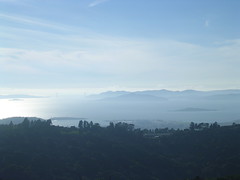
When we left to return to Chicago last Tuesday it was raining. The rains come heavy there from December through February, long stretches of it that sometimes last for days. Everything goes green and so it was while we were there, the Berkeley hills luminously poking up through the fog and Tilden's paths, which we walked on Saturday, verdant and squishy. We came back because when we left we made a promise to return a year later. I don't know when we'll be back next or how much of us will still be there.
No wrong decisions, and so we made the right one. We've been content to find ourselves living back in what Dan Quayle once called "the great state of Chicago," even if its winters deplorably drag on and on only to teasingly linger through most of its springs. There's a nagging distance here too, a lover's cold shoulder- something waiting to be reclaimed, reexamined and made wholly our own again.
Lately I've been perusing some of the class readers Cathy used while in graduate school. In particular, I've been attracted to a handful of articles that explore ideas about landscape perception, interpretation and a sense of place. I'm probably attracted to these articles because the original move from Chicago to Berkeley in 2001 and our consequent attempts to put down roots in the Bay Area, followed once again by our move back to Chicago in February of last year and our attempts to reclaim our roots, created a sense of being always on the cusp of integrating into a place, of feeling like our roots were shallow and fragile.
When we were living in Berkeley I wrestled with how to best go about creating a sense of place. Was such an amorphous thing at its most conducive when simply left alone and not forced? This kind of thinking is similar to how I feel about traveling abroad- do you make an itinerary and madly rush about trying to "see it all," take the obligatory pictures of the landmarks, pay for the tours, set foot in the required museums- or do you chart your own course, allow for spontaneity and the opportunity to simply linger amongst the natives and soak up an arguably more authentic ambience?
Unfortunately, the place where one lives is not a vacation spot. So maybe cultivating a sense of place or a sense of relatedness is better served by actively seeking out experiences more conducive to its flourishing. Increasingly, the idea that a sense of place magically arrives wholly via the passage of time has come to feel depressingly casual. That's part of it. But how to go out and create place and meaning and experience? How do we interact with a place beyond the superficial level? And how does somebody such as myself, more introverted and socially anxious and plagued by ugly thickets of self doubt then your average person (I could play you my small violin here, but we'll save the self confessions for some other time) find ways to interact more fully with our environments and gain a greater and more fulfilling sense of place and relatedness and experience?
In one of those handful articles I've recently read, The Meaning of Place, urban strategist Peter Smirniotopoulos writes, "The true meaning of place is grounded in theories of cognition, the physiology of memory, the complementary disciplines of anthropology and sociology, and- perhaps most important- the basic human need for community and social interaction." That's a lot to unpack, and yet when Cathy and I were searching to buy our first home last year, it was this "true meaning of place" that we were hoping to find. We eventually, after much looking, bought a place in a neighborhood we adore. The Edgewater/Andersonville neighborhoods we belong to are rich in the possibilities of interesting social interaction and ripe with conveniences, diversity and amenities. (I sound like a brochure.) There's no chance of our neighborhood suffering from what Jane Jacobs called "The Great Blight of Dullness." We love the fact that it's walking distance to urine scented transit stops, gut buster burritos, million dollar homes with sprinkler fed lawns and a few of Lake Michigan's 1600 miles of shoreline. We're continuing to grow into the place we live, both inside and out, though feel like we've barely begun to scratch the surface of its potential.
All this hope for creating an authentic sense of place runs into roadblocks. My current unemployment, a stubborn roadblock if ever there was one, is laden with more ironies and frustrations then I care to detail. I'm crashing into debris each day but histrionics aside (and I could play you my violin!) it's terribly difficult to feel motivated in taking the steps necessary to fulfill this potential. I'm feeling listless. I have a fledging video project I've been tinkering with and its helped me to become more conscious of my environment while allowing me to be creative in an area I've long been interested in playing with. As i've mentioned before, this video project is really a tool to help me interact with the people and places around me in ways I wouldn't probably have the courage to do otherwise. It's a prop and a way to find deeper meanings in the human and geographical landscapes that surround me.
Returning back to Berkeley, then, as we did last week, was bittersweet. It was a place whose deeper strata we were just beginning to discover and incorporate into our lives. It was becoming our home and we were beginning to finally feel an intimate part of its culture rather then just observers of it. Walking its lush streets last week I had a sense of contented limbo- of straddling two places ample in the familiars of kinship. Berkeley is still our home- the rituals we had woven into its landscape, those places we identified so strongly with in the area (its restaurants, the Bay, Tilden, campus, Telegraph, 4th St, Mt. Tam, Mt. Diablo...) were still present and exerting a powerful attraction.
Having only been away a year it felt like we hadn't left at all, as though things had remained fixed even without our presence. The time we lived here, a little under 3 years, had a powerful effect on both of us, one that encompassed both knuckle scraping emotional lows and giddy intellectual highs. The residue from that time still lingers and holds a powerful allure- and returning I simultaneously recoiled from it while lovingly examining the remnants. It no longer belongs so wholly to us as it did a year ago and I found myself wondering how long the enchantment of a place, its intimacies and personal rituals, retains its influence before growing more rounded and remote- decoyed with nostalgia. How long will we continue to recognize ourselves in Berkeley before the details begin to disappear? What are these intangibles we lose?
As difficult as it was for us, we fell in love with the Bay Area. It may simply be impossible not to. The people (engaged, for better or worse), the politics (to the left of Kucinich, a bumper sticker favorite) the food (slow food organic), the natural beauty (big ocean, rolling hills and Redwood awe), the relentless pleasantness of the weather (N. American's only Meditation climate) advection fogs (right thru the Golden Gate), the kookiness (Freak flags still flying proud) are all going to conspire to offer you something unavoidably enchanting if not entirely confusing.
The Bay Area resides in a state full of contradictions and is burdened with one of the nation's most murderously interesting histories. In her book, Where I was From, native Joan Didion writes eloquently about some of California's many contradictions, of its "extreme reliance on federal money," so starkly in contrast with its "emphasis on unfettered individualism," of its reliance on massive government construction projects to irrigate "millions of acres of essentially arid land" while simultaneously subsidizing enormous crop yields that glut national and international markets. Its current governor was, just 3 short years ago, mumbling and shooting his way through a waning movie career when, fortuitously enough, long sought opportunity to hold political office arose in the form of widespread disenchantment with its current governor, Gray Davis and the ensuing Republican led recall drive. Schwarzenegger won the 2003 recall (itself a vestige of California's increasingly troubled experiment with direct democracy, a system which as currently stands allows those privileged few who are able and willing to pony up the capital necessary to hire petition circulators who'll gather the necessary signatures, the affluently singular opportunity to see their pet proposition on the next state ballot) by announcing his decision to run on The Tonight Show With Jay Leno and proceeding to regale the close to 5 million Californians who eventually voted for him by running a campaign with the support of the likes of fellow sex offender, Rob Lowe, and the ample use of well worn one-liners from his films. It's important to note that we voted in this election. It's also important to note that Gary Coleman garnered 14, 242 votes.
But all this aside, and it's a lot to discount, what's not to like? Well, yes, the cost- there's that. According to a report published last year by the Bay Area Economic Forum, "housing prices have continued to rise at a 6.5% cumulative annual growth rate (CAGR), while salaries have flattened." The exorbitant costs of living in the area would have eventually sent us packing barring the sudden appearance of exorbitant paychecks, something I'm having difficulty even receiving with dependable regularity let alone having an account burdened with expendable income. Unemployment's a bitch. Still, we wonder if someday we might move back.
When we left to return to Chicago last Tuesday it was raining. The rains come heavy there from December through February, long stretches of it that sometimes last for days. Everything goes green and so it was while we were there, the Berkeley hills luminously poking up through the fog and Tilden's paths, which we walked on Saturday, verdant and squishy. We came back because when we left we made a promise to return a year later. I don't know when we'll be back next or how much of us will still be there.
Thursday, February 10, 2005
Watts, Who and Issac (Washington, Not Hayes)
One of those talking heads in Wattstax looked terribly familiar. I didn’t pick up on it the first time around, but by the second or third sweep I realized it was Ted Lange, better known as Isaac Washington from Aaron Spelling’s The Love Boat. He’s playing himself in 1972, just another brother shooting the shit in some Watts diner.
Wattstax has more to offer then Ted Lange (who soon found work as Melvin the Pimp in 1973’s Trick Baby) -there’s hilarious and trenchant commentary from Richard Pryor, long before his freebasing explosions to the face, excellent performances by Rufas Thomas, The Staple Singers, Issac Hayes and an absolutely smoking club performance by Johnnie Taylor.
Also watched The Who: The Kids Are Alright, a 1979 documentary made almost entirely out of old concert footage (most of it is fantastic- from their mod beginnings in the mid-60’s to their manic arena rock performances of the 70’s), guest appearances, television interviews and a sprinkling of new footage recorded for the documentary in, presumably, 1978, not long before Keith Moon’s overdose. Total blast to watch, especially the footage of John (Boris The Spider) Entwistle skeet shooting his gold records with a Tommy Gun. There’s also some wonderful behind the scenes studio footage of the recording of the song, Who Are You, where we get to see the band recording everything from background vocals to handclaps.
Lastly, we’re off to California for the next 5 days. Mt. Tam, we’re all over you come Saturday.
One of those talking heads in Wattstax looked terribly familiar. I didn’t pick up on it the first time around, but by the second or third sweep I realized it was Ted Lange, better known as Isaac Washington from Aaron Spelling’s The Love Boat. He’s playing himself in 1972, just another brother shooting the shit in some Watts diner.
Wattstax has more to offer then Ted Lange (who soon found work as Melvin the Pimp in 1973’s Trick Baby) -there’s hilarious and trenchant commentary from Richard Pryor, long before his freebasing explosions to the face, excellent performances by Rufas Thomas, The Staple Singers, Issac Hayes and an absolutely smoking club performance by Johnnie Taylor.
Also watched The Who: The Kids Are Alright, a 1979 documentary made almost entirely out of old concert footage (most of it is fantastic- from their mod beginnings in the mid-60’s to their manic arena rock performances of the 70’s), guest appearances, television interviews and a sprinkling of new footage recorded for the documentary in, presumably, 1978, not long before Keith Moon’s overdose. Total blast to watch, especially the footage of John (Boris The Spider) Entwistle skeet shooting his gold records with a Tommy Gun. There’s also some wonderful behind the scenes studio footage of the recording of the song, Who Are You, where we get to see the band recording everything from background vocals to handclaps.
Lastly, we’re off to California for the next 5 days. Mt. Tam, we’re all over you come Saturday.
Monday, February 07, 2005
When I’m Stuck With A Day, That’s Grey And Lonely
Reading Nicholas Dawidoff’s In The Country of the Country: A Journey To The Roots Of American Music and really enjoying it. Still amusing to think that there was a time not so long ago when I met the very idea of Country/Hillbilly/Old Time music with strong feelings of displeasure if not outright hostility. I belonged to that camp that admitted smatterings of Johnny Cash, Patsy Cline and Willie Nelson and saw fit to narrowly generalize the rest of the genre as a vestige ofsouthern redneck racism.
Dawidoff, like Peter Guralnick’s awesome trilogy on Blues, Country, Rhythm and Blues and Rock ‘N Roll, knows when to provide context and when to disappear and allow his subjects to talk and tell their stories.
A few interesting anecdotes:
Elvis Presley’s all-time favorite country gospel group was the Louvin’ Brothers, but he never recorded one of there songs because Ira Louvin, (a sad template for redneck clichés if ever there was one- though his singing voice is magnificent) upon hearing Elvis sing a gospel song to unwind after a show in the mid-50’s, humiliated him by shouting, “You fuckin’ white nigger. If that’s the kind of music you like, why don’t you do that out there instead of that shit you do?” Ira Louvin was eventually shot 5 times by his third wife.
The head of Doc Watson’s first banjo was made out of his grandmother’s decrepit old cat. His brother, asked to put the thing out of its misery, scraped off its hair, tanned it and his father stretched it across the hoop. Watson tells Dawidoff, “The catskin made a great head and a beautiful sound.”
Johnny Cash once recorded a song called, Flushed From The Bathroom Of Your Heart. In 1983 he tried to hit his pet ostrich with a two-by-four only to be kicked in the chest and have three of his ribs broken.
George Jones, who many believe to possess one of Country Music’s greatest voices, was once one so filled with delusions and self-loathing that he sang live concerts in the voice of Daffy Duck. Believe it or not! No, it’s true, and I have to say, that may be my favorite anecdote- I mean, can you imagine?
Now we’re going to watch Wattstax.
Reading Nicholas Dawidoff’s In The Country of the Country: A Journey To The Roots Of American Music and really enjoying it. Still amusing to think that there was a time not so long ago when I met the very idea of Country/Hillbilly/Old Time music with strong feelings of displeasure if not outright hostility. I belonged to that camp that admitted smatterings of Johnny Cash, Patsy Cline and Willie Nelson and saw fit to narrowly generalize the rest of the genre as a vestige of
Dawidoff, like Peter Guralnick’s awesome trilogy on Blues, Country, Rhythm and Blues and Rock ‘N Roll, knows when to provide context and when to disappear and allow his subjects to talk and tell their stories.
A few interesting anecdotes:
Elvis Presley’s all-time favorite country gospel group was the Louvin’ Brothers, but he never recorded one of there songs because Ira Louvin, (a sad template for redneck clichés if ever there was one- though his singing voice is magnificent) upon hearing Elvis sing a gospel song to unwind after a show in the mid-50’s, humiliated him by shouting, “You fuckin’ white nigger. If that’s the kind of music you like, why don’t you do that out there instead of that shit you do?” Ira Louvin was eventually shot 5 times by his third wife.
The head of Doc Watson’s first banjo was made out of his grandmother’s decrepit old cat. His brother, asked to put the thing out of its misery, scraped off its hair, tanned it and his father stretched it across the hoop. Watson tells Dawidoff, “The catskin made a great head and a beautiful sound.”
Johnny Cash once recorded a song called, Flushed From The Bathroom Of Your Heart. In 1983 he tried to hit his pet ostrich with a two-by-four only to be kicked in the chest and have three of his ribs broken.
George Jones, who many believe to possess one of Country Music’s greatest voices, was once one so filled with delusions and self-loathing that he sang live concerts in the voice of Daffy Duck. Believe it or not! No, it’s true, and I have to say, that may be my favorite anecdote- I mean, can you imagine?
Now we’re going to watch Wattstax.
Wednesday, February 02, 2005
There’s Acid In The House
Richard James is back, releasing a string of 12” singles as AFX on his Rephlex label. Very exciting. The Analord singles (a pun on Analogue), as they’re called, will supposedly be a string of 10 releases, with 1 and 2 having just been released last Tuesday.
For many of the techno cognoscenti, James has a mandate to break new ground with each new release. Talk about pressure! Innovate, you Cornwall fiend! Somewhere back in the mid-90’s he was flagged as the pacesetter for all future electronic music, each of his releases to be nothing less then the gold standard on which all else was judged. He was done gone and hailed a genius, a judgment I wholeheartedly embraced- his Ambient Works 85-92, being one of the earliest full albums of electronic music I ever purchased (right around the time of other, then rare and stellar full length releases coming out by the likes of LFO, Black Dog, Autechre, The Future Sound of London, The Orb, and Orbital) and the album I probably cherished and listened to the most throughout the decade.
Throughout the remainder of the 90’s James was fairly prolific. He seemed willing to oblige his critics by releasing a string of extraordinarily innovative albums, his last acknowledged masterwork being 1999’s Miami bootylicious Windowlicker single. There was, however, a palpable sense of disappointment upon the release of 2001’s Drukqs, a collective impression that James had lazily reached into his vaults and released a 2 CD set of half-baked cast-offs. The disheartened consensus seemed to be that he wasn’t breaking new ground, not properly fulfilling his mandate and progressing. I have to admit, however, to being wary of this idea/legacy that somehow novels, poems, paintings, music, etc… must somehow be…what? more advanced then their predecessors…an idea that seems intimately connected to the arts function as a commodity in a capitalist society rather then its emotional/intellectual connection to the person engrossed in it. This idea of progress first is particularly entrenched in the world of electronic music- that somehow because of its production reliance on computers it must shadow and demonstrate a kind of Moore’s Law rate of development- its complexity and wow factor doubling every 18 months or else.
We digress, man.
The initial Analord releases seem to be all all about heading back to the sound of old skool aciiiiiid, supposedly made on James’s hefty collection of classic analogue gear. It’s the antithesis of progress, the sound of a dude reveling in an acid (analogue) bubble bath. The Roland 303 is sputtering and squiggling all over these tracks and the beat programming, while exquisite (those crisp hi-hat’s- oye!), is kept simple and supportive rather then eclipsing via cut-up ‘how’d he do that? mayhem. Most of the tracks are in fact pretty straightforward, which is to say James’s is cool with keeping things fairly minimal and letting the acid gurgle and shine. Take a track like Analord 10’s untitled track 1 (James released a couple tracks from Analord 10 as teasers a few weeks ago), where a fat and dampened kick drum serves to reinforce propulsive dueling acid lines that are oh so delicately tweaked up and out and into a sublime grind that, in the tracks final seconds, are dramatically dropped leaving just the kick and a distant acid arpeggio. Sweaty and sublime, and yes, we've certainly been here and done this before- any use of the Roland 303 at this point has what Simon Reynolds aptly called the "patina of homage," but it would take a lot more by way of record collection acid fatigue (simply put, I don't have all that much music laced with the Roland 303) for me to find this an "utterly lame" retread.
Richard James is back, releasing a string of 12” singles as AFX on his Rephlex label. Very exciting. The Analord singles (a pun on Analogue), as they’re called, will supposedly be a string of 10 releases, with 1 and 2 having just been released last Tuesday.
For many of the techno cognoscenti, James has a mandate to break new ground with each new release. Talk about pressure! Innovate, you Cornwall fiend! Somewhere back in the mid-90’s he was flagged as the pacesetter for all future electronic music, each of his releases to be nothing less then the gold standard on which all else was judged. He was done gone and hailed a genius, a judgment I wholeheartedly embraced- his Ambient Works 85-92, being one of the earliest full albums of electronic music I ever purchased (right around the time of other, then rare and stellar full length releases coming out by the likes of LFO, Black Dog, Autechre, The Future Sound of London, The Orb, and Orbital) and the album I probably cherished and listened to the most throughout the decade.
Throughout the remainder of the 90’s James was fairly prolific. He seemed willing to oblige his critics by releasing a string of extraordinarily innovative albums, his last acknowledged masterwork being 1999’s Miami bootylicious Windowlicker single. There was, however, a palpable sense of disappointment upon the release of 2001’s Drukqs, a collective impression that James had lazily reached into his vaults and released a 2 CD set of half-baked cast-offs. The disheartened consensus seemed to be that he wasn’t breaking new ground, not properly fulfilling his mandate and progressing. I have to admit, however, to being wary of this idea/legacy that somehow novels, poems, paintings, music, etc… must somehow be…what? more advanced then their predecessors…an idea that seems intimately connected to the arts function as a commodity in a capitalist society rather then its emotional/intellectual connection to the person engrossed in it. This idea of progress first is particularly entrenched in the world of electronic music- that somehow because of its production reliance on computers it must shadow and demonstrate a kind of Moore’s Law rate of development- its complexity and wow factor doubling every 18 months or else.
We digress, man.
The initial Analord releases seem to be all all about heading back to the sound of old skool aciiiiiid, supposedly made on James’s hefty collection of classic analogue gear. It’s the antithesis of progress, the sound of a dude reveling in an acid (analogue) bubble bath. The Roland 303 is sputtering and squiggling all over these tracks and the beat programming, while exquisite (those crisp hi-hat’s- oye!), is kept simple and supportive rather then eclipsing via cut-up ‘how’d he do that? mayhem. Most of the tracks are in fact pretty straightforward, which is to say James’s is cool with keeping things fairly minimal and letting the acid gurgle and shine. Take a track like Analord 10’s untitled track 1 (James released a couple tracks from Analord 10 as teasers a few weeks ago), where a fat and dampened kick drum serves to reinforce propulsive dueling acid lines that are oh so delicately tweaked up and out and into a sublime grind that, in the tracks final seconds, are dramatically dropped leaving just the kick and a distant acid arpeggio. Sweaty and sublime, and yes, we've certainly been here and done this before- any use of the Roland 303 at this point has what Simon Reynolds aptly called the "patina of homage," but it would take a lot more by way of record collection acid fatigue (simply put, I don't have all that much music laced with the Roland 303) for me to find this an "utterly lame" retread.
Monday, January 31, 2005
6 Hudred Million Dollar Baby
Cathy and I went to see Eastwood’s Million Dollar Baby yesterday. We got there 20 minutes before the movie (I need to be at most films 20 minutes before or I get cranky and unmanageable and downright peevish) and sat through the awful onslaught of pre-movie commercial music videos, one of which included Shania Twain walking through some generic urban landscape handing out party invitations to 20-something white people who upon receiving them gaze back with muse like adoration. There are numerous shots of Shania shaking her head to denote, I think, unrestrained Shania merrymaking. Her music seemed to be made out of that cardboard eggs come in.
Million Dollar Baby is, in my mind, a far better film then the much heralded Mystic River, which despite its fantastic across the board acting and perfectly inflected Boston accents, only became exceptional during its final 10 minutes, when it took on a spooky mythic resonance. Million Dollar Baby, however, was stunning from beginning to end, a minor masterpiece flawed only by a couple unnecessary white trash interludes that veered too close to trailer-park cliché.
The story itself is a kind of archetype, well worn and familiar but Eastwood makes no attempt to hide the stories cogs. What he does, and what so few mainstream Hollywood films seem unable to accomplish these days, is to tell the story with a graceful nonchalance, free of firework displays and a refreshing modicum of the unnecessary. The film focuses on just three characters and it tells their story so well (and Eastwood, Hillary Swank and Morgan Freeman are all outstanding) and with such requisite economy that it’s an elegant, oftentimes exquisite character study of the time worn story arc of protagonists haunted by their pasts and offered redemption.
The tragedy that arrives midway through the film could have unhinged things, and my initial response to it was that Eastwood had lost the reigns and dipped his ladle into that big easy pool of Hollywood pathos. (Those bargain-basement pools of cheap sentiment lie like pitfalls all around the film and it’s to Eastwood’s great credit that he avoids them all.) It’s here, after the tragedy, that the trailer park clichés rear their ugly heads again and sucker punch us. It’s Eastwood’s biggest misstep and while its presence is glaring (and reminds us of just how perfect the rest of the film’s classical narrative has been progressing) it’s one of those stumbles that I was quick to forgive, to subtract and cast aside. The central story (surrogate father/daughter) comes roaring back at us and the tragedy and its ensuing complications and actions carry the themes of loss and regret, of what Amy Taubin called “a grief that can never be assuaged,” to a scene of such heartrending poignancy and power that it’s shattering.
Cathy and I went to see Eastwood’s Million Dollar Baby yesterday. We got there 20 minutes before the movie (I need to be at most films 20 minutes before or I get cranky and unmanageable and downright peevish) and sat through the awful onslaught of pre-movie commercial music videos, one of which included Shania Twain walking through some generic urban landscape handing out party invitations to 20-something white people who upon receiving them gaze back with muse like adoration. There are numerous shots of Shania shaking her head to denote, I think, unrestrained Shania merrymaking. Her music seemed to be made out of that cardboard eggs come in.
Million Dollar Baby is, in my mind, a far better film then the much heralded Mystic River, which despite its fantastic across the board acting and perfectly inflected Boston accents, only became exceptional during its final 10 minutes, when it took on a spooky mythic resonance. Million Dollar Baby, however, was stunning from beginning to end, a minor masterpiece flawed only by a couple unnecessary white trash interludes that veered too close to trailer-park cliché.
The story itself is a kind of archetype, well worn and familiar but Eastwood makes no attempt to hide the stories cogs. What he does, and what so few mainstream Hollywood films seem unable to accomplish these days, is to tell the story with a graceful nonchalance, free of firework displays and a refreshing modicum of the unnecessary. The film focuses on just three characters and it tells their story so well (and Eastwood, Hillary Swank and Morgan Freeman are all outstanding) and with such requisite economy that it’s an elegant, oftentimes exquisite character study of the time worn story arc of protagonists haunted by their pasts and offered redemption.
The tragedy that arrives midway through the film could have unhinged things, and my initial response to it was that Eastwood had lost the reigns and dipped his ladle into that big easy pool of Hollywood pathos. (Those bargain-basement pools of cheap sentiment lie like pitfalls all around the film and it’s to Eastwood’s great credit that he avoids them all.) It’s here, after the tragedy, that the trailer park clichés rear their ugly heads again and sucker punch us. It’s Eastwood’s biggest misstep and while its presence is glaring (and reminds us of just how perfect the rest of the film’s classical narrative has been progressing) it’s one of those stumbles that I was quick to forgive, to subtract and cast aside. The central story (surrogate father/daughter) comes roaring back at us and the tragedy and its ensuing complications and actions carry the themes of loss and regret, of what Amy Taubin called “a grief that can never be assuaged,” to a scene of such heartrending poignancy and power that it’s shattering.
Friday, January 28, 2005
When I Listen To The World It’s An Act of Aestheticism Or Else
We tentatively reach for new works by David Toop, what with his penchant for descriptions more evasive then illuminating and eschewment of fully flushed linear writing in favor of a kind of episodic assembly of ideas, personal ruminations, and tangents that are oftentimes frustratingly fleeting when they’re most intriguing and long-winded when at their dullest. Still, his books are good for generating inspiration and offering interesting ideas or anecdotes in need of further exploration. In his latest, Haunted Weather: Music, Silence and Memory (a title way too alluring to pass up, right?) he talks about the Canadian composer/teacher R. Murray Schafer, one of the founders of the acoustic ecology movement and coiner of such terms as soundscape and sound mark. In the late 60’s and early 70’s Schafer taught college classes that explored “Cageian concepts of creative hearing,” published the influential book, The Tuning of the World and founded The Vancouver Soundscape in order to document and protect sonic environments from a historical perspective (i.e., acoustic ecology) which Toop describes as such:
He devised the term ‘soundmark,’ a derivation from landmark, to describe ‘a community sound which is unique or possesses qualities which make it specially regarded or noticed by the people in that community.’ This established the conservationist agenda in Schafer’s work, as well as seeding poetic and socially constructive links between soundscape and memory. In the late 1960’s, Schafer founded the World Soundscape Project at Simon Fraser University, Vancouver, and in the early 1970’s, members of the Project created a highly influential publication (a book and two LP records) entitled The Vancouver Soundscape. Here was the historical perspective otherwise missing from audio recordings. Statistics on the introduction of telephones mix with documentation of police signals, bellringing and muzak, photographs of sound generators such as steam trains, and written accounts of the noise of the Hastings Saw Mill Company or the spooky sound of the Point Atkinson foghorn, echoing under a sewing machine. The book concludes with a suggested soundwalk through a historic part of Vancouver, a guided tour past the whirr-click of Fleck Brothers’ clock, the Western Electric neon light and the varying road surfaces by Young Iron Works.
Toop goes on to offer critiques of Schafer’s acoustic ecology/conervationist postition, calling it ‘aversive to urbanism,’ confusing ‘issues of health and environment with aesthetic judgment (Schafer is quick, supposedly, to let us know what sounds he thinks are “rich”) and even his belief that future soundscapers have an activist role rather then a sensual, purely aesthetic one.
We tentatively reach for new works by David Toop, what with his penchant for descriptions more evasive then illuminating and eschewment of fully flushed linear writing in favor of a kind of episodic assembly of ideas, personal ruminations, and tangents that are oftentimes frustratingly fleeting when they’re most intriguing and long-winded when at their dullest. Still, his books are good for generating inspiration and offering interesting ideas or anecdotes in need of further exploration. In his latest, Haunted Weather: Music, Silence and Memory (a title way too alluring to pass up, right?) he talks about the Canadian composer/teacher R. Murray Schafer, one of the founders of the acoustic ecology movement and coiner of such terms as soundscape and sound mark. In the late 60’s and early 70’s Schafer taught college classes that explored “Cageian concepts of creative hearing,” published the influential book, The Tuning of the World and founded The Vancouver Soundscape in order to document and protect sonic environments from a historical perspective (i.e., acoustic ecology) which Toop describes as such:
He devised the term ‘soundmark,’ a derivation from landmark, to describe ‘a community sound which is unique or possesses qualities which make it specially regarded or noticed by the people in that community.’ This established the conservationist agenda in Schafer’s work, as well as seeding poetic and socially constructive links between soundscape and memory. In the late 1960’s, Schafer founded the World Soundscape Project at Simon Fraser University, Vancouver, and in the early 1970’s, members of the Project created a highly influential publication (a book and two LP records) entitled The Vancouver Soundscape. Here was the historical perspective otherwise missing from audio recordings. Statistics on the introduction of telephones mix with documentation of police signals, bellringing and muzak, photographs of sound generators such as steam trains, and written accounts of the noise of the Hastings Saw Mill Company or the spooky sound of the Point Atkinson foghorn, echoing under a sewing machine. The book concludes with a suggested soundwalk through a historic part of Vancouver, a guided tour past the whirr-click of Fleck Brothers’ clock, the Western Electric neon light and the varying road surfaces by Young Iron Works.
Toop goes on to offer critiques of Schafer’s acoustic ecology/conervationist postition, calling it ‘aversive to urbanism,’ confusing ‘issues of health and environment with aesthetic judgment (Schafer is quick, supposedly, to let us know what sounds he thinks are “rich”) and even his belief that future soundscapers have an activist role rather then a sensual, purely aesthetic one.
Friday, January 21, 2005
There’s Rhetoric, Then There’s Reality
Another instance of the liberal media daring to remind us of the pain found in the obvious.
President Bush's soaring rhetoric yesterday that the United States will promote the growth of democratic movements and institutions worldwide is at odds with the administration's increasingly close relations with repressive governments in every corner of the world.
Some of the administration's allies in the war against terrorism -- including Egypt, Saudi Arabia, Pakistan and Uzbekistan -- are ranked by the State Department as among the worst human rights abusers. The president has proudly proclaimed his friendship with Russian President Vladimir Putin while remaining largely silent about Putin's dismantling of democratic institutions in the past four years. The administration, eager to enlist China as an ally in the effort to restrain North Korea's nuclear ambitions, has played down human rights concerns there, as well.
Another instance of the liberal media daring to remind us of the pain found in the obvious.
President Bush's soaring rhetoric yesterday that the United States will promote the growth of democratic movements and institutions worldwide is at odds with the administration's increasingly close relations with repressive governments in every corner of the world.
Some of the administration's allies in the war against terrorism -- including Egypt, Saudi Arabia, Pakistan and Uzbekistan -- are ranked by the State Department as among the worst human rights abusers. The president has proudly proclaimed his friendship with Russian President Vladimir Putin while remaining largely silent about Putin's dismantling of democratic institutions in the past four years. The administration, eager to enlist China as an ally in the effort to restrain North Korea's nuclear ambitions, has played down human rights concerns there, as well.
As They Become Available, Please Put These In Your Queue And Smoke Them
Read enough end of the year Best Of lists and the critical consensus that begins to congeal around you makes offering up your own feel like an exercise in banality. But as one friend to another, each of the films listed below comes enthusiastically recommended.
I’ve been more consistently excited about watching older movies (so many to catch up on) this past year then checking out newer releases. I’ve had a Film Center membership since May of this year but feel like I’ve only just now begun to take full advantage of the films coming through there. For example, there’s currently a retrospective running through March devoted to the films of the great Japanese director, Yasujiro Ozu. Not only is it a thrill to see these films on the big screen (and, so far, with an appreciative audience, which is really nice) but it’s also a chance to see 25 of the 34 existing Ozu films (not that I’m complaining, but where are those missing 9?), only a smattering of which are currently available on DVD here in the United States.
Which isn’t to say there weren’t some great films released in 2004.
There are a number of films showing up on a lot of Best Of lists that I’ve regrettably yet to see. I hope to see Million Dollar Baby before it leaves the theater but it looks like I’ll have to wait and catch Bad Education and Vera Drake on DVD. Others, like Godard’s Notre musique, Wong Kar-wai’s 4 years in the making 2046, Hou Hsiao-hsien’s Café Lumiere and Eric Rohmer’s Triple Agent, have yet to even open in Chicago though I hope that’ll change soon.
In no order of preference,
Springtime In A Small Town: Zhuangzhuang Tian
Before Sunset: Richard Linklater
Moolaade: Ousmane Sembene
Eternal Sunshine of the Spotless Mind: Michel Gondry
Sideways: Alexander Payne
Time of the Wolf: Michael Haneke
Goodbye Dragon Inn: Tsai Ming-liang
Tropical Malady: Apichatpong Weerasethakul
Crimson Gold: Jafar Panahi
Harry Potter and the Prisoner of Azkaban: Alfonso Cuarón
Bright Leaves: Ross McElwee
Read enough end of the year Best Of lists and the critical consensus that begins to congeal around you makes offering up your own feel like an exercise in banality. But as one friend to another, each of the films listed below comes enthusiastically recommended.
I’ve been more consistently excited about watching older movies (so many to catch up on) this past year then checking out newer releases. I’ve had a Film Center membership since May of this year but feel like I’ve only just now begun to take full advantage of the films coming through there. For example, there’s currently a retrospective running through March devoted to the films of the great Japanese director, Yasujiro Ozu. Not only is it a thrill to see these films on the big screen (and, so far, with an appreciative audience, which is really nice) but it’s also a chance to see 25 of the 34 existing Ozu films (not that I’m complaining, but where are those missing 9?), only a smattering of which are currently available on DVD here in the United States.
Which isn’t to say there weren’t some great films released in 2004.
There are a number of films showing up on a lot of Best Of lists that I’ve regrettably yet to see. I hope to see Million Dollar Baby before it leaves the theater but it looks like I’ll have to wait and catch Bad Education and Vera Drake on DVD. Others, like Godard’s Notre musique, Wong Kar-wai’s 4 years in the making 2046, Hou Hsiao-hsien’s Café Lumiere and Eric Rohmer’s Triple Agent, have yet to even open in Chicago though I hope that’ll change soon.
In no order of preference,
Springtime In A Small Town: Zhuangzhuang Tian
Before Sunset: Richard Linklater
Moolaade: Ousmane Sembene
Eternal Sunshine of the Spotless Mind: Michel Gondry
Sideways: Alexander Payne
Time of the Wolf: Michael Haneke
Goodbye Dragon Inn: Tsai Ming-liang
Tropical Malady: Apichatpong Weerasethakul
Crimson Gold: Jafar Panahi
Harry Potter and the Prisoner of Azkaban: Alfonso Cuarón
Bright Leaves: Ross McElwee
Sunday, January 16, 2005
Further Adventures In Liquid Decadence
In a slaphappy fit of (over)indulgence you may have found yourself asking your partner, “Well, why don’t we just open this other bottle of wine?” and she may have replied, “Yeah, lets!” and so you went ahead and did. Nothing really wrong with that, you meathead- you’re responsible drinkers and the last time you went for the second bottle of wine was on your honeymoon in Italy, where the spirit of Bacchus is eternally ripe, so why the hell not? You unbelievable blockhead! And so, when you went to sleep and noticed that the room was doing queasy pirouettes (we were told back in our college days that placing your feet on the floor can mitigate this, though we fell asleep before such measures were necessary) you may have thought, “Oh, I’m going to pay for this,” but you didn’t, you boob, not that there was anything you could have done by then anyway. And then there’s morning. Your body might have felt terribly unfortunate- brackish, in fact. You may have felt drywalled. You might have just stayed in bed until noon, the consequence of your ample sousing.
In a slaphappy fit of (over)indulgence you may have found yourself asking your partner, “Well, why don’t we just open this other bottle of wine?” and she may have replied, “Yeah, lets!” and so you went ahead and did. Nothing really wrong with that, you meathead- you’re responsible drinkers and the last time you went for the second bottle of wine was on your honeymoon in Italy, where the spirit of Bacchus is eternally ripe, so why the hell not? You unbelievable blockhead! And so, when you went to sleep and noticed that the room was doing queasy pirouettes (we were told back in our college days that placing your feet on the floor can mitigate this, though we fell asleep before such measures were necessary) you may have thought, “Oh, I’m going to pay for this,” but you didn’t, you boob, not that there was anything you could have done by then anyway. And then there’s morning. Your body might have felt terribly unfortunate- brackish, in fact. You may have felt drywalled. You might have just stayed in bed until noon, the consequence of your ample sousing.
Thursday, January 13, 2005
Nitrogenous Organic Molecules On The Brain
Be aware, that if you’re gonna go and drink 20 completely unnecessary ounces of Diet Coca-Cola w/ Lime at, like, 9:00 pm, the caffeine found therein is gonna go and stimulate your nervous system way, way past bed time! And then, quite possible, your wife may wake you up the next morning at 7:30, after you’ve been asleep for, say, ‘bout 3 hours, to let you know that some dudes may be coming around at 8:00 to do some touch-up painting downstairs. Or they might cancel, thank god, and promise to come on Saturday, which means you could probably go and finish the book you’re reading and zero back in on sleep while big, wet chunks of snow fell outside your bedroom window and the mercury inched back down from weird April like highs to pissed off arctic negatives.
Be aware, that if you’re gonna go and drink 20 completely unnecessary ounces of Diet Coca-Cola w/ Lime at, like, 9:00 pm, the caffeine found therein is gonna go and stimulate your nervous system way, way past bed time! And then, quite possible, your wife may wake you up the next morning at 7:30, after you’ve been asleep for, say, ‘bout 3 hours, to let you know that some dudes may be coming around at 8:00 to do some touch-up painting downstairs. Or they might cancel, thank god, and promise to come on Saturday, which means you could probably go and finish the book you’re reading and zero back in on sleep while big, wet chunks of snow fell outside your bedroom window and the mercury inched back down from weird April like highs to pissed off arctic negatives.
Best Albums of 2004
In no particular order, mind you. Except for the first, that is, which was the bestest of them all.
Last Exit- Junior Boys: Effortlessly drawing from and weaving the past influences of New Romanticism, David Sylvian, early OMD, Derrick May, Timabaland andThe Blue Nile and forging them with an irresistibly spacious delicacy, silky melodies and a keen sense of newfangled production finesse, the Junior Boys album was my favorite album of the year. Electro-pop hasn’t sounded this buoyantly longing since New Order’s heady days in the mid 80’s.
The Blue Notebooks- Max Richter: Actress Tilda Swinton’s voice appears from time to time, reading excerpts from the writings of Kafka and Czelaw Milosz, her voice mingling with the highly affecting ambience of a ticking clock, a train passing and a typewriter. Surprisingly, it’s not pretentious really, though it does smell of libraries and sounds like something we’ve heard before with all those violins, cellos, and pianos churning melancholy motifs. Winter music, for sure- cold white light through windows and gorgeously meditative, that too. "If someone walks fast and one pricks up one’s ears and listens, say at night, when everything round about is quiet, one hears, for instance, the rattling of a mirror not quite firmly fastened to the wall.”
Black Mahogani- Moodymann: Kenny Dixon, Jr’s past few albums have been harassed by annoyingly indulgent sound collages, his otherwise sublime disco-house grooves given too little room to stretch out before being submerged in murky party chatter (endless replications of the first few seconds of Marvin Gaye’s What’s Goin’ On?- which he’s also sampled and looped) along with Dixon’s own stoned ramblings and found sound experiments. On Black Mahogani, however, he seems to have reached the perfect balance, the party chatter sound collages actually working in accord with the music (he’s cutting them up more, giving them more polyrhythmic stress) to create a suite of murky funk house that effortlessly takes detours into swanky lounge, blaxploitation samples, and some of his most joyous and successful 4/4 grooves and riffs.
Thé Au Harem D'Archimède- Ricardo Villalobos: Rhythm as texture, often subaqueous. Swamp gas harnessed and transformed into polyrhythm. Micro sonic incidentals accumulate baggage and take on meaning- little sputters and splashes, hisses and crackles- continuously clustered and diffused atop ever morphing 4/4’s and fluky bass lines. Markedly organic, too, with acoustic percussion intimately miked and crisply springing upward and out from spongy crevices.
Margerine Eclipse- Stereolab: Their first album after the tragic death of band member, Mary Hanson and their best since Dots and Loops. There’s been a lot of pooh-poohing concerning the bands lack of “progress” over the last few albums, and admittedly, when buying a Stereolab album you acknowledge and appreciate that you’ll probably be getting more of the same- and, sheesh, given the sonic gold they’ve successfully mined from this territory over the years, even those albums that weren’t exactly consistent had more then enough about them that was fantastic and rewarding. So this one- not earth shattering, no, but solid and charming and lush enough to offer numerous rewards of wow and flutter. The Man With One Hundred Cells, for example, offers one of the loveliest examples of all that is right with a Farfisa organ played properly.
SMiLE- Brian Wilson: It took me a long time to break free of my Beach Boys prejudices. For a good while they acted as the contemptible totems of the Golden Oldies circuit, with its heavy syrup of canned nostalgia and (we’ll have) fun fun fun summer tours attended by balding boomers and their bored spawn. Of course, fronted as these tours are by the contemptible Mike Love, who was notoriously and forcefully opposed to the ingenious direction Wilson was taking the Beach Boys back in the days of Pet Sounds and the famously abandoned original SMiLE, it’s not so difficult to understand my disesteem, no matter how rehabilitated he may be. Now, of course, all Beach Boys disregard has been put aside by the fact that, without a doubt, Brian Wilson was and continues to be, as this album attests, a fucking genius. It really could have gone so horribly horribly wrong. You held your breath when you put it on. But damn if he didn’t get it about as right as you could some 30 years later.
Avalon Sutra- Harold Budd: Like Stereolab, Harold Budd has been successfully mining his own distinctive niche for a while now. Roughly 30 years , in fact, of which I’ve been tagging along for over 15 of- ever since I heard and fell in love with his track, The Gunfighter in the autumn of 1989. Avalon Sutra, recorded for David Sylvian’s new label, Samadi Sound is supposedly his last album, though given how prolific he’s been over the last decade and his age (68), I can’t imagine this is anything more then a marketing conceit or Mr. Budd talking nonsense. Like most of his work over the last 30 years it’s decidedly minimalist and vapidly pretty, his piano meanderings adrift in soft pedal reverb and sometimes accompanied, to great effect, by violins, flutes and a saxophone. I would build a house here, where the sky goes on forever.
Venice- Fennesz: Christian Fennesz is a master of processing the shit out of sound. Venice is teeming with laptop manipulations of granulated guitars and sonorous static lapping up to the edge of the speakers and spilling over. Discharges of distortion are rounded off and tamed, layered and stripped back, sunk and extinguished. Glacial drones gurgle, sputter, peal back, bristle and becalm. Austere, gentle, finely sculpted- at times like My Bloody Valentine’s Loveless slowed down to a fraction of its proper speed.
The Milk-Eyed Wonder- Joanna Newsome: “That voice.” the critics meme proliferated, “you either love it or you hate it.” Oh, how I loved it- girlish, to be sure, but maturely assured and like a fictional protagonist from the weird coalmining hills of yore. In this month’s Wire Newsome says that when making the album she “was listening to a lot of old Appalachian folk recordings” and that what wowed her about them were the odd timbre of the voices, their unaffectedness (“they don’t adhere to conventional ideas of beauty”) and the fact that “there can be worth and strength in an unconventional voice.” Definitely. Couple that, then, with her expressive, versatile harp playing (usually the only accompanying instrument) and supple melodies and you get more inspired greatness coming down from the mountains.
Funeral- The Arcade Fire: After, Junior Boys, the years best debut. It’s brimming over with spine tingling teenage anxieties and idiot glees. It’s sometimes sloppy, overly lush and always, always (and I mean always) kicking me in the ass, pumping my fists in the air and making me feel Annie Lennox-like 17 all over again. There’s a touch of New Order in Neighborhood #3 (Power Out) circa Brotherhood and they channel it so well that their collective powers to endear are set repeatedly to stun. Oh, the grandeur. It’s not all nostalgia poses however. It’s now, man, totally now. Homebred and seemingly out of nowhere, it’s earnest all over its sleeve and their ballads incite just as much shiver as their fever dreams. I feel like I’m still discovering this one.
Riot On An Empty Street- Kings of Convenience: Norwegian fey, they harmonize like sweaters and corduroy. Though we’ve been spared, we’re aware that this could find its way to Starbuck sound systems, inoccously mingling with the hum of laptops and espresso machines. But fuck it. It made me love its neutered seductiveness late this summer when Cathy and I were lolling at a B&B in Galena-that day the rain fell all afternoon and we did the requisite curling up with books and ate coconut chicken with salsa for dinner.
Odds and Ends: Seven Swans-Sufjan Stevens, Underachievers Please Try Harder -Camera Obscura, Rejoicing In Hands- Devandra Banhart, Ta Det Lugnt- Dungen, Milk and Honey- Klimek, The Lovely- Mara Carlyle, We Shall All Be Released- The Mountain Goats, The Tigers Have Spoken- Neko Case, Kompakt 100, How To Dismantle An Atomic Bomb- U2.
In no particular order, mind you. Except for the first, that is, which was the bestest of them all.
Last Exit- Junior Boys: Effortlessly drawing from and weaving the past influences of New Romanticism, David Sylvian, early OMD, Derrick May, Timabaland andThe Blue Nile and forging them with an irresistibly spacious delicacy, silky melodies and a keen sense of newfangled production finesse, the Junior Boys album was my favorite album of the year. Electro-pop hasn’t sounded this buoyantly longing since New Order’s heady days in the mid 80’s.
The Blue Notebooks- Max Richter: Actress Tilda Swinton’s voice appears from time to time, reading excerpts from the writings of Kafka and Czelaw Milosz, her voice mingling with the highly affecting ambience of a ticking clock, a train passing and a typewriter. Surprisingly, it’s not pretentious really, though it does smell of libraries and sounds like something we’ve heard before with all those violins, cellos, and pianos churning melancholy motifs. Winter music, for sure- cold white light through windows and gorgeously meditative, that too. "If someone walks fast and one pricks up one’s ears and listens, say at night, when everything round about is quiet, one hears, for instance, the rattling of a mirror not quite firmly fastened to the wall.”
Black Mahogani- Moodymann: Kenny Dixon, Jr’s past few albums have been harassed by annoyingly indulgent sound collages, his otherwise sublime disco-house grooves given too little room to stretch out before being submerged in murky party chatter (endless replications of the first few seconds of Marvin Gaye’s What’s Goin’ On?- which he’s also sampled and looped) along with Dixon’s own stoned ramblings and found sound experiments. On Black Mahogani, however, he seems to have reached the perfect balance, the party chatter sound collages actually working in accord with the music (he’s cutting them up more, giving them more polyrhythmic stress) to create a suite of murky funk house that effortlessly takes detours into swanky lounge, blaxploitation samples, and some of his most joyous and successful 4/4 grooves and riffs.
Thé Au Harem D'Archimède- Ricardo Villalobos: Rhythm as texture, often subaqueous. Swamp gas harnessed and transformed into polyrhythm. Micro sonic incidentals accumulate baggage and take on meaning- little sputters and splashes, hisses and crackles- continuously clustered and diffused atop ever morphing 4/4’s and fluky bass lines. Markedly organic, too, with acoustic percussion intimately miked and crisply springing upward and out from spongy crevices.
Margerine Eclipse- Stereolab: Their first album after the tragic death of band member, Mary Hanson and their best since Dots and Loops. There’s been a lot of pooh-poohing concerning the bands lack of “progress” over the last few albums, and admittedly, when buying a Stereolab album you acknowledge and appreciate that you’ll probably be getting more of the same- and, sheesh, given the sonic gold they’ve successfully mined from this territory over the years, even those albums that weren’t exactly consistent had more then enough about them that was fantastic and rewarding. So this one- not earth shattering, no, but solid and charming and lush enough to offer numerous rewards of wow and flutter. The Man With One Hundred Cells, for example, offers one of the loveliest examples of all that is right with a Farfisa organ played properly.
SMiLE- Brian Wilson: It took me a long time to break free of my Beach Boys prejudices. For a good while they acted as the contemptible totems of the Golden Oldies circuit, with its heavy syrup of canned nostalgia and (we’ll have) fun fun fun summer tours attended by balding boomers and their bored spawn. Of course, fronted as these tours are by the contemptible Mike Love, who was notoriously and forcefully opposed to the ingenious direction Wilson was taking the Beach Boys back in the days of Pet Sounds and the famously abandoned original SMiLE, it’s not so difficult to understand my disesteem, no matter how rehabilitated he may be. Now, of course, all Beach Boys disregard has been put aside by the fact that, without a doubt, Brian Wilson was and continues to be, as this album attests, a fucking genius. It really could have gone so horribly horribly wrong. You held your breath when you put it on. But damn if he didn’t get it about as right as you could some 30 years later.
Avalon Sutra- Harold Budd: Like Stereolab, Harold Budd has been successfully mining his own distinctive niche for a while now. Roughly 30 years , in fact, of which I’ve been tagging along for over 15 of- ever since I heard and fell in love with his track, The Gunfighter in the autumn of 1989. Avalon Sutra, recorded for David Sylvian’s new label, Samadi Sound is supposedly his last album, though given how prolific he’s been over the last decade and his age (68), I can’t imagine this is anything more then a marketing conceit or Mr. Budd talking nonsense. Like most of his work over the last 30 years it’s decidedly minimalist and vapidly pretty, his piano meanderings adrift in soft pedal reverb and sometimes accompanied, to great effect, by violins, flutes and a saxophone. I would build a house here, where the sky goes on forever.
Venice- Fennesz: Christian Fennesz is a master of processing the shit out of sound. Venice is teeming with laptop manipulations of granulated guitars and sonorous static lapping up to the edge of the speakers and spilling over. Discharges of distortion are rounded off and tamed, layered and stripped back, sunk and extinguished. Glacial drones gurgle, sputter, peal back, bristle and becalm. Austere, gentle, finely sculpted- at times like My Bloody Valentine’s Loveless slowed down to a fraction of its proper speed.
The Milk-Eyed Wonder- Joanna Newsome: “That voice.” the critics meme proliferated, “you either love it or you hate it.” Oh, how I loved it- girlish, to be sure, but maturely assured and like a fictional protagonist from the weird coalmining hills of yore. In this month’s Wire Newsome says that when making the album she “was listening to a lot of old Appalachian folk recordings” and that what wowed her about them were the odd timbre of the voices, their unaffectedness (“they don’t adhere to conventional ideas of beauty”) and the fact that “there can be worth and strength in an unconventional voice.” Definitely. Couple that, then, with her expressive, versatile harp playing (usually the only accompanying instrument) and supple melodies and you get more inspired greatness coming down from the mountains.
Funeral- The Arcade Fire: After, Junior Boys, the years best debut. It’s brimming over with spine tingling teenage anxieties and idiot glees. It’s sometimes sloppy, overly lush and always, always (and I mean always) kicking me in the ass, pumping my fists in the air and making me feel Annie Lennox-like 17 all over again. There’s a touch of New Order in Neighborhood #3 (Power Out) circa Brotherhood and they channel it so well that their collective powers to endear are set repeatedly to stun. Oh, the grandeur. It’s not all nostalgia poses however. It’s now, man, totally now. Homebred and seemingly out of nowhere, it’s earnest all over its sleeve and their ballads incite just as much shiver as their fever dreams. I feel like I’m still discovering this one.
Riot On An Empty Street- Kings of Convenience: Norwegian fey, they harmonize like sweaters and corduroy. Though we’ve been spared, we’re aware that this could find its way to Starbuck sound systems, inoccously mingling with the hum of laptops and espresso machines. But fuck it. It made me love its neutered seductiveness late this summer when Cathy and I were lolling at a B&B in Galena-that day the rain fell all afternoon and we did the requisite curling up with books and ate coconut chicken with salsa for dinner.
Odds and Ends: Seven Swans-Sufjan Stevens, Underachievers Please Try Harder -Camera Obscura, Rejoicing In Hands- Devandra Banhart, Ta Det Lugnt- Dungen, Milk and Honey- Klimek, The Lovely- Mara Carlyle, We Shall All Be Released- The Mountain Goats, The Tigers Have Spoken- Neko Case, Kompakt 100, How To Dismantle An Atomic Bomb- U2.
Sunday, January 09, 2005
I Had So Many Admirations- Songs of 2004:
The song that meant the most to me this past year, Jon Brion’s Peer Pressure, from The Eternal Sunshine of The Spotless Mind Soundtrack, is just 1 minute 12 seconds long. It’s brief but incredibly potent. It begins with a slightly out of tune barrelhouse piano somberly chording before it gently settles into a riff and is accompanied by breaths of strings that gorgeously billow before crashing back to reality in a swath of feedback. It’s a fragment of ache, evanescent and forever linked in my mind to one of this year’s great movie moments at the end of Eternal Sunshine, when the films chief protagonists and lovers, Joel and Clementine (Kate Winslet, in one this year’s best performances) recognize they’re experiencing the memory of when they first met for the last time. Their acquiescence (“What do we do?” “Enjoy it."), the dizzy and giddy joy of their loves original potential eroding before their eyes, is suddenly framed in a shot that has quite simply destroyed me each of the 4 times I’ve seen the film. Joel and Clementine walking on the beach at dusk, the wind fiercely blowing as Clementine turns to the sea, digs her feet into the sand and stretches both arms out. With Brion’s Peer Pressure accompanying and no dialogue, it’s a breathtakingly moment both deliriously romantic and devastatingly bittersweet.
There were so many songs I admired this past year. What follows is a fairly comprehensive list of them, most of which were released in 2004 though a fair number of them weren’t. I operated under the understanding that if I had never heard it until 2004 and it moved me, it should be (by all means!) included in the roundup. So bumping up against Lambchop’s Sunrise, from their 2004 release, Noyoucomon, is Up With People (which helped me through April), a song I only first heard this year but was released on 2000’s Nixon. There’s Minnie Ripperton’s Seeing You This Way from 1973’s Stevie Wonder produced Perfect Angel and Faron Young’s take on the Willie Nelson penned country classic, Hello Walls from 1961. There’s That’s Us/Wild Combination, from Arthur Russell’s Calling Out of Context, a collection of the last songs the artist recorded between 1986 and 1990 before dying of Aids in 1992. You get the picture.
The bulk, however, are from 2004 and include numerous artists new to me. In the realm of pop/rock I loved the blatant My Bloody Valentine homage in the introductory coos of Snow Patrol’s Spitting Games. I loved singing along to the hilariously catchy non sequitur lyrics of McLusky’s She Will Bring You Happiness (“Our old singer is… a sex criminal!”) Additionally, the sublime folk-pop of the Innocence Mission’s Tomorrow on the Runway (the song that most helped me to say goodbye to Berkeley back in February) and When Mack Was Swimming from their album Befriended were a couple of the most popular tracks when played for friends and family. Camera Obscura’s Lunar Sea brought late 80’s Sire Records pop back to my doorstep (like an outtake from The Wild Swan’s Bringing Home the Ashes) and Devandra Banhart released a couple albums that drew heavily from the weirder elements of the 60’s folk revival (had Banhart been recording in the 60’s, Joe Boyd would have been his producer and he would have, no doubt, toured with Incredible String Band) and I was especially fond of The Body Breaks from Rejoicing In Hands. Banhart’s weird folk peer, Johanna Newsome’s The Book Of Right On from her perfectly titled debut, The Milk-Eyed Wonder sways under the wintry spell of her luminous harp playing and the spooky charm of her childlike voice. The Arcade Fire’s album, Funeral, contained some of the most ecstatically joyful slices of pop released all year and I’ve included two of my favorites, Neighborhood #2 (Laika) and Une Annee Sans Lumiere, one of this years most swooning final minute of song.
There’s more. Bellona, from Junior Boys masterful debut, Last Exit (my favorite album of last year) is a clever merging of New Romantics early 80’s synthpop and spaciously cool sensuality, while Casual Friday’s Black Leotard Front funks one of last year’s tightest drum and bass lines- and I can attest that I’ve danced to it on the treadmill more then a few times. Mouse on Mars’s Send Me Shivers, like its name, rides an ice etched groove with processed vocals suspended in halcyon atmosphere. Hireklon, the first track on Ricardo Villalobos’s Thé Au Harem D'Archimèd has all of his characteristic percussion acuteness and texture along with a restless guitar that tinges the song with something vaguely ominous. Moodymann’s Black Mahogani, from the album of the same name, is one of his best no-nonsense moments of ecstatic disco-house, funky as papa’s brand new bag and, for once, descending into a collage of party chatter (think the beginning of Marvin Gaye’s What’s Goin’ On, certainly a touchstone for Moodymann’s Kenny Dixon, Jr.) that doesn’t feel like a stoned indulgence. Justus Köhncke’s remix of Frieland's Frei was the highlight from the stellar Kompakt 100 remix compilation, with its rolling shuffle beats, gauzy strings, hijacked lyrics from Marc Bolan’s Hot Love and unabashed embrace of the absolutely fabulous- it sounded like something from an off Broadway musical about drag queens in space.
Quality albums of ambient music continued to be released as well. When you think about it, those great and explicitly ambient late 70’s and early 80’s albums released by folks like Eno, Budd, Sylvian and Astley that so many of us first got into when we were in our late teens, are now over 20 years old- and while there were certainly a healthy number of great ambient albums released throughout the 90s by newer artists like Aphex Twin, Global Communications, The Orb, Steve Roach, Marc Van Hoen, Biosphere and Manna, there’s been a much welcome and noticeable surge in the number of worthy ambient albums over the last few years, with most being released via labels like Kompakt, Touch, Kranky, Leaf and Rune Grammofon. It’s a tremendously good thing for those of us fond of drift music- of music “where, in terms of space, you’re not aware of the edges.” This year alone saw a great number of new ambient releases by Tim Hecker, Fennesz, Murcof, Klimek, Harold Budd, Pan American, Deathprod, Nils Okland, Max Richter (classical ambient?) and Jóhann Jóhannsson among others.
This was also the year I fell hard for classic country music. My port of entry into country music came, like many of my peers,via the alternative country scene- falling a few years back for the many charms of Wilco’s Summerteeth before branching out and “stumbling” upon Sweetheart of the Rodeo at the Berkeley Main Library, the album where Gram Parsons joined The Byrds and they went all country without an ounce of irony. Suddenly I was smitten and a couple decades of saying “I like just about any kind of music except country” suddenly felt terribly close-minded and cruel. Good music is good music.
A fateful February day pursuing I Love Music and LimeWire turned up golden country oldies by the likes of Faron Young (Hello Walls), George Hamilton (Abeline), Roger Miller( Dang Me), Claude King (Wolverton Mountain), Marty Robbins (The Story of My Life) that have been some of the most listened to tracks of the year. In the Spring I began purchasing some great compilations by Jim Reeves, Hank Williams, George Jones and Jimmie Rodgers- though I must take a moment to decry the horrible state of the country music sections in the cities Virgin Megastore and Tower Records- which are horribly overwhelmed with crap. You get the sense that the country music buyers at these stores lack powers of discrimination when it comes to what they fill their bins with. I say this as somebody who has been to Down Home Music Store in El Cerrito, California and knows better.
What would I do without the music, man? Here's the list.
001. Peer Pressure: Jon Brion
002. Spitting Games: Snow Patrol
003. Float On: Modest Mouse
004. She Will Only Bring You Happiness: McLusky
005. Everybody Come Down: The Delgados
006. Neighborhood #2 (Laika): The Arcade Fire
007. Pipe Dreams: Jimmy Beck & His Orchestra
008. Kings And Queens: Apostle Of Hustle Folk
009. These Are The Ghosts: The Bees
010. City Of Blinding Lights: U2
011. Teenage Kicks: Nouvelle Vague
012. Rated X: Neko Case
013. High On A Mountain Top: Loretta Lynn
014. Summer Kids Go: Moonbabies
015. I'm Just A Prisoner (Of Your Good Lovin'): Candi Staton
016. Festival: Dungen
017. Need To Be: Stereolab
018. You're The Storm: The Cardigans
019. Kicking The Heart Out: Rogue Wave
020. Up With People: Lambchop
021. Tomorrow On The Runway: The Innocence Mission
022. You Can’t Hurry Love: The Concretes
023. Seeing You This Way: Minnie Riperton
024. Hello Walls: Faron Young
025. Your Cover's Blown: Belle and Sebastian
026. Got My Boogaloo: Jackie Mittoo And The Soul Brothers
027. The Power Is On! The Go! Team
028. Frontin' On Debra (Pharrell and Beck): DJ Reset
029. Move Your Body Girl: Nina Sky
030. Sunshowers: M.I.A
031. My Heartbeat: Annie
032. Because: Ulf Lohmann
033. Gravity Rides Everything: Modest Mouse
034. Your Silent Face (In Session): New Order
035. Beautiful Close Double: Damon & Naomi
036. Make A Mistake: Brad Paisley
037. Sunrise: Lambchop
038. Lake Arthur Stomp: David Doucet
039. Handshake Drugs: Wilco
040. Drink To Me, Babe, Then: A.C. Newman
041. Music When The Lights Go Out : The Libertines
042. Lunar Sea: Camera Obscura
043. Train In The Distance: Paul Simon
044. Mr. Grieves: TV on the Radio
045. Set Me Free: John Cale
046. Tudo Que Você Podia Ser: Quarteto Em Cy
047. Shake Sugaree: Elizabeth Cotten
048. Iambic 9 Poetry: Squarepusher
049. Portland Grove Am: Corker Conboy
050. Whispering Dub: The Skatalites
051. I Dig It - You Dig It: Albert Mangelsdorff
052. Friends And Gardens (For Don Cherry): Hu Vibrational
053. I'm Gonna Change Everything: Jim Reeves
054. Dang Me : Roger Miller
055. Wolverton Mountain: Claude King
056. Moa Lei'ã'I: Jon Rauhouse
057. ¿Qué Ella Vino? Savath & Savalas
058. Everything You Need: Adem
059. Cool Water: Hank Williams
060. At The Hop: Devendra Banhart
061. Stambul Naturil: Usman Achmad & Diswansoni
062. The Lithium Stiffs: Tortoise
063. Run: AIR
064. Une Annee Sans Lumiere: The Arcade Fire
065. Narc: Interpol
066. Bellona: Junior Boys
067. Story About William Riley Shelton: Doug And Jack Wallin
068. Casual Friday: Black Leotard Front
069. Dinosaur L - Go Bang (Francois Kevorkian Mix): Arthur Russell
070. Ping Pong: Art Blakey
071. Clean Living: RJD2
072. Bedbugs: Brooks
073. Triumph Of A Heart: Bjork
074. Send Me Shivers: Mouse On Mars
075. I Think About You (Original Mix): Heiko Voss
076. No Under On The Ground: The Visitors
077. Sunplus: J.O.Y.
078, Run Into Flowers (Jackson Mix) : M83
079. Ding Dong: Nellie McKay
080. Extraordinary Machine: Fiona Apple
081. Bedda At Home: Jill Scott
082. Magpie (Morgan Geist Remix): Morgan Geist & Darshan Jesrani
083. One Day: RJD2
084. Stay Cool: The Roots
085. Dream: Dizzee Rascal
086. Accordian: Madvillain
087. Theo's Theory (To Theo Parrish): Akufen
088. Radeln (Saschu Funke Remix): Thomas Fehlmann
089. Doubledip Uuh..: Pantytec
090. The Spirit (Innervision-Mix) Pile
091. 1980: Estelle
092. You Don't Know My Name (Reggae Remix): Alicia Keys
093. I Can't Wait: Sleepy Brown Featuring Outkast
094. Say Goodbye Featuring Julee Cruise: (Losoul "She Homeless" Mix): Khan
095. Hireklon: Ricardo Villalobos
096. Timecode : Justus Köhncke
098. Black Mahogani: Moodymann
099. Privat: Michael Mayer
100. Saddic Gladdic: Wagon Christ
101. Hot Love (Justus Köhncke Featuring Meloboy Remix): Frei
102. Because (Michael Mayer Remix): Ulf Lohmann
103. Highlights: Van Hunt
104. If It's Not With You: Phoenix
105. Even Angels: Superpitcher
106. Black Cow: Steely Dan
107. Child Is The Father Of The Man : Brian Wilson
108. Because Of Toledo: The Blue Nile
109. Jamaican Rum Rhumba: The Clientele
110. I Don't Believe You: The Magnetic Fields
111. Dru me Negrita: Ry Cooder and Manuel Galban
112. Maybe You`re Gone: Sondre Lerche
113. Dry Your Eyes: The Streets
114. That's Us/Wild Combination: Arthur Russell
115. Grandmother's Teaching: Johnny Dyani
116. In The Meantime: Kenny Larkin
117. Wingbone: Califone
118. I Believe In You: Neil Young
119. Who Knows Where The Time Goes: Fairport Convention
120. Alive In 85: Broken Social Scene
121. Gulf Shores: Bonnie 'Prince' Billy
122. The Story Of My Life: Marty Robbins
123. Your Belgian Things: The Mountain Goats
124. I Just Don't Think I'll Ever Get Over You: Colin Hay
125. Know-How: Kings Of Convenience
126. When Mac Was Swimming: The Innocence Mission
127. O Caçador: Lô Borges
128. First Walk (Peel Session Version): Boom Bip
129. Look the Sky: Vinicius Cantuária
130. The Book of Right-On: Joanna Newsom
131: I Blame You Not: Mara Carlye
132. Carnival Town: Norah Jones
133. I Do It For Your Love: Paul Simon
134. Too Many Bridges To Cross Over: Merle Haggard
135. Not Going Anywhere: Keren Ann
136. One Of Us Is Dead: The Earlies
137. What A Difference A Day Made: Dinah Washington
138. Painting Box: Incredible String Band
139. Head Over Heels: Deadbeat
140. Maps: Ada
141. Lion Thief: The Beta Band
142. Feat: Thomas Fehlmann
143. Extra Ordinary: Dani Siciliano
144. Phone Call: Jon Brion
145. Alushe's Night Out: Terrestre
146. Ulysses: Murcof
147. Horizon Variations: Max Richter
148. The Point Of It All: Fennesz
149. L'enfant Perdu: Harold Budd
150. Milk (Edit): Klimek
151. Even If You're Never Awake (Version): Stars Of The Lid
152. Ulysses (Fax Mix): Murcof
153. Isfahan: Duke Ellington
154. One Jack Rose: Glenn Jones
155, Astral Traveling (Alternate): Lonnie Liston Smith
156. Sketch For Summer: The Durutti Column
157. Encuentro: Alberto Iglesias
158. The Body Breaks: Devendra Banhart
159. Achin' Breakin' Heart: George Jones
160. Size Too Small: Sufjan Stevens
161. The Warmth Inside You: Mark Van Hoen
162. Incurably Optimistic! Tim Hecker
163. With My Eyes Wide Open I'm Dreaming: Virginia Astley
164. Leuchtturm: Triola
The song that meant the most to me this past year, Jon Brion’s Peer Pressure, from The Eternal Sunshine of The Spotless Mind Soundtrack, is just 1 minute 12 seconds long. It’s brief but incredibly potent. It begins with a slightly out of tune barrelhouse piano somberly chording before it gently settles into a riff and is accompanied by breaths of strings that gorgeously billow before crashing back to reality in a swath of feedback. It’s a fragment of ache, evanescent and forever linked in my mind to one of this year’s great movie moments at the end of Eternal Sunshine, when the films chief protagonists and lovers, Joel and Clementine (Kate Winslet, in one this year’s best performances) recognize they’re experiencing the memory of when they first met for the last time. Their acquiescence (“What do we do?” “Enjoy it."), the dizzy and giddy joy of their loves original potential eroding before their eyes, is suddenly framed in a shot that has quite simply destroyed me each of the 4 times I’ve seen the film. Joel and Clementine walking on the beach at dusk, the wind fiercely blowing as Clementine turns to the sea, digs her feet into the sand and stretches both arms out. With Brion’s Peer Pressure accompanying and no dialogue, it’s a breathtakingly moment both deliriously romantic and devastatingly bittersweet.
There were so many songs I admired this past year. What follows is a fairly comprehensive list of them, most of which were released in 2004 though a fair number of them weren’t. I operated under the understanding that if I had never heard it until 2004 and it moved me, it should be (by all means!) included in the roundup. So bumping up against Lambchop’s Sunrise, from their 2004 release, Noyoucomon, is Up With People (which helped me through April), a song I only first heard this year but was released on 2000’s Nixon. There’s Minnie Ripperton’s Seeing You This Way from 1973’s Stevie Wonder produced Perfect Angel and Faron Young’s take on the Willie Nelson penned country classic, Hello Walls from 1961. There’s That’s Us/Wild Combination, from Arthur Russell’s Calling Out of Context, a collection of the last songs the artist recorded between 1986 and 1990 before dying of Aids in 1992. You get the picture.
The bulk, however, are from 2004 and include numerous artists new to me. In the realm of pop/rock I loved the blatant My Bloody Valentine homage in the introductory coos of Snow Patrol’s Spitting Games. I loved singing along to the hilariously catchy non sequitur lyrics of McLusky’s She Will Bring You Happiness (“Our old singer is… a sex criminal!”) Additionally, the sublime folk-pop of the Innocence Mission’s Tomorrow on the Runway (the song that most helped me to say goodbye to Berkeley back in February) and When Mack Was Swimming from their album Befriended were a couple of the most popular tracks when played for friends and family. Camera Obscura’s Lunar Sea brought late 80’s Sire Records pop back to my doorstep (like an outtake from The Wild Swan’s Bringing Home the Ashes) and Devandra Banhart released a couple albums that drew heavily from the weirder elements of the 60’s folk revival (had Banhart been recording in the 60’s, Joe Boyd would have been his producer and he would have, no doubt, toured with Incredible String Band) and I was especially fond of The Body Breaks from Rejoicing In Hands. Banhart’s weird folk peer, Johanna Newsome’s The Book Of Right On from her perfectly titled debut, The Milk-Eyed Wonder sways under the wintry spell of her luminous harp playing and the spooky charm of her childlike voice. The Arcade Fire’s album, Funeral, contained some of the most ecstatically joyful slices of pop released all year and I’ve included two of my favorites, Neighborhood #2 (Laika) and Une Annee Sans Lumiere, one of this years most swooning final minute of song.
There’s more. Bellona, from Junior Boys masterful debut, Last Exit (my favorite album of last year) is a clever merging of New Romantics early 80’s synthpop and spaciously cool sensuality, while Casual Friday’s Black Leotard Front funks one of last year’s tightest drum and bass lines- and I can attest that I’ve danced to it on the treadmill more then a few times. Mouse on Mars’s Send Me Shivers, like its name, rides an ice etched groove with processed vocals suspended in halcyon atmosphere. Hireklon, the first track on Ricardo Villalobos’s Thé Au Harem D'Archimèd has all of his characteristic percussion acuteness and texture along with a restless guitar that tinges the song with something vaguely ominous. Moodymann’s Black Mahogani, from the album of the same name, is one of his best no-nonsense moments of ecstatic disco-house, funky as papa’s brand new bag and, for once, descending into a collage of party chatter (think the beginning of Marvin Gaye’s What’s Goin’ On, certainly a touchstone for Moodymann’s Kenny Dixon, Jr.) that doesn’t feel like a stoned indulgence. Justus Köhncke’s remix of Frieland's Frei was the highlight from the stellar Kompakt 100 remix compilation, with its rolling shuffle beats, gauzy strings, hijacked lyrics from Marc Bolan’s Hot Love and unabashed embrace of the absolutely fabulous- it sounded like something from an off Broadway musical about drag queens in space.
Quality albums of ambient music continued to be released as well. When you think about it, those great and explicitly ambient late 70’s and early 80’s albums released by folks like Eno, Budd, Sylvian and Astley that so many of us first got into when we were in our late teens, are now over 20 years old- and while there were certainly a healthy number of great ambient albums released throughout the 90s by newer artists like Aphex Twin, Global Communications, The Orb, Steve Roach, Marc Van Hoen, Biosphere and Manna, there’s been a much welcome and noticeable surge in the number of worthy ambient albums over the last few years, with most being released via labels like Kompakt, Touch, Kranky, Leaf and Rune Grammofon. It’s a tremendously good thing for those of us fond of drift music- of music “where, in terms of space, you’re not aware of the edges.” This year alone saw a great number of new ambient releases by Tim Hecker, Fennesz, Murcof, Klimek, Harold Budd, Pan American, Deathprod, Nils Okland, Max Richter (classical ambient?) and Jóhann Jóhannsson among others.
This was also the year I fell hard for classic country music. My port of entry into country music came, like many of my peers,via the alternative country scene- falling a few years back for the many charms of Wilco’s Summerteeth before branching out and “stumbling” upon Sweetheart of the Rodeo at the Berkeley Main Library, the album where Gram Parsons joined The Byrds and they went all country without an ounce of irony. Suddenly I was smitten and a couple decades of saying “I like just about any kind of music except country” suddenly felt terribly close-minded and cruel. Good music is good music.
A fateful February day pursuing I Love Music and LimeWire turned up golden country oldies by the likes of Faron Young (Hello Walls), George Hamilton (Abeline), Roger Miller( Dang Me), Claude King (Wolverton Mountain), Marty Robbins (The Story of My Life) that have been some of the most listened to tracks of the year. In the Spring I began purchasing some great compilations by Jim Reeves, Hank Williams, George Jones and Jimmie Rodgers- though I must take a moment to decry the horrible state of the country music sections in the cities Virgin Megastore and Tower Records- which are horribly overwhelmed with crap. You get the sense that the country music buyers at these stores lack powers of discrimination when it comes to what they fill their bins with. I say this as somebody who has been to Down Home Music Store in El Cerrito, California and knows better.
What would I do without the music, man? Here's the list.
001. Peer Pressure: Jon Brion
002. Spitting Games: Snow Patrol
003. Float On: Modest Mouse
004. She Will Only Bring You Happiness: McLusky
005. Everybody Come Down: The Delgados
006. Neighborhood #2 (Laika): The Arcade Fire
007. Pipe Dreams: Jimmy Beck & His Orchestra
008. Kings And Queens: Apostle Of Hustle Folk
009. These Are The Ghosts: The Bees
010. City Of Blinding Lights: U2
011. Teenage Kicks: Nouvelle Vague
012. Rated X: Neko Case
013. High On A Mountain Top: Loretta Lynn
014. Summer Kids Go: Moonbabies
015. I'm Just A Prisoner (Of Your Good Lovin'): Candi Staton
016. Festival: Dungen
017. Need To Be: Stereolab
018. You're The Storm: The Cardigans
019. Kicking The Heart Out: Rogue Wave
020. Up With People: Lambchop
021. Tomorrow On The Runway: The Innocence Mission
022. You Can’t Hurry Love: The Concretes
023. Seeing You This Way: Minnie Riperton
024. Hello Walls: Faron Young
025. Your Cover's Blown: Belle and Sebastian
026. Got My Boogaloo: Jackie Mittoo And The Soul Brothers
027. The Power Is On! The Go! Team
028. Frontin' On Debra (Pharrell and Beck): DJ Reset
029. Move Your Body Girl: Nina Sky
030. Sunshowers: M.I.A
031. My Heartbeat: Annie
032. Because: Ulf Lohmann
033. Gravity Rides Everything: Modest Mouse
034. Your Silent Face (In Session): New Order
035. Beautiful Close Double: Damon & Naomi
036. Make A Mistake: Brad Paisley
037. Sunrise: Lambchop
038. Lake Arthur Stomp: David Doucet
039. Handshake Drugs: Wilco
040. Drink To Me, Babe, Then: A.C. Newman
041. Music When The Lights Go Out : The Libertines
042. Lunar Sea: Camera Obscura
043. Train In The Distance: Paul Simon
044. Mr. Grieves: TV on the Radio
045. Set Me Free: John Cale
046. Tudo Que Você Podia Ser: Quarteto Em Cy
047. Shake Sugaree: Elizabeth Cotten
048. Iambic 9 Poetry: Squarepusher
049. Portland Grove Am: Corker Conboy
050. Whispering Dub: The Skatalites
051. I Dig It - You Dig It: Albert Mangelsdorff
052. Friends And Gardens (For Don Cherry): Hu Vibrational
053. I'm Gonna Change Everything: Jim Reeves
054. Dang Me : Roger Miller
055. Wolverton Mountain: Claude King
056. Moa Lei'ã'I: Jon Rauhouse
057. ¿Qué Ella Vino? Savath & Savalas
058. Everything You Need: Adem
059. Cool Water: Hank Williams
060. At The Hop: Devendra Banhart
061. Stambul Naturil: Usman Achmad & Diswansoni
062. The Lithium Stiffs: Tortoise
063. Run: AIR
064. Une Annee Sans Lumiere: The Arcade Fire
065. Narc: Interpol
066. Bellona: Junior Boys
067. Story About William Riley Shelton: Doug And Jack Wallin
068. Casual Friday: Black Leotard Front
069. Dinosaur L - Go Bang (Francois Kevorkian Mix): Arthur Russell
070. Ping Pong: Art Blakey
071. Clean Living: RJD2
072. Bedbugs: Brooks
073. Triumph Of A Heart: Bjork
074. Send Me Shivers: Mouse On Mars
075. I Think About You (Original Mix): Heiko Voss
076. No Under On The Ground: The Visitors
077. Sunplus: J.O.Y.
078, Run Into Flowers (Jackson Mix) : M83
079. Ding Dong: Nellie McKay
080. Extraordinary Machine: Fiona Apple
081. Bedda At Home: Jill Scott
082. Magpie (Morgan Geist Remix): Morgan Geist & Darshan Jesrani
083. One Day: RJD2
084. Stay Cool: The Roots
085. Dream: Dizzee Rascal
086. Accordian: Madvillain
087. Theo's Theory (To Theo Parrish): Akufen
088. Radeln (Saschu Funke Remix): Thomas Fehlmann
089. Doubledip Uuh..: Pantytec
090. The Spirit (Innervision-Mix) Pile
091. 1980: Estelle
092. You Don't Know My Name (Reggae Remix): Alicia Keys
093. I Can't Wait: Sleepy Brown Featuring Outkast
094. Say Goodbye Featuring Julee Cruise: (Losoul "She Homeless" Mix): Khan
095. Hireklon: Ricardo Villalobos
096. Timecode : Justus Köhncke
098. Black Mahogani: Moodymann
099. Privat: Michael Mayer
100. Saddic Gladdic: Wagon Christ
101. Hot Love (Justus Köhncke Featuring Meloboy Remix): Frei
102. Because (Michael Mayer Remix): Ulf Lohmann
103. Highlights: Van Hunt
104. If It's Not With You: Phoenix
105. Even Angels: Superpitcher
106. Black Cow: Steely Dan
107. Child Is The Father Of The Man : Brian Wilson
108. Because Of Toledo: The Blue Nile
109. Jamaican Rum Rhumba: The Clientele
110. I Don't Believe You: The Magnetic Fields
111. Dru me Negrita: Ry Cooder and Manuel Galban
112. Maybe You`re Gone: Sondre Lerche
113. Dry Your Eyes: The Streets
114. That's Us/Wild Combination: Arthur Russell
115. Grandmother's Teaching: Johnny Dyani
116. In The Meantime: Kenny Larkin
117. Wingbone: Califone
118. I Believe In You: Neil Young
119. Who Knows Where The Time Goes: Fairport Convention
120. Alive In 85: Broken Social Scene
121. Gulf Shores: Bonnie 'Prince' Billy
122. The Story Of My Life: Marty Robbins
123. Your Belgian Things: The Mountain Goats
124. I Just Don't Think I'll Ever Get Over You: Colin Hay
125. Know-How: Kings Of Convenience
126. When Mac Was Swimming: The Innocence Mission
127. O Caçador: Lô Borges
128. First Walk (Peel Session Version): Boom Bip
129. Look the Sky: Vinicius Cantuária
130. The Book of Right-On: Joanna Newsom
131: I Blame You Not: Mara Carlye
132. Carnival Town: Norah Jones
133. I Do It For Your Love: Paul Simon
134. Too Many Bridges To Cross Over: Merle Haggard
135. Not Going Anywhere: Keren Ann
136. One Of Us Is Dead: The Earlies
137. What A Difference A Day Made: Dinah Washington
138. Painting Box: Incredible String Band
139. Head Over Heels: Deadbeat
140. Maps: Ada
141. Lion Thief: The Beta Band
142. Feat: Thomas Fehlmann
143. Extra Ordinary: Dani Siciliano
144. Phone Call: Jon Brion
145. Alushe's Night Out: Terrestre
146. Ulysses: Murcof
147. Horizon Variations: Max Richter
148. The Point Of It All: Fennesz
149. L'enfant Perdu: Harold Budd
150. Milk (Edit): Klimek
151. Even If You're Never Awake (Version): Stars Of The Lid
152. Ulysses (Fax Mix): Murcof
153. Isfahan: Duke Ellington
154. One Jack Rose: Glenn Jones
155, Astral Traveling (Alternate): Lonnie Liston Smith
156. Sketch For Summer: The Durutti Column
157. Encuentro: Alberto Iglesias
158. The Body Breaks: Devendra Banhart
159. Achin' Breakin' Heart: George Jones
160. Size Too Small: Sufjan Stevens
161. The Warmth Inside You: Mark Van Hoen
162. Incurably Optimistic! Tim Hecker
163. With My Eyes Wide Open I'm Dreaming: Virginia Astley
164. Leuchtturm: Triola
Thursday, January 06, 2005
Did I Say Quaint?
Op-Ed by Mark Danner in today’s Times right on the money concerning Gonzales. Read it here.
But what we are unlikely to hear, given the balance of votes in the Senate, are many voices making the obvious argument that with this record, Mr. Gonzales is unfit to serve as attorney general. So let me make it: Mr. Gonzales is unfit because the slow river of litigation is certain to bring before the next attorney general a raft of torture cases that challenge the very policies that he personally helped devise and put into practice. He is unfit because, while the attorney general is charged with upholding the law, the documents show that as White House counsel, Mr. Gonzales, in the matter of torture, helped his client to concoct strategies to circumvent it. And he is unfit, finally, because he has rightly become the symbol of the United States' fateful departure from a body of settled international law and human rights practice for which the country claims to stand.
On the other hand, perhaps it is fitting that Mr. Gonzales be confirmed. The system of torture has, after all, survived its disclosure. We have entered a new era; the traditional story line in which scandal leads to investigation and investigation leads to punishment has been supplanted by something else. Wrongdoing is still exposed; we gaze at the photographs and read the documents, and then we listen to the president's spokesman "reiterate," as he did last week, "the president's determination that the United States never engage in torture." And there the story ends.
Op-Ed by Mark Danner in today’s Times right on the money concerning Gonzales. Read it here.
But what we are unlikely to hear, given the balance of votes in the Senate, are many voices making the obvious argument that with this record, Mr. Gonzales is unfit to serve as attorney general. So let me make it: Mr. Gonzales is unfit because the slow river of litigation is certain to bring before the next attorney general a raft of torture cases that challenge the very policies that he personally helped devise and put into practice. He is unfit because, while the attorney general is charged with upholding the law, the documents show that as White House counsel, Mr. Gonzales, in the matter of torture, helped his client to concoct strategies to circumvent it. And he is unfit, finally, because he has rightly become the symbol of the United States' fateful departure from a body of settled international law and human rights practice for which the country claims to stand.
On the other hand, perhaps it is fitting that Mr. Gonzales be confirmed. The system of torture has, after all, survived its disclosure. We have entered a new era; the traditional story line in which scandal leads to investigation and investigation leads to punishment has been supplanted by something else. Wrongdoing is still exposed; we gaze at the photographs and read the documents, and then we listen to the president's spokesman "reiterate," as he did last week, "the president's determination that the United States never engage in torture." And there the story ends.
Did I Say Obsolete?
Alberto Gonzalez: He was against the Geneva Conventions before he was for them! I don’t know what more it would take to prove just how damaging it will be, nationally and internationally, to have Gonzalez acting as the representative of the American people and our commitment to the rule of law over the next 4 years. His track record over the previous 4 years has been all but disastrous. People For the American Way have a good primer that’s well worth checking out.
Alberto Gonzalez: He was against the Geneva Conventions before he was for them! I don’t know what more it would take to prove just how damaging it will be, nationally and internationally, to have Gonzalez acting as the representative of the American people and our commitment to the rule of law over the next 4 years. His track record over the previous 4 years has been all but disastrous. People For the American Way have a good primer that’s well worth checking out.
New Years Morning Kids
Pele and Sam acting all cute 'n stuff while playing with pillows on New Years morning. The night before we celebrated a New York New Years at 11:00 for those Moms and Dads with sleepy kids, and then again at 12:00 for those with a bit more stamina. Just about the whole gang came back over again for New Years breakfast. All in all, not a bad way to ring in the New year at all.
Let it snow!


Let it snow!
Monday, January 03, 2005
Infinitely Looped With Audrey
Well, after a couple weeks of fighting colds and ravaging holiday cookie trays and tins (and what a spectacular array of sugary madness it was- jellied, chocolate dipped, dyed holy greens and felt Santa-Hat reds) I made my triumphant return to the treadmill tonight. Of course, any health benefits gained may have since been usurped by the consumption of a couple Abita Ambers.
I got out of the house around noon. The rain had been trying its best to deter me and I had almost given in (and you gotta admit, January rain is a pretty good deterrent) but after pausing briefly on the outside steps that lead down to the sidewalk (the January rain then only feet away, the deep chill of its humidity glazing my face) I thought, “Oh, fuck it! Open up the damn umbrella and move!” And that’s thankfully just what I did.
Getting out of the house was important because I was feeling monotone. Even-keeled sorry for myself. Mopey and unsure. The holidays had acted as a buffer to the reality of being laid off and the fact that I was once again going to have to find a new job. My aptitude for such a task is daunted by a fierce dread of being judged. Having my character assessed, a prerequisite to any job offer, is a terrible strain. Interviews are like a kind of hyper-theater of the absurd and I forget that, more often then not (and contrary to my fear of them) I’m fairly good at them, giving nicely succinct answers to questions regarding a time when I rose to a challenge at work, or what qualities I’d bring to the job at hand (“Occasional episodes of levity, my iPod, homemade lunches”) and where I’d like to see myself in 5 years time. (“Can I be honest with you? In five years time I see myself organizing numerous Guinness Book of World Records events for the public. I desperately want to bring more awareness to the parade of physical oddities, deformities and astonishments so poignantly captured in each yearly edition. Are you aware of, for example, Radhakant Baipai- world record holder for the longest ear hair, measuring an astonishing 5.19 inches at its longest point?”)
Getting out of the house meant heading to the Landmark Cinema in Evanston to see Jean-Pierre Jeanet’s follow-up to Amélie, A Very Long Engagement. Going to see a film on the first Monday after the holidays means you’ve got just about the entire theater to yourself. Prior to the film’s start it was just me, a couple in their 50’s and a handful of other loners. During the opening credits a gaggle of young women entered ("Oh, no...please shut up...please shut up...") and quickly, thankfully, settled.
For whatever reason I wasn’t expecting much. Perhaps it was some of the early reviews cautioning thatA Very Long Engagement was Amélie Goes To World War I that had tainted my expectations and sent me in wary, fearful that Jeanut had bowed to commercial obligations and was going to coast on a proven, slowly dulling formula. And while it turns out that A Very Long Engagement does indeed draw heavily from romantic quirkiness of Amélie (which is initially disappointing, even distracting) I soon found myself unconcerned with Jeanet’s tendency to endow his characters with cloying idiosyncrasies (which worked with such great success in Amélie and takes a little longer to ingratiate here) and was completely won over. Amelie Goes To World War I it is not.
It’s a bunch of things that do it, too. The lush cinematography, for one- bursting with period detail and moving effortlessly between the harsh brutalities of trench warfare and the amber melancholy of a rural French village by the sea. The production design by Aline Bonetto, who has worked with Jeanet since 1991’s Delicatessen, is particularly stunning, too, giving the trench warfare sequences a nightmarish realism and practically saturating the French village scenes, where the films protagonist, Mathilde (the radiant Audrey Tautou) spends a good deal of her time alongside her Aunt Bénédicte and Uncle Sylvian (played by Jeanut mainstay, Dominique Pinon, especially charming in this avuncular role) with bucolic coziness. The whole film is restrained, too- surprisingly mellow and graceful. It’s not without its tensions (harrowing scenes of warfare) but its core is blanket soft.
The film saunters into its ending. It’s in no rush. There’s just the right mix of languorousness and amorous garden lushness. It’s almost austere. Like in Amélie, Jeanet knows that sometimes less is far, far more.
Well, after a couple weeks of fighting colds and ravaging holiday cookie trays and tins (and what a spectacular array of sugary madness it was- jellied, chocolate dipped, dyed holy greens and felt Santa-Hat reds) I made my triumphant return to the treadmill tonight. Of course, any health benefits gained may have since been usurped by the consumption of a couple Abita Ambers.
I got out of the house around noon. The rain had been trying its best to deter me and I had almost given in (and you gotta admit, January rain is a pretty good deterrent) but after pausing briefly on the outside steps that lead down to the sidewalk (the January rain then only feet away, the deep chill of its humidity glazing my face) I thought, “Oh, fuck it! Open up the damn umbrella and move!” And that’s thankfully just what I did.
Getting out of the house was important because I was feeling monotone. Even-keeled sorry for myself. Mopey and unsure. The holidays had acted as a buffer to the reality of being laid off and the fact that I was once again going to have to find a new job. My aptitude for such a task is daunted by a fierce dread of being judged. Having my character assessed, a prerequisite to any job offer, is a terrible strain. Interviews are like a kind of hyper-theater of the absurd and I forget that, more often then not (and contrary to my fear of them) I’m fairly good at them, giving nicely succinct answers to questions regarding a time when I rose to a challenge at work, or what qualities I’d bring to the job at hand (“Occasional episodes of levity, my iPod, homemade lunches”) and where I’d like to see myself in 5 years time. (“Can I be honest with you? In five years time I see myself organizing numerous Guinness Book of World Records events for the public. I desperately want to bring more awareness to the parade of physical oddities, deformities and astonishments so poignantly captured in each yearly edition. Are you aware of, for example, Radhakant Baipai- world record holder for the longest ear hair, measuring an astonishing 5.19 inches at its longest point?”)
Getting out of the house meant heading to the Landmark Cinema in Evanston to see Jean-Pierre Jeanet’s follow-up to Amélie, A Very Long Engagement. Going to see a film on the first Monday after the holidays means you’ve got just about the entire theater to yourself. Prior to the film’s start it was just me, a couple in their 50’s and a handful of other loners. During the opening credits a gaggle of young women entered ("Oh, no...please shut up...please shut up...") and quickly, thankfully, settled.
For whatever reason I wasn’t expecting much. Perhaps it was some of the early reviews cautioning thatA Very Long Engagement was Amélie Goes To World War I that had tainted my expectations and sent me in wary, fearful that Jeanut had bowed to commercial obligations and was going to coast on a proven, slowly dulling formula. And while it turns out that A Very Long Engagement does indeed draw heavily from romantic quirkiness of Amélie (which is initially disappointing, even distracting) I soon found myself unconcerned with Jeanet’s tendency to endow his characters with cloying idiosyncrasies (which worked with such great success in Amélie and takes a little longer to ingratiate here) and was completely won over. Amelie Goes To World War I it is not.
It’s a bunch of things that do it, too. The lush cinematography, for one- bursting with period detail and moving effortlessly between the harsh brutalities of trench warfare and the amber melancholy of a rural French village by the sea. The production design by Aline Bonetto, who has worked with Jeanet since 1991’s Delicatessen, is particularly stunning, too, giving the trench warfare sequences a nightmarish realism and practically saturating the French village scenes, where the films protagonist, Mathilde (the radiant Audrey Tautou) spends a good deal of her time alongside her Aunt Bénédicte and Uncle Sylvian (played by Jeanut mainstay, Dominique Pinon, especially charming in this avuncular role) with bucolic coziness. The whole film is restrained, too- surprisingly mellow and graceful. It’s not without its tensions (harrowing scenes of warfare) but its core is blanket soft.
The film saunters into its ending. It’s in no rush. There’s just the right mix of languorousness and amorous garden lushness. It’s almost austere. Like in Amélie, Jeanet knows that sometimes less is far, far more.
Subscribe to:
Posts (Atom)