Siren Call
I’ve only heard a few 15 second samples (no downloads for this one- I want to wait and listen to it in its entirety alone and with the headphones set to stun) but New Order’s latest, Waiting For the Sirens Call is getting a lot of love over at I Love Music. Of course, like me, most of the posters are biased, but there’s a healthy consensus running through the thread that I can get behind- namely that after Technique, New Order’s output suffered a dramatic downturn in quality. Other then Revenge (in my book, the last great New Order track) from the otherwise lackluster Republic album and a sprinkling of decent tracks off of Get Ready (which was consistently nice, if not revelatory) there’s been a lot of hopeful anticipation that the band would somehow manage to once again tap into the creative depths and successes of their stunning 80’s run- where there’s nary a dud track in sight. That pregnant expectation, that churning wistfulness, moody and exultant and brimming over with grandeur- us fans are still carrying the torch and giddy for more. From the tenor of those that have heard it, the new one sounds like a pretty strong return to form, perhaps as close as they’re ever going to get again.
It’s nice to wallow in this post, so much good feeling for the band- like hanging out with an otherwise disparate bunch of folks all tethered together through highly emotional connections to a few dozen songs. We have such high hopes.
More to come…
Monday, March 28, 2005

Thursday, March 17, 2005
The Green Fuse Drives The Flower
These are doing it for me the past few days:
10. Promise: When In Rome (Tip 'o the hat to Napoleon Dynamite.)
09. One Evening: Feist
08. When I Goose-Step: The Shins
07. Every Day Is Like Sunday: Morrissey (Who would have thought this would be Morrissey's last hurrah? Sure, there was Bona Drag, but that didn't really count, you know, just a bunch of singles and cast offs. The stings are gorgeous on this one.)
06. The Beautiful Ones : Prince (Had forgotten just how lovely this song is- Prince at his creamiest- and that ending! "What's it gonna be babe? Do you want him? Do you want me? Cause I want you! Pure hormone histrionics.)
05. The Difference It Makes (Superpitcher Remix): The MFA (The best thing Superpitcher has yet to do, and the man has quite a catalog of great singles already. My favorite song of the year so far- no doubt about it- a cathartic sugar rush, a burst of cherry colored funk, the build up and the release of the force that drives the green fuse through the flower. I'm ringing moonlight and stars out of my eyes every time I hear it.)
04. Oh My Gosh: Basement Jaxx
03. Hugendubel: Robag Wruhme (Oh, this guy is fantastic- and it was only a few weeks ago that I was first introduced to his music- where have you been all my life, man? It's like he picked up the torch after Aphex's Windowlicker and kept running with it.)
02. Children's Dreams: Antonio Carlos Jobim (Sounds just like the title- from the majestic Stone Flower album.)
01. Sodom, South Georgia: Iron and Wine (We've had Mr. Bean's second full-length for almost a year, but it's only been in the past month that this song fortuitously popped up on shuffle play and wove its sweet melancholy through me like a murky river- these past few days I've called it up repeatedly and found solace in it.)
We're heading home to Cleveland tomorrow to say goodbye. It's all very surreal and tragic. I don't know how to write about this and avoid sounding mawkish.

10. Promise: When In Rome (Tip 'o the hat to Napoleon Dynamite.)
09. One Evening: Feist
08. When I Goose-Step: The Shins
07. Every Day Is Like Sunday: Morrissey (Who would have thought this would be Morrissey's last hurrah? Sure, there was Bona Drag, but that didn't really count, you know, just a bunch of singles and cast offs. The stings are gorgeous on this one.)
06. The Beautiful Ones : Prince (Had forgotten just how lovely this song is- Prince at his creamiest- and that ending! "What's it gonna be babe? Do you want him? Do you want me? Cause I want you! Pure hormone histrionics.)
05. The Difference It Makes (Superpitcher Remix): The MFA (The best thing Superpitcher has yet to do, and the man has quite a catalog of great singles already. My favorite song of the year so far- no doubt about it- a cathartic sugar rush, a burst of cherry colored funk, the build up and the release of the force that drives the green fuse through the flower. I'm ringing moonlight and stars out of my eyes every time I hear it.)
04. Oh My Gosh: Basement Jaxx
03. Hugendubel: Robag Wruhme (Oh, this guy is fantastic- and it was only a few weeks ago that I was first introduced to his music- where have you been all my life, man? It's like he picked up the torch after Aphex's Windowlicker and kept running with it.)
02. Children's Dreams: Antonio Carlos Jobim (Sounds just like the title- from the majestic Stone Flower album.)
01. Sodom, South Georgia: Iron and Wine (We've had Mr. Bean's second full-length for almost a year, but it's only been in the past month that this song fortuitously popped up on shuffle play and wove its sweet melancholy through me like a murky river- these past few days I've called it up repeatedly and found solace in it.)
We're heading home to Cleveland tomorrow to say goodbye. It's all very surreal and tragic. I don't know how to write about this and avoid sounding mawkish.
Tuesday, March 15, 2005
Doldrums
One of my oldest friends, Will Bisch, committed suicide this past week. I just found out this morning through a mutual friend. We had drifted apart, as will happen sometimes, though I never really doubted that 20 or 30 years from now I'd still know where he was living, what he was up to and, I hoped, still seeing him in person on occasion. We had traded a series of e-mails around this time last year, catching up with each other. I missed him.
It feels unseemly to process here but disingenuous to let it go unacknowledged. It is a very sad day. The more I remember all the good times we shared the more heartbroken I feel. There's anger here, too, but it feels useless.
I say, Live, Live because of the sun,
the dream, the excitable gift.
-Anne Sexton

It feels unseemly to process here but disingenuous to let it go unacknowledged. It is a very sad day. The more I remember all the good times we shared the more heartbroken I feel. There's anger here, too, but it feels useless.
I say, Live, Live because of the sun,
the dream, the excitable gift.
-Anne Sexton
Monday, March 14, 2005
Some Movies
Last Life In the Universe- Pen-Ek Ratenaruang: More interested in texture then logic, Ratenaruang’s film belongs to the stunning cinematography of Christopher Doyle, the man who has given so much to Wong Kar-Wai’s films over the last decade and is, quite simply, the greatest cameraman working today in film. Impeccably framed and rich in color, each shot swoons with Doyle’s ability to endow the films characters with subtle gradations. Ratenaruang allows for stillness and space- there’s a languorous quality at work and it burrows into you. Imagination repeatedly and unobtrusively intrudes on logic as characters are replaced by figments with such subtlety that you know better then to question the disparity. It’s supremely elegant (the soundtrack, provided by Hualampong Riddim and Small Room and sadly unavailable, is particularly fine, providing just the right undertow of melancholy), and refined: if it’s about anything, it involves two characters suffering from loss and isolation attempting to connect. There are three different endings, a montage that feels surprising unfractured and whole.
Since Otar Left- Julie Bertucelli: Led by an astounding trio of Georgian (the country, no the state) actresses representing three generations, Esther Gorintin, Nino Khomassouridze and Dinara Droukavora are a joy to watch together. Portraying a family living and struggling under the same roof in the city of Tbilisi, each actress gracefully supports the other. You’re aware of just how detailed and skillfully this ensemble of actresses works together- how perceptive they are, for example, of their characters' body language and the rich details subtle movements of intimacy can reveal. Bertucelli has a keen grasp of domestic atmosphere and the film’s interiors, the props and other personal accruements that add all those unconscious shadings to the characters, are a marvel of harmonious specificity. I’ve really been getting into set design of late, in particular how good set design can assist in fleshing out character and story. One of the cool extra features included with this DVD are the accompanying video’s and photographs Bertucelli took while on location scouts in Tbilisi before she began shooting where you get a behind the scenes look at the work that goes into creating a quality mis-en-scene. The last third of the film takes place in Paris. It shares almost an identical ending to Maria Full of Grace. It’s about women crossing boarders, seeking new identities in countries that call to them and promise something more. It’s about the threshold, the moment of decision: to return to their old life or to begin anew. This ending, with the youngest of the three actresses, the daughter Ada (Droukavora), waving through the airport glass to her grandmother, Eka (Gorintin) who returns an empathetic wave and nod of the head that validates her grand-daughters decision, is one of the most tender and pitch perfect endings I’ve seen since Linklater’s Before Sunset. The mother, Marina (Khomassouridze), turns to her daughter and bursts into tears of wrenching realization. A stewardess arrives to briskly usher them onto the plane and Ada turns, begins walking and the screen goes to black. The second great film I’ve seen this year after Nobody Knows.
Maria Full of Grace- Joshua Marston: Marston tries a little too hard in the beginning to make sure we’re aware that the title character, the wonderful Catalina Sandino Moreno, has dreams and ambitions larger and feistier then anything her little Columbian village can provide. That aside, this is a powerful, nicely made film that offers a compelling, almost documentary like look behind the scenes of the drug war and especially those, like Maria, who are exploited by it. Watching Maria swallowing the latex covered cocaine capsules she’ll later smuggle into the US is especially harrowing, her impulsive decision to become a mule suddenly, gravely, taking on an almost unbearable gravity. As already mentioned, the ending is nearly identical to that of Since Otar Left, with Maria in the airport about to return to Columbia but instead stepping back from the threshold, waving goodbye to her friend and turning to walk away. Like Since Otar left, this could easily soften into bathos, but it pulls back on the reigns: we know the consequences of her act- and Marston maintains the film’s overall integrity until the final fade.
Napoleon Dynamite- Jared Hess: With its Idaho embalmed deadpan delivery perhaps a bit too peculiarly mannered and its plotless meanderings perhaps a bit too casual and its 80’s penchant perhaps a bit too willfully quirky, I still found it hard not to be totally charmed by this one. Much has been made of its similarities to Todd Solondz’s Welcome To The Dollhouse (cheap laughs at the expense of nerds followed by violent consequences that add a discomforting veneer of shame to our previous laughter) and Wes Andersons now thoroughly entrenched brand of quirkiness (with, for example, The Life Aquatic, Anderson’s films have become a set of whimsical poses, so much eccentric façade as to find depth in its oddball idiosyncrasies) while adding its own layer of dry monotone daffiness. Special mention goes to Jon Heder, who as the film’s title character gives us a performance both hilarious and comatose at the same time: like a nerd both shell-shocked and dulled by his very outlandishness.
Rustling Landscapes- Janez Lapajne (Slovenia): Part of the current European Union Film Festival at the Siskel Film Center, this debut by the Slovenian filmmaker, Janez Lapajne was shot in 14 days in July of 2001 on digital video before being transferred over to 35mm. A couple on a summer vacation in rural Slovenia (which sure looks nice), 7 years together, slowly self-destruct after miscommunications, lack of support and emotional exhaustion lead to an abortion that both may or may not have wanted. The first third, a brutally in your face assessment of their relationship and an oftentimes powerful examination of the pettiness that creeps into the arguments and assessments of longtime partners, gives way to a film that becomes surprisingly light, pastoral and warmly funny. In need of distance, the couple (played by Barbara Cerar, who is wonderful and Rok Vihar who is miscast) goes their separate ways. Katarina (Cerar) meets a soldier named Primoz (Gregor Zork) who she spends a sun-dappled day with while Luka (Vihar) spends the day and evening talking about relationships with a woman he befriends at a nearby campsite. Each is made to question what they want: to remain in their relationship or stray. Owing a whole lot to Eric Rohmer, this one comes close to replicating his lovely, chatty films about lovers in flux.
The Motorcycle Diaries- Walter Salles: It’s nice, this one, when the two leads are on their road-trip through South America. It’s not so good when it wears its schematics on its sleeve and knocks you over the head with, should you forget, the fact that we’re watching the pre-revolutionary Che coming face to face with injustice and his conscience for the first time. Cool! Oh, what wrestling he’ll do. And how noble! There is a horribly silly scene of Che, played by the always enjoyable Gael Garcia Bernal, swimming the Amazon to spend his birthday with those in a leper colony. This spontaneous act of solidarity is swollen with all sorts of unnecessary grandeur and it wears, like so many films that come out of the Sundance camp, its schematics on its sleeve: attention viewers, this is a metaphor, our hero is going to a place from which he’ll never return, the beginning of his revolutionary fervor- look, behold how much he cares for those less fortunate! At the same time, we’re given little political or philosophical context; this film wants to give us the Che we can all agree on- heroic, noble and ultimately vapid.
Last Life In the Universe- Pen-Ek Ratenaruang: More interested in texture then logic, Ratenaruang’s film belongs to the stunning cinematography of Christopher Doyle, the man who has given so much to Wong Kar-Wai’s films over the last decade and is, quite simply, the greatest cameraman working today in film. Impeccably framed and rich in color, each shot swoons with Doyle’s ability to endow the films characters with subtle gradations. Ratenaruang allows for stillness and space- there’s a languorous quality at work and it burrows into you. Imagination repeatedly and unobtrusively intrudes on logic as characters are replaced by figments with such subtlety that you know better then to question the disparity. It’s supremely elegant (the soundtrack, provided by Hualampong Riddim and Small Room and sadly unavailable, is particularly fine, providing just the right undertow of melancholy), and refined: if it’s about anything, it involves two characters suffering from loss and isolation attempting to connect. There are three different endings, a montage that feels surprising unfractured and whole.
Since Otar Left- Julie Bertucelli: Led by an astounding trio of Georgian (the country, no the state) actresses representing three generations, Esther Gorintin, Nino Khomassouridze and Dinara Droukavora are a joy to watch together. Portraying a family living and struggling under the same roof in the city of Tbilisi, each actress gracefully supports the other. You’re aware of just how detailed and skillfully this ensemble of actresses works together- how perceptive they are, for example, of their characters' body language and the rich details subtle movements of intimacy can reveal. Bertucelli has a keen grasp of domestic atmosphere and the film’s interiors, the props and other personal accruements that add all those unconscious shadings to the characters, are a marvel of harmonious specificity. I’ve really been getting into set design of late, in particular how good set design can assist in fleshing out character and story. One of the cool extra features included with this DVD are the accompanying video’s and photographs Bertucelli took while on location scouts in Tbilisi before she began shooting where you get a behind the scenes look at the work that goes into creating a quality mis-en-scene. The last third of the film takes place in Paris. It shares almost an identical ending to Maria Full of Grace. It’s about women crossing boarders, seeking new identities in countries that call to them and promise something more. It’s about the threshold, the moment of decision: to return to their old life or to begin anew. This ending, with the youngest of the three actresses, the daughter Ada (Droukavora), waving through the airport glass to her grandmother, Eka (Gorintin) who returns an empathetic wave and nod of the head that validates her grand-daughters decision, is one of the most tender and pitch perfect endings I’ve seen since Linklater’s Before Sunset. The mother, Marina (Khomassouridze), turns to her daughter and bursts into tears of wrenching realization. A stewardess arrives to briskly usher them onto the plane and Ada turns, begins walking and the screen goes to black. The second great film I’ve seen this year after Nobody Knows.
Maria Full of Grace- Joshua Marston: Marston tries a little too hard in the beginning to make sure we’re aware that the title character, the wonderful Catalina Sandino Moreno, has dreams and ambitions larger and feistier then anything her little Columbian village can provide. That aside, this is a powerful, nicely made film that offers a compelling, almost documentary like look behind the scenes of the drug war and especially those, like Maria, who are exploited by it. Watching Maria swallowing the latex covered cocaine capsules she’ll later smuggle into the US is especially harrowing, her impulsive decision to become a mule suddenly, gravely, taking on an almost unbearable gravity. As already mentioned, the ending is nearly identical to that of Since Otar Left, with Maria in the airport about to return to Columbia but instead stepping back from the threshold, waving goodbye to her friend and turning to walk away. Like Since Otar left, this could easily soften into bathos, but it pulls back on the reigns: we know the consequences of her act- and Marston maintains the film’s overall integrity until the final fade.
Napoleon Dynamite- Jared Hess: With its Idaho embalmed deadpan delivery perhaps a bit too peculiarly mannered and its plotless meanderings perhaps a bit too casual and its 80’s penchant perhaps a bit too willfully quirky, I still found it hard not to be totally charmed by this one. Much has been made of its similarities to Todd Solondz’s Welcome To The Dollhouse (cheap laughs at the expense of nerds followed by violent consequences that add a discomforting veneer of shame to our previous laughter) and Wes Andersons now thoroughly entrenched brand of quirkiness (with, for example, The Life Aquatic, Anderson’s films have become a set of whimsical poses, so much eccentric façade as to find depth in its oddball idiosyncrasies) while adding its own layer of dry monotone daffiness. Special mention goes to Jon Heder, who as the film’s title character gives us a performance both hilarious and comatose at the same time: like a nerd both shell-shocked and dulled by his very outlandishness.
Rustling Landscapes- Janez Lapajne (Slovenia): Part of the current European Union Film Festival at the Siskel Film Center, this debut by the Slovenian filmmaker, Janez Lapajne was shot in 14 days in July of 2001 on digital video before being transferred over to 35mm. A couple on a summer vacation in rural Slovenia (which sure looks nice), 7 years together, slowly self-destruct after miscommunications, lack of support and emotional exhaustion lead to an abortion that both may or may not have wanted. The first third, a brutally in your face assessment of their relationship and an oftentimes powerful examination of the pettiness that creeps into the arguments and assessments of longtime partners, gives way to a film that becomes surprisingly light, pastoral and warmly funny. In need of distance, the couple (played by Barbara Cerar, who is wonderful and Rok Vihar who is miscast) goes their separate ways. Katarina (Cerar) meets a soldier named Primoz (Gregor Zork) who she spends a sun-dappled day with while Luka (Vihar) spends the day and evening talking about relationships with a woman he befriends at a nearby campsite. Each is made to question what they want: to remain in their relationship or stray. Owing a whole lot to Eric Rohmer, this one comes close to replicating his lovely, chatty films about lovers in flux.
The Motorcycle Diaries- Walter Salles: It’s nice, this one, when the two leads are on their road-trip through South America. It’s not so good when it wears its schematics on its sleeve and knocks you over the head with, should you forget, the fact that we’re watching the pre-revolutionary Che coming face to face with injustice and his conscience for the first time. Cool! Oh, what wrestling he’ll do. And how noble! There is a horribly silly scene of Che, played by the always enjoyable Gael Garcia Bernal, swimming the Amazon to spend his birthday with those in a leper colony. This spontaneous act of solidarity is swollen with all sorts of unnecessary grandeur and it wears, like so many films that come out of the Sundance camp, its schematics on its sleeve: attention viewers, this is a metaphor, our hero is going to a place from which he’ll never return, the beginning of his revolutionary fervor- look, behold how much he cares for those less fortunate! At the same time, we’re given little political or philosophical context; this film wants to give us the Che we can all agree on- heroic, noble and ultimately vapid.
Friday, March 11, 2005
We’re Not Worried About the Solvency of Social Security, What With The Rapture Approaching And All
Andrew Ward of the Financial Times as quoted via Dan Froomin’s invaluable White House Briefing.
Lashawn Winston, a 31 year-old petrol station cashier, believes the whole debate is irrelevant. She is one of many Americans -- 59 per cent, according to a Time/CNN poll in 2002 -- who believe the apocalypse described in the Book of Revelation will eventually come true. “I'm not worried [about Social Security],' she says. 'Because by the time it becomes a problem we'll be on the other side.”
Maybe the Dems could start hammering this point home! For that matter, why bother with making tax cuts permanent? Hell, the Dems could carry this apocalyptic logic to all sorts of extremes in order to recapture the evangelical heart. Let gays marry, after all their all going to suffer a thousand years of torment at the hands of the one from Nazarath anyway, you know?
The Apocolypse! Catch The Fever!!
Andrew Ward of the Financial Times as quoted via Dan Froomin’s invaluable White House Briefing.
Lashawn Winston, a 31 year-old petrol station cashier, believes the whole debate is irrelevant. She is one of many Americans -- 59 per cent, according to a Time/CNN poll in 2002 -- who believe the apocalypse described in the Book of Revelation will eventually come true. “I'm not worried [about Social Security],' she says. 'Because by the time it becomes a problem we'll be on the other side.”
Maybe the Dems could start hammering this point home! For that matter, why bother with making tax cuts permanent? Hell, the Dems could carry this apocalyptic logic to all sorts of extremes in order to recapture the evangelical heart. Let gays marry, after all their all going to suffer a thousand years of torment at the hands of the one from Nazarath anyway, you know?
The Apocolypse! Catch The Fever!!
Monday, March 07, 2005
As Old As Corn Itself
Back in college, when I unexpectedly had the urge to eat foods prepared in something other then a microwave, my mom gave me Bob Sloan’s Dad’s Own Cookbook: Everything Your Mother Never Taught You. While the cookbook doesn’t stray from the staples (“Many recipes here are familiar,” Sloan writes in the introduction, “[T]hey are favorite foods of your childhood, so they’re bound to be hits with your kids.”) and assumes that users of it are culinary dolts (the recipe for scrambled eggs, for example, begins: Break the eggs into a medium bowl and beat with a whisk) there have been times when Cathy has found it surprisingly worthy of her own high culinary standards. One of our favorite recipes, found in its Bread Basics chapter, is the one for cornbread, which when accompanied by bowl of chili has been one of our most enduring comfort-food meals. Here it is:
Ingreedients (makes twenty pieces)
10 tablespoons (1 1/4 sticks) butter, plus extra greasing for the pan
3 cups unbleached all-purpose flour
2 cups yellow cornmeal
1 cup sugar
4 tablespoons baking powder
1 teaspoon salt
2 2/3 cups milk
2 large eggs
1. Preheat the over to 350 F. Grease a 9 1/2 x 12 1/2 –inch baking pan with butter.
2. Melt the butter in a small saucepan.
3. Use a whisk to combine the flour, cornmeal, sugar, baking powder, and salt in a large bowl.
4. Whisk together the milk, eggs, and the melted butter in a medium bowl. Pour the liquid mixture into the flour mixture and blend wall with a wooden spoon until all the flour mixture is incorporated. the batter should be very moist but not runny.
5. Use a rubber spatula to transfer the batter to the prepared baking pan and spread the batter evenly over the whole pan.
6. Bake the break on the center rack of the oven until it is set (i.e., doesn’t wiggle in the middle) and a toothpick inserted in the center comes out clean, about 12 minutes.
7. Let the bread cool on a rack in the pan for 20 minutes before cutting 20 squares.
Back in college, when I unexpectedly had the urge to eat foods prepared in something other then a microwave, my mom gave me Bob Sloan’s Dad’s Own Cookbook: Everything Your Mother Never Taught You. While the cookbook doesn’t stray from the staples (“Many recipes here are familiar,” Sloan writes in the introduction, “[T]hey are favorite foods of your childhood, so they’re bound to be hits with your kids.”) and assumes that users of it are culinary dolts (the recipe for scrambled eggs, for example, begins: Break the eggs into a medium bowl and beat with a whisk) there have been times when Cathy has found it surprisingly worthy of her own high culinary standards. One of our favorite recipes, found in its Bread Basics chapter, is the one for cornbread, which when accompanied by bowl of chili has been one of our most enduring comfort-food meals. Here it is:
Ingreedients (makes twenty pieces)
10 tablespoons (1 1/4 sticks) butter, plus extra greasing for the pan
3 cups unbleached all-purpose flour
2 cups yellow cornmeal
1 cup sugar
4 tablespoons baking powder
1 teaspoon salt
2 2/3 cups milk
2 large eggs
1. Preheat the over to 350 F. Grease a 9 1/2 x 12 1/2 –inch baking pan with butter.
2. Melt the butter in a small saucepan.
3. Use a whisk to combine the flour, cornmeal, sugar, baking powder, and salt in a large bowl.
4. Whisk together the milk, eggs, and the melted butter in a medium bowl. Pour the liquid mixture into the flour mixture and blend wall with a wooden spoon until all the flour mixture is incorporated. the batter should be very moist but not runny.
5. Use a rubber spatula to transfer the batter to the prepared baking pan and spread the batter evenly over the whole pan.
6. Bake the break on the center rack of the oven until it is set (i.e., doesn’t wiggle in the middle) and a toothpick inserted in the center comes out clean, about 12 minutes.
7. Let the bread cool on a rack in the pan for 20 minutes before cutting 20 squares.
Sunday, March 06, 2005
Pushing Up
The Great Omega-3 Connection Mystery
About a month ago this book arrived in the mail from Amazon. It was addressed to Cathy, but there was no note or any evidence as to who may have been so moved as to send it. The Amazon review of the book says that it’s a “must read for anyone dealing with depression,” a mental funk that Cathy’s rarely if ever afflicted with. The cover heralds the book as, “THE GROUNDBREAKING ANTIDEPRESSION DIET AND BRAIN PROGRAM,” and contains chapters with titles like, “Fighting Major Depression with Omega-3 Oils,” and “Omega-3 and Bipolar Disorder.” Its author, the salmon healing Adrew L. Stoll, M.D., introduces the book with an anecdote concerning a patient of his whose life had been under the screws of bipolar depression for decades before he nobly ushered her into a controlled, double-bind study he was conducting testing the merits of fish oil (“consisting of fatty acids in the omega-3 category”) where her mania and depression lifted.
So weird, man, to have received this in the mail without any note or follow-up from the person or persons who ordered it and sent it to Cathy. We’re big fans of the fish, and have long known of the magical health properties of omega-3’s and the difference between the good and bad cholesterols so it’s always nice to get a book that further extols the virtues of eating foods rich in the right kinds of fatty acids but we’d love for its sender to make themselves known in addition to explaining there reasoning.
More days like today! A hearty round of applause for the warmth and the sun attending to us this early in March. We knew we’d get a few of these days this month, so how great to be rewarded this soon. I took a great walk this morning and was amazed by how many baby carriages I saw out for a cruise, as though all these new moms and dads were taking their Winter newborns outside for the first time, strapping them into their pimped out strollers and proudly introducing them to the virtues of sidewalks and warmth generated from something other then heating ducts. Welcome little peanuts!

About a month ago this book arrived in the mail from Amazon. It was addressed to Cathy, but there was no note or any evidence as to who may have been so moved as to send it. The Amazon review of the book says that it’s a “must read for anyone dealing with depression,” a mental funk that Cathy’s rarely if ever afflicted with. The cover heralds the book as, “THE GROUNDBREAKING ANTIDEPRESSION DIET AND BRAIN PROGRAM,” and contains chapters with titles like, “Fighting Major Depression with Omega-3 Oils,” and “Omega-3 and Bipolar Disorder.” Its author, the salmon healing Adrew L. Stoll, M.D., introduces the book with an anecdote concerning a patient of his whose life had been under the screws of bipolar depression for decades before he nobly ushered her into a controlled, double-bind study he was conducting testing the merits of fish oil (“consisting of fatty acids in the omega-3 category”) where her mania and depression lifted.
So weird, man, to have received this in the mail without any note or follow-up from the person or persons who ordered it and sent it to Cathy. We’re big fans of the fish, and have long known of the magical health properties of omega-3’s and the difference between the good and bad cholesterols so it’s always nice to get a book that further extols the virtues of eating foods rich in the right kinds of fatty acids but we’d love for its sender to make themselves known in addition to explaining there reasoning.
More days like today! A hearty round of applause for the warmth and the sun attending to us this early in March. We knew we’d get a few of these days this month, so how great to be rewarded this soon. I took a great walk this morning and was amazed by how many baby carriages I saw out for a cruise, as though all these new moms and dads were taking their Winter newborns outside for the first time, strapping them into their pimped out strollers and proudly introducing them to the virtues of sidewalks and warmth generated from something other then heating ducts. Welcome little peanuts!
Friday, March 04, 2005
Cursory Breakdown Of The American Indie
There’s no need to read Peter Biskind’s Down and Dirty Pictures: Miramax, Sundance, And The Rise Of Independent Film when I can just as easily break down its 484 pages into these 4 representative quotes:
Then there’s Miramax, run by the Weinstein brothers, Harvey and Bob. They have a reputation for brilliance, but also for malice and brutality.
Once again Sundance was adrift.
Harvey flew into a rage.
You Fuckin’ piece of shit!
There’s no need to read Peter Biskind’s Down and Dirty Pictures: Miramax, Sundance, And The Rise Of Independent Film when I can just as easily break down its 484 pages into these 4 representative quotes:
Then there’s Miramax, run by the Weinstein brothers, Harvey and Bob. They have a reputation for brilliance, but also for malice and brutality.
Once again Sundance was adrift.
Harvey flew into a rage.
You Fuckin’ piece of shit!
Thursday, March 03, 2005
Working Out With Tracy And Budaixi
I worked out this morning with Tracy York. And it’s true what they say about her- she’s not exceedingly spunky at all. She’s cheerful, but just the right kind of cheerful. She reminds us that certain exercises are going to make us look great in "a strapless dress in summer." So look out, girls, my shoulders are going to have so much definition come June!
I must admit to having never worked out to video instruction before (not that I’ve been overcome previously with any burning desires), but given that we recently purchased a workout bench, I wanted to find something that would demonstrate the proper techniques for a variety of different upper and lower body exercises. And Tracy comes through. In roughly an hour she walks you through a dozen exercises, demonstrating the correct posture, brightly extolling their benefits and gently coaxing you on. I felt I had let her down whenever she'd say, "Just two more," and I had already put my weights down. Next time, Tracy, I'm with you all the way. Best of all, she teaches some simple stretches to do between each exercise, something I’m guilty of all but abandoning in my day to day workouts. After I was done I had a King Size thing of Peanut M & M’s. No shit. They’d been sitting in the freezer for over a week and I just felt like, well, “This will be my lunch today.”
The January 15-21st issue of the Economist has a special survey of Taiwan, which is especially interesting given the EU’s recent push to lift the 15-year old arms embargo on China and the tensions that’s creating with the U.S. The U.S. fears that any such decision to lift the embargo would give China access to the kind of high technology battlefield wares it currently can’t provide for itself but Europe can. This all makes the administration and many in Congress (Republicans and Democrats alike) wary, especially given China’s huge arms build-up over the last decade and their frequent saber rattling whenever Taiwan makes mention or even hints of asserting its independence from China. We’ve taken it upon ourselves to protect Taiwan, so if anything were to go down (the current President, Chen Shui-bian, would love to establish this independence before his term is up in 2008, but I can’t imagine he’ll really do anything in earnest) we’d probably be dragged into a fight, something that would be disastrous for not just for those involved, but for the world.
But what I really wanted to mention was that in this Economist survey about Taiwan there was this great article that reminded me of “Taiwan’s deep fascination with a televised form of puppet theatre,” called budaixi.
Budaixi, as the art form is known, is an omnipresent feature of Taiwan’s cultural and political life. The island’s biggest budaixi production company, PiLi International Multimedia, says it has an annual turnover of $35m. A million people a week rent the latest PiLi shows on DVD. Dudaixi puppets feature the wooden expressions and jerky movements of early TV animations, but the characters, costumes and plots draw on ancient Chinese sources, with a heavy dose of martial arts and special effects. The target audience is grownups as well as children.
Hou Hsiao-hsien, a brilliant Taiwanese director, made a stunning (it’s definitely his masterpiece, and many consider him one the world’s greatest living directors- he’s definitely one of my favorites) film in 1993 about one of Taiwan’s greatest budaixi puppeteers, Li Tien-Lu. The Puppetmaster, through interviews with Li (a fourth generation puppeteer who died in 1998 and was considered by many in Taiwan to be their greatest puppeteer and a national treasure) and recreations of his life, poetically examines early 20th-century Taiwan through the prism of Li’s life. So you get to see a lot of amazing budaixi performances as well as listen to Li reminisce not only about the scene we just saw but about his profession and his life. It’s available on DVD, as are a number of Hou’s films, and definitely worth your time and patience.

I must admit to having never worked out to video instruction before (not that I’ve been overcome previously with any burning desires), but given that we recently purchased a workout bench, I wanted to find something that would demonstrate the proper techniques for a variety of different upper and lower body exercises. And Tracy comes through. In roughly an hour she walks you through a dozen exercises, demonstrating the correct posture, brightly extolling their benefits and gently coaxing you on. I felt I had let her down whenever she'd say, "Just two more," and I had already put my weights down. Next time, Tracy, I'm with you all the way. Best of all, she teaches some simple stretches to do between each exercise, something I’m guilty of all but abandoning in my day to day workouts. After I was done I had a King Size thing of Peanut M & M’s. No shit. They’d been sitting in the freezer for over a week and I just felt like, well, “This will be my lunch today.”
The January 15-21st issue of the Economist has a special survey of Taiwan, which is especially interesting given the EU’s recent push to lift the 15-year old arms embargo on China and the tensions that’s creating with the U.S. The U.S. fears that any such decision to lift the embargo would give China access to the kind of high technology battlefield wares it currently can’t provide for itself but Europe can. This all makes the administration and many in Congress (Republicans and Democrats alike) wary, especially given China’s huge arms build-up over the last decade and their frequent saber rattling whenever Taiwan makes mention or even hints of asserting its independence from China. We’ve taken it upon ourselves to protect Taiwan, so if anything were to go down (the current President, Chen Shui-bian, would love to establish this independence before his term is up in 2008, but I can’t imagine he’ll really do anything in earnest) we’d probably be dragged into a fight, something that would be disastrous for not just for those involved, but for the world.
But what I really wanted to mention was that in this Economist survey about Taiwan there was this great article that reminded me of “Taiwan’s deep fascination with a televised form of puppet theatre,” called budaixi.
Budaixi, as the art form is known, is an omnipresent feature of Taiwan’s cultural and political life. The island’s biggest budaixi production company, PiLi International Multimedia, says it has an annual turnover of $35m. A million people a week rent the latest PiLi shows on DVD. Dudaixi puppets feature the wooden expressions and jerky movements of early TV animations, but the characters, costumes and plots draw on ancient Chinese sources, with a heavy dose of martial arts and special effects. The target audience is grownups as well as children.
Hou Hsiao-hsien, a brilliant Taiwanese director, made a stunning (it’s definitely his masterpiece, and many consider him one the world’s greatest living directors- he’s definitely one of my favorites) film in 1993 about one of Taiwan’s greatest budaixi puppeteers, Li Tien-Lu. The Puppetmaster, through interviews with Li (a fourth generation puppeteer who died in 1998 and was considered by many in Taiwan to be their greatest puppeteer and a national treasure) and recreations of his life, poetically examines early 20th-century Taiwan through the prism of Li’s life. So you get to see a lot of amazing budaixi performances as well as listen to Li reminisce not only about the scene we just saw but about his profession and his life. It’s available on DVD, as are a number of Hou’s films, and definitely worth your time and patience.
Mr. President, How May I Kiss More Ass?
Now why would they want to go and do something like that?
Can you imagine any of those Republican members of the House or Senate who will be up for re-election next year wanting to hold a vote on privatizing Social Security in 2006?
Finally, it seems like a majority of the public has awoken to the fact that the whole thing is, as usual, a façade. Potemkin village style!
Now why would they want to go and do something like that?
Can you imagine any of those Republican members of the House or Senate who will be up for re-election next year wanting to hold a vote on privatizing Social Security in 2006?
Finally, it seems like a majority of the public has awoken to the fact that the whole thing is, as usual, a façade. Potemkin village style!
Tuesday, March 01, 2005
5-4
It’s funny how you come to expect these “sharp divide” 5-4 decisions in these sure to be contorversial Supreme Court rulings, holding your breath in hopes that Kennedy or O’Conner made the right decision and sided with Stevens, Souter, Ginsberg and Breyer rather than with the dark forces of Rehnquist, Scalia and Thomas. This time it was Kennedy who joined the good wizards and who also wrote the majority opinion. He wrote:
A majority of states have rejected the imposition of the death penalty on juvenile offenders under 18, and we now hold this is required by the Eighth Amendment.
Also of interest and applause were Kennedy and the majority’s look at international standards in regards to the issue of juveniles and the death penalty. He writes:
Our determination that the death penalty is disproportionate punishment for offenders under 18 finds confirmation in the stark reality that the United States is the only country in the world that continues to give official sanction to the juvenile death penalty.
In fact, as he goes on the mention, the only other countries to execute juveniles since 1990 besides the United States hardly made for good company: Iran, Pakistan, Saudi Arabia, Yemen, Nigeria, Democratic Republic of Congo and China, all of whom, since 1990, have “either abolished capital punishment for juveniles or made public disavowal of their practice.”
Charles Lane of the Washington Post writes more about the relevance of international law:
For the Supreme Court itself, perhaps the most significant effect of today's decision is to reaffirm the relevance of international law to its interpretation of the U.S. Constitution.
The European Union, human right lawyers from the United Kingdom and a group of former Nobel Peace Prize winners had urged the court in friend-of-the-court briefs to strike down the juvenile death penalty.
In saying that this strong expression of international sentiment "provide[s] respected and significant confirmation for our own conclusions," Kennedy lengthened the recent string of decisions in which the court has incorporated foreign views -- and decisively rejected the arguments of those on the court, led by Justice Antonin Scalia, who say the court should consider U.S. law exclusively.
Nice to see, especially in light of Ashcroft and Gonzalez’s recent and deplorable excusing of the President’s obligations to international law.
It’s worth reading or skimming all of Kennedy’s majority opinion, which delves into all sorts of fascinating and thought provocative issues like constitutional interpretation (how is something with such expansive language as “cruel and unusual punishment,” to be interpreted?), and the necessity in this case of “referring to ‘the evolving standards of decency that mark the progress of a maturing society’ to determine which punishments are so disproportionate as to be cruel and unusual,” which involves taking a good long look at what constitutes a “national consensus,” and whether or not one has developed against the execution of offenders who were under 18 when the crime was committed. Just as important is to read Scalia’s scathing (he went so far as to read it from the bench, a rareity and a sign of the minority's displeasure) minority dissent (joined by Rehnquist and Thomas, O’Conner wrote her own dissent) which makes some interesting (if not entirely trustworthy) points regarding the majority’s supposed cherry-picking of sociological opinions and reliance on the aforementioned views of other countries in barring or disavowing the execution of under-18 offenders in supporting their opinion.
With this ruling we are, I sincerely hope, one step closer to abolishing our barbaric death penalty system altogether.
It’s funny how you come to expect these “sharp divide” 5-4 decisions in these sure to be contorversial Supreme Court rulings, holding your breath in hopes that Kennedy or O’Conner made the right decision and sided with Stevens, Souter, Ginsberg and Breyer rather than with the dark forces of Rehnquist, Scalia and Thomas. This time it was Kennedy who joined the good wizards and who also wrote the majority opinion. He wrote:
A majority of states have rejected the imposition of the death penalty on juvenile offenders under 18, and we now hold this is required by the Eighth Amendment.
Also of interest and applause were Kennedy and the majority’s look at international standards in regards to the issue of juveniles and the death penalty. He writes:
Our determination that the death penalty is disproportionate punishment for offenders under 18 finds confirmation in the stark reality that the United States is the only country in the world that continues to give official sanction to the juvenile death penalty.
In fact, as he goes on the mention, the only other countries to execute juveniles since 1990 besides the United States hardly made for good company: Iran, Pakistan, Saudi Arabia, Yemen, Nigeria, Democratic Republic of Congo and China, all of whom, since 1990, have “either abolished capital punishment for juveniles or made public disavowal of their practice.”
Charles Lane of the Washington Post writes more about the relevance of international law:
For the Supreme Court itself, perhaps the most significant effect of today's decision is to reaffirm the relevance of international law to its interpretation of the U.S. Constitution.
The European Union, human right lawyers from the United Kingdom and a group of former Nobel Peace Prize winners had urged the court in friend-of-the-court briefs to strike down the juvenile death penalty.
In saying that this strong expression of international sentiment "provide[s] respected and significant confirmation for our own conclusions," Kennedy lengthened the recent string of decisions in which the court has incorporated foreign views -- and decisively rejected the arguments of those on the court, led by Justice Antonin Scalia, who say the court should consider U.S. law exclusively.
Nice to see, especially in light of Ashcroft and Gonzalez’s recent and deplorable excusing of the President’s obligations to international law.
It’s worth reading or skimming all of Kennedy’s majority opinion, which delves into all sorts of fascinating and thought provocative issues like constitutional interpretation (how is something with such expansive language as “cruel and unusual punishment,” to be interpreted?), and the necessity in this case of “referring to ‘the evolving standards of decency that mark the progress of a maturing society’ to determine which punishments are so disproportionate as to be cruel and unusual,” which involves taking a good long look at what constitutes a “national consensus,” and whether or not one has developed against the execution of offenders who were under 18 when the crime was committed. Just as important is to read Scalia’s scathing (he went so far as to read it from the bench, a rareity and a sign of the minority's displeasure) minority dissent (joined by Rehnquist and Thomas, O’Conner wrote her own dissent) which makes some interesting (if not entirely trustworthy) points regarding the majority’s supposed cherry-picking of sociological opinions and reliance on the aforementioned views of other countries in barring or disavowing the execution of under-18 offenders in supporting their opinion.
With this ruling we are, I sincerely hope, one step closer to abolishing our barbaric death penalty system altogether.
Monday, February 28, 2005
I'd Like To Thank My Transportation Coordinator
To even consider writing seriously about the Oscars these days you might just have to explain why you’d even bother, you have to break down for your reader what its potential allure might be given its less then stellar reputation for boring folks pants off and its transparently gaudy, self-congratulatory tenor, something New York Times film critic Manohla Dargis took a stab at yesterday when we wrote, “Part of what makes the Oscars such an addictive spectacle is that there are few times when the struggle between cinematic art and industry, vision and profit plays out as openly as during the awards show, with its veneer of high seriousness and molten core of greed.” Fair enough, even if Dargis might be stretching it a bit thin when one considers that there’s rarely much of a struggle in Hollywood between cinematic art and profit: the dollar always triumphs. Business first, art second or third or whatever. Should you have had any doubts about this pecking order last night, Hillary Swank was up there on stage, using her precious 30 seconds in front of millions and millions to thank everybody who ever helped her cash a check, including her lawyers. That she did it all while stuffed in a mammary inflated dress made out of blueberries was doubly gormandizing.
The show itself, the 77th Annual Academy Awards, was a better spectacle then last years, where Billy Crystal was dusted off and rolled out of storage to perform his proven system of Catskills operation. Chris Rock, fresh from a couple weeks of witless homophobic bating hype (“Watch out,” it seemed designed to say, “this guy is a loose-ass and highly controversial black cannon that you simply cannot miss tuning in for!”) started off strong (bashing Bush is good and necessary) but was quickly cast aside, appearing every now and again to dash off some canned one-liner, very few of which scored, though I did like the bit about next years Oscar’s being handed out via drive-thru’s along with a McFlurry. Rock turned out to be a disposable host when deflated of the hype, which is what you’d expect from a network made so jittery of offending that it axed the song Robin Williams was originally set to perform skewering Focus On Family’s SpongeBob SquarePants outcry. Making light of intolerance posing as family values might offend.
Oh, we also liked how the Oscar audience all rose when Chris Rock first walked out, a standing ovation in praise of The First Black Man To Ever Host The Oscars! Bastian of progressivism they are, the audience felt the over-indulgent need to stand and give Rock and, one imagines, themselves, a pat on the back. The first words out of Rock’s mouth? “Sit your asses down!”
So why do we watch? To catch fleeting glimpses of Kate Winslet of course!
To even consider writing seriously about the Oscars these days you might just have to explain why you’d even bother, you have to break down for your reader what its potential allure might be given its less then stellar reputation for boring folks pants off and its transparently gaudy, self-congratulatory tenor, something New York Times film critic Manohla Dargis took a stab at yesterday when we wrote, “Part of what makes the Oscars such an addictive spectacle is that there are few times when the struggle between cinematic art and industry, vision and profit plays out as openly as during the awards show, with its veneer of high seriousness and molten core of greed.” Fair enough, even if Dargis might be stretching it a bit thin when one considers that there’s rarely much of a struggle in Hollywood between cinematic art and profit: the dollar always triumphs. Business first, art second or third or whatever. Should you have had any doubts about this pecking order last night, Hillary Swank was up there on stage, using her precious 30 seconds in front of millions and millions to thank everybody who ever helped her cash a check, including her lawyers. That she did it all while stuffed in a mammary inflated dress made out of blueberries was doubly gormandizing.
The show itself, the 77th Annual Academy Awards, was a better spectacle then last years, where Billy Crystal was dusted off and rolled out of storage to perform his proven system of Catskills operation. Chris Rock, fresh from a couple weeks of witless homophobic bating hype (“Watch out,” it seemed designed to say, “this guy is a loose-ass and highly controversial black cannon that you simply cannot miss tuning in for!”) started off strong (bashing Bush is good and necessary) but was quickly cast aside, appearing every now and again to dash off some canned one-liner, very few of which scored, though I did like the bit about next years Oscar’s being handed out via drive-thru’s along with a McFlurry. Rock turned out to be a disposable host when deflated of the hype, which is what you’d expect from a network made so jittery of offending that it axed the song Robin Williams was originally set to perform skewering Focus On Family’s SpongeBob SquarePants outcry. Making light of intolerance posing as family values might offend.
Oh, we also liked how the Oscar audience all rose when Chris Rock first walked out, a standing ovation in praise of The First Black Man To Ever Host The Oscars! Bastian of progressivism they are, the audience felt the over-indulgent need to stand and give Rock and, one imagines, themselves, a pat on the back. The first words out of Rock’s mouth? “Sit your asses down!”
So why do we watch? To catch fleeting glimpses of Kate Winslet of course!
Friday, February 25, 2005
To End As We Began
There’s a lovely scene in Kenneth Branagh’s screen adaptation of Much Ado About Nothing where Emma Thompson, as Beatrice, is perched in a tree languorously sighing:
Sigh no more, ladies, sigh no more,
Men were deceivers ever;
One foot in sea, and one on shore,
To one thing constant never.
Then sigh not so,
But let them go,
And be you blithe and bonny,
Converting all your sounds of woe
Into Hey nonny, nonny.
Sing no more ditties, sing no mo
Of dumps so dull and heavy;
The fraud of men was ever so,
Since summer first was leavy.
Then sigh not so,
But let them go,
And be you blithe and bonny,
Converting all your sounds of woe
Into Hey nonny, nonny.
You could listen to Thompson do this sort of thing all day, the way she makes each word sound lazy, ripe and luscious. Contrast that with Keanu Reeves line readings in the same film. Yikes.
In Wit, the play adaptation Thompson co-wrote with its director Mike Nichols for HBO, she plays a professor of John Donne, the 17th century metaphysical poet, who, like Marvin Gaye, wrestled mightily with sexy secularism and righteous spirituality. (Only Donne didn’t work for Berry Gordy or snort blow.) Her character also has terminal cancer. Thompson acts her ass off, and once again we’re lucky to get some of those ripe and luscious line readings of Thompson’s, this time drawing from Donne’s Holy Sonnets and especially the following from Holy Sonnet X:
One short sleep past, we wake eternally,
And death shall be no more; death,
though shalt die.
Not as light as Hey nonny nonny, but still thrilling to hear when Thompson recites it.
Wit has many beautiful scenes but it falters in the sentimentality department. The film, which takes some nice albeit blunt shots at the humane deficiencies of our health care system, is for the most part a brutal look at a terminal cancer patient physically and mentally disintegrating before our eyes. This is devastating stuff to begin with, and Thompson’s characterization nicely captures the emotional acrobatics of a woman (her character arc moves from hardened and flinty to desperate and needy) inexorably dying. Unfortunately, at the same time, Nichols and Thompson lacquer on a goopy sheen of twinkling piano and a crassly manipulative final 20 minutes where a former mentor, grandmotherly with age and empathy, fortuitously arrives to tenderly take Thompson’s character, now at death’s door, into her arms and…read her a children’s book about bunnies! It’s like going from unsweetened tea to having sugar cubes ground into your teeth. You’re fighting off both tears and anger at the same time, acutely aware of that there’s something bullying about this need to herald in so much additional emotional padding.
Sigh no more, ladies, sigh no more,
Men were deceivers ever;
One foot in sea, and one on shore,
To one thing constant never.
Then sigh not so,
But let them go,
And be you blithe and bonny,
Converting all your sounds of woe
Into Hey nonny, nonny.
Sing no more ditties, sing no mo
Of dumps so dull and heavy;
The fraud of men was ever so,
Since summer first was leavy.
Then sigh not so,
But let them go,
And be you blithe and bonny,
Converting all your sounds of woe
Into Hey nonny, nonny.
You could listen to Thompson do this sort of thing all day, the way she makes each word sound lazy, ripe and luscious. Contrast that with Keanu Reeves line readings in the same film. Yikes.
In Wit, the play adaptation Thompson co-wrote with its director Mike Nichols for HBO, she plays a professor of John Donne, the 17th century metaphysical poet, who, like Marvin Gaye, wrestled mightily with sexy secularism and righteous spirituality. (Only Donne didn’t work for Berry Gordy or snort blow.) Her character also has terminal cancer. Thompson acts her ass off, and once again we’re lucky to get some of those ripe and luscious line readings of Thompson’s, this time drawing from Donne’s Holy Sonnets and especially the following from Holy Sonnet X:
One short sleep past, we wake eternally,
And death shall be no more; death,
though shalt die.
Not as light as Hey nonny nonny, but still thrilling to hear when Thompson recites it.
Wit has many beautiful scenes but it falters in the sentimentality department. The film, which takes some nice albeit blunt shots at the humane deficiencies of our health care system, is for the most part a brutal look at a terminal cancer patient physically and mentally disintegrating before our eyes. This is devastating stuff to begin with, and Thompson’s characterization nicely captures the emotional acrobatics of a woman (her character arc moves from hardened and flinty to desperate and needy) inexorably dying. Unfortunately, at the same time, Nichols and Thompson lacquer on a goopy sheen of twinkling piano and a crassly manipulative final 20 minutes where a former mentor, grandmotherly with age and empathy, fortuitously arrives to tenderly take Thompson’s character, now at death’s door, into her arms and…read her a children’s book about bunnies! It’s like going from unsweetened tea to having sugar cubes ground into your teeth. You’re fighting off both tears and anger at the same time, acutely aware of that there’s something bullying about this need to herald in so much additional emotional padding.
Wednesday, February 23, 2005
Dude, It’s the Mullah’s Fault, Not Any Of Us!
From today’s Times:
European officials say the negotiations with Iran in Vienna are at an impasse, and they have become increasingly vocal in saying that the talks will fail without the Americans at the table. But the White House is skeptical of the European approach, which is to offer economic and political incentives to Iran to try to get the country to drop its nuclear program.
It’s all Iran all the time in Europe right now, isn’t it? It provides a nice smokescreen, I suppose, a way for Bush and European leaders to pretend that when it comes to Iran’s nuclear ambitions they finally have an issue on which they can all agree. Bad, very bad! Of course, just how the US and Europe hope to approach this problem is at odds, but that’s not something you’ll hear the gang talking too loudly about. Europe is tired of being mad at the US and the US is tired of being mad at Europe. It’s time for hugs and backslaps. Look, Europe is going to train Iraqi troops! Well, yeah, it’s modest, but gosh, it’s something! Now Europe would love to have the US at the bargaining table with them concerning Iran but Bush refuses. Why, I can’t entirely understand but Bush did offer this revealing piece of realpolitik:
Look, first, let me just make this very clear -- the party that has caused these discussions to occur in the first place are the Iranians. . . . They're the party that needs to be held to account, not any of us.
So there! I’m sure the Iran’s mullahs are chewing on that one. “Well, by Allah, he’s right! Away with these nuclear weapons programs!”
And yet you've got to wonder, if the Bush gang aren’t hip to Europe’s way of dealing with Iran, what’s their alternative? Bush offered his assurances at a press conference yesterday:
And finally, this notion that the United States is getting ready to attack Iran is simply ridiculous. And having said that, all options are on the table.
And might one of those options be attacking Iran? You want to say, “Well, that’s impossible given how stretched we are in Iraq, it’s simply not possible,” but then, I’ve learned to never underestimate the lunacy of this administration and what they’re capable of.
This kind of refusal to take part in negotiations while failing to provide a necessary alternative is not unlike the administrations current troubled relationship with North Korea and that countries own nuclear ambitions. Pyongyang has strongly hinted that it would stop processing plutonium in return for energy assistance from the US, South Korea and Japan but it’s currently refusing to continue negotiations within the framework of the current 6-party disarmament talks, favoring instead dealing one on one with the US, something the Bush administration refuses to even consider.
Now granted, North Korea ain’t exactly the sanest kid on the block, but doesn’t that provide even more reason to resolve this issue? When we know it has, according to our latest intelligence, anywhere between 2 to 15 bombs, three-phase rockets capable of reaching as far as the US West Coast and a country slowly starving itself to death, you have to wonder about the ideological rigidity of this administration. Avert nuclear crisis? Some other time perhaps.
From today’s Times:
European officials say the negotiations with Iran in Vienna are at an impasse, and they have become increasingly vocal in saying that the talks will fail without the Americans at the table. But the White House is skeptical of the European approach, which is to offer economic and political incentives to Iran to try to get the country to drop its nuclear program.
It’s all Iran all the time in Europe right now, isn’t it? It provides a nice smokescreen, I suppose, a way for Bush and European leaders to pretend that when it comes to Iran’s nuclear ambitions they finally have an issue on which they can all agree. Bad, very bad! Of course, just how the US and Europe hope to approach this problem is at odds, but that’s not something you’ll hear the gang talking too loudly about. Europe is tired of being mad at the US and the US is tired of being mad at Europe. It’s time for hugs and backslaps. Look, Europe is going to train Iraqi troops! Well, yeah, it’s modest, but gosh, it’s something! Now Europe would love to have the US at the bargaining table with them concerning Iran but Bush refuses. Why, I can’t entirely understand but Bush did offer this revealing piece of realpolitik:
Look, first, let me just make this very clear -- the party that has caused these discussions to occur in the first place are the Iranians. . . . They're the party that needs to be held to account, not any of us.
So there! I’m sure the Iran’s mullahs are chewing on that one. “Well, by Allah, he’s right! Away with these nuclear weapons programs!”
And yet you've got to wonder, if the Bush gang aren’t hip to Europe’s way of dealing with Iran, what’s their alternative? Bush offered his assurances at a press conference yesterday:
And finally, this notion that the United States is getting ready to attack Iran is simply ridiculous. And having said that, all options are on the table.
And might one of those options be attacking Iran? You want to say, “Well, that’s impossible given how stretched we are in Iraq, it’s simply not possible,” but then, I’ve learned to never underestimate the lunacy of this administration and what they’re capable of.
This kind of refusal to take part in negotiations while failing to provide a necessary alternative is not unlike the administrations current troubled relationship with North Korea and that countries own nuclear ambitions. Pyongyang has strongly hinted that it would stop processing plutonium in return for energy assistance from the US, South Korea and Japan but it’s currently refusing to continue negotiations within the framework of the current 6-party disarmament talks, favoring instead dealing one on one with the US, something the Bush administration refuses to even consider.
Now granted, North Korea ain’t exactly the sanest kid on the block, but doesn’t that provide even more reason to resolve this issue? When we know it has, according to our latest intelligence, anywhere between 2 to 15 bombs, three-phase rockets capable of reaching as far as the US West Coast and a country slowly starving itself to death, you have to wonder about the ideological rigidity of this administration. Avert nuclear crisis? Some other time perhaps.
Tuesday, February 22, 2005
Links Ahoy
Happy 30th to Holly P! (We’ve been lurking.)
The most depressing site ever?
Movie I’ll be at later this afternoon.
Movie I’ll be at Thursday night.
Album on now.
Shouldn’t it become a museum?
I can go to this because I’m unemployed.
John Barlow’s pretty daughters.
Still the best thing going for The Nation.

The most depressing site ever?
Movie I’ll be at later this afternoon.
Movie I’ll be at Thursday night.
Album on now.
Shouldn’t it become a museum?
I can go to this because I’m unemployed.
John Barlow’s pretty daughters.
Still the best thing going for The Nation.
Monday, February 21, 2005
Creating Place
We left California a little over a year ago. We boarded Amtraks California Zephyr line in early February of last year, pressed our noses up against its murky windows as it pulled out of the Emeryville station and wondered, "Are we making the right decision?" At the time we believed we couldn't make a wrong decision. Staying in Berkeley would have been just fine and, for that matter, so would moving back to Chicago. Both choices, leading toward two radically different sets of experiences, had merits we were prepared to fully embrace. "It'ss a Win Win situation," we'd tell each other daily.
No wrong decisions, and so we made the right one. We've been content to find ourselves living back in what Dan Quayle once called "the great state of Chicago," even if its winters deplorably drag on and on only to teasingly linger through most of its springs. There's a nagging distance here too, a lover's cold shoulder- something waiting to be reclaimed, reexamined and made wholly our own again.
Lately I've been perusing some of the class readers Cathy used while in graduate school. In particular, I've been attracted to a handful of articles that explore ideas about landscape perception, interpretation and a sense of place. I'm probably attracted to these articles because the original move from Chicago to Berkeley in 2001 and our consequent attempts to put down roots in the Bay Area, followed once again by our move back to Chicago in February of last year and our attempts to reclaim our roots, created a sense of being always on the cusp of integrating into a place, of feeling like our roots were shallow and fragile.
When we were living in Berkeley I wrestled with how to best go about creating a sense of place. Was such an amorphous thing at its most conducive when simply left alone and not forced? This kind of thinking is similar to how I feel about traveling abroad- do you make an itinerary and madly rush about trying to "see it all," take the obligatory pictures of the landmarks, pay for the tours, set foot in the required museums- or do you chart your own course, allow for spontaneity and the opportunity to simply linger amongst the natives and soak up an arguably more authentic ambience?
Unfortunately, the place where one lives is not a vacation spot. So maybe cultivating a sense of place or a sense of relatedness is better served by actively seeking out experiences more conducive to its flourishing. Increasingly, the idea that a sense of place magically arrives wholly via the passage of time has come to feel depressingly casual. That's part of it. But how to go out and create place and meaning and experience? How do we interact with a place beyond the superficial level? And how does somebody such as myself, more introverted and socially anxious and plagued by ugly thickets of self doubt then your average person (I could play you my small violin here, but we'll save the self confessions for some other time) find ways to interact more fully with our environments and gain a greater and more fulfilling sense of place and relatedness and experience?
In one of those handful articles I've recently read, The Meaning of Place, urban strategist Peter Smirniotopoulos writes, "The true meaning of place is grounded in theories of cognition, the physiology of memory, the complementary disciplines of anthropology and sociology, and- perhaps most important- the basic human need for community and social interaction." That's a lot to unpack, and yet when Cathy and I were searching to buy our first home last year, it was this "true meaning of place" that we were hoping to find. We eventually, after much looking, bought a place in a neighborhood we adore. The Edgewater/Andersonville neighborhoods we belong to are rich in the possibilities of interesting social interaction and ripe with conveniences, diversity and amenities. (I sound like a brochure.) There's no chance of our neighborhood suffering from what Jane Jacobs called "The Great Blight of Dullness." We love the fact that it's walking distance to urine scented transit stops, gut buster burritos, million dollar homes with sprinkler fed lawns and a few of Lake Michigan's 1600 miles of shoreline. We're continuing to grow into the place we live, both inside and out, though feel like we've barely begun to scratch the surface of its potential.
All this hope for creating an authentic sense of place runs into roadblocks. My current unemployment, a stubborn roadblock if ever there was one, is laden with more ironies and frustrations then I care to detail. I'm crashing into debris each day but histrionics aside (and I could play you my violin!) it's terribly difficult to feel motivated in taking the steps necessary to fulfill this potential. I'm feeling listless. I have a fledging video project I've been tinkering with and its helped me to become more conscious of my environment while allowing me to be creative in an area I've long been interested in playing with. As i've mentioned before, this video project is really a tool to help me interact with the people and places around me in ways I wouldn't probably have the courage to do otherwise. It's a prop and a way to find deeper meanings in the human and geographical landscapes that surround me.
Returning back to Berkeley, then, as we did last week, was bittersweet. It was a place whose deeper strata we were just beginning to discover and incorporate into our lives. It was becoming our home and we were beginning to finally feel an intimate part of its culture rather then just observers of it. Walking its lush streets last week I had a sense of contented limbo- of straddling two places ample in the familiars of kinship. Berkeley is still our home- the rituals we had woven into its landscape, those places we identified so strongly with in the area (its restaurants, the Bay, Tilden, campus, Telegraph, 4th St, Mt. Tam, Mt. Diablo...) were still present and exerting a powerful attraction.
Having only been away a year it felt like we hadn't left at all, as though things had remained fixed even without our presence. The time we lived here, a little under 3 years, had a powerful effect on both of us, one that encompassed both knuckle scraping emotional lows and giddy intellectual highs. The residue from that time still lingers and holds a powerful allure- and returning I simultaneously recoiled from it while lovingly examining the remnants. It no longer belongs so wholly to us as it did a year ago and I found myself wondering how long the enchantment of a place, its intimacies and personal rituals, retains its influence before growing more rounded and remote- decoyed with nostalgia. How long will we continue to recognize ourselves in Berkeley before the details begin to disappear? What are these intangibles we lose?
As difficult as it was for us, we fell in love with the Bay Area. It may simply be impossible not to. The people (engaged, for better or worse), the politics (to the left of Kucinich, a bumper sticker favorite) the food (slow food organic), the natural beauty (big ocean, rolling hills and Redwood awe), the relentless pleasantness of the weather (N. American's only Meditation climate) advection fogs (right thru the Golden Gate), the kookiness (Freak flags still flying proud) are all going to conspire to offer you something unavoidably enchanting if not entirely confusing.
The Bay Area resides in a state full of contradictions and is burdened with one of the nation's most murderously interesting histories. In her book, Where I was From, native Joan Didion writes eloquently about some of California's many contradictions, of its "extreme reliance on federal money," so starkly in contrast with its "emphasis on unfettered individualism," of its reliance on massive government construction projects to irrigate "millions of acres of essentially arid land" while simultaneously subsidizing enormous crop yields that glut national and international markets. Its current governor was, just 3 short years ago, mumbling and shooting his way through a waning movie career when, fortuitously enough, long sought opportunity to hold political office arose in the form of widespread disenchantment with its current governor, Gray Davis and the ensuing Republican led recall drive. Schwarzenegger won the 2003 recall (itself a vestige of California's increasingly troubled experiment with direct democracy, a system which as currently stands allows those privileged few who are able and willing to pony up the capital necessary to hire petition circulators who'll gather the necessary signatures, the affluently singular opportunity to see their pet proposition on the next state ballot) by announcing his decision to run on The Tonight Show With Jay Leno and proceeding to regale the close to 5 million Californians who eventually voted for him by running a campaign with the support of the likes of fellow sex offender, Rob Lowe, and the ample use of well worn one-liners from his films. It's important to note that we voted in this election. It's also important to note that Gary Coleman garnered 14, 242 votes.
But all this aside, and it's a lot to discount, what's not to like? Well, yes, the cost- there's that. According to a report published last year by the Bay Area Economic Forum, "housing prices have continued to rise at a 6.5% cumulative annual growth rate (CAGR), while salaries have flattened." The exorbitant costs of living in the area would have eventually sent us packing barring the sudden appearance of exorbitant paychecks, something I'm having difficulty even receiving with dependable regularity let alone having an account burdened with expendable income. Unemployment's a bitch. Still, we wonder if someday we might move back.
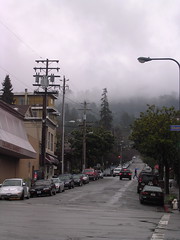
When we left to return to Chicago last Tuesday it was raining. The rains come heavy there from December through February, long stretches of it that sometimes last for days. Everything goes green and so it was while we were there, the Berkeley hills luminously poking up through the fog and Tilden's paths, which we walked on Saturday, verdant and squishy. We came back because when we left we made a promise to return a year later. I don't know when we'll be back next or how much of us will still be there.



No wrong decisions, and so we made the right one. We've been content to find ourselves living back in what Dan Quayle once called "the great state of Chicago," even if its winters deplorably drag on and on only to teasingly linger through most of its springs. There's a nagging distance here too, a lover's cold shoulder- something waiting to be reclaimed, reexamined and made wholly our own again.
Lately I've been perusing some of the class readers Cathy used while in graduate school. In particular, I've been attracted to a handful of articles that explore ideas about landscape perception, interpretation and a sense of place. I'm probably attracted to these articles because the original move from Chicago to Berkeley in 2001 and our consequent attempts to put down roots in the Bay Area, followed once again by our move back to Chicago in February of last year and our attempts to reclaim our roots, created a sense of being always on the cusp of integrating into a place, of feeling like our roots were shallow and fragile.
When we were living in Berkeley I wrestled with how to best go about creating a sense of place. Was such an amorphous thing at its most conducive when simply left alone and not forced? This kind of thinking is similar to how I feel about traveling abroad- do you make an itinerary and madly rush about trying to "see it all," take the obligatory pictures of the landmarks, pay for the tours, set foot in the required museums- or do you chart your own course, allow for spontaneity and the opportunity to simply linger amongst the natives and soak up an arguably more authentic ambience?
Unfortunately, the place where one lives is not a vacation spot. So maybe cultivating a sense of place or a sense of relatedness is better served by actively seeking out experiences more conducive to its flourishing. Increasingly, the idea that a sense of place magically arrives wholly via the passage of time has come to feel depressingly casual. That's part of it. But how to go out and create place and meaning and experience? How do we interact with a place beyond the superficial level? And how does somebody such as myself, more introverted and socially anxious and plagued by ugly thickets of self doubt then your average person (I could play you my small violin here, but we'll save the self confessions for some other time) find ways to interact more fully with our environments and gain a greater and more fulfilling sense of place and relatedness and experience?
In one of those handful articles I've recently read, The Meaning of Place, urban strategist Peter Smirniotopoulos writes, "The true meaning of place is grounded in theories of cognition, the physiology of memory, the complementary disciplines of anthropology and sociology, and- perhaps most important- the basic human need for community and social interaction." That's a lot to unpack, and yet when Cathy and I were searching to buy our first home last year, it was this "true meaning of place" that we were hoping to find. We eventually, after much looking, bought a place in a neighborhood we adore. The Edgewater/Andersonville neighborhoods we belong to are rich in the possibilities of interesting social interaction and ripe with conveniences, diversity and amenities. (I sound like a brochure.) There's no chance of our neighborhood suffering from what Jane Jacobs called "The Great Blight of Dullness." We love the fact that it's walking distance to urine scented transit stops, gut buster burritos, million dollar homes with sprinkler fed lawns and a few of Lake Michigan's 1600 miles of shoreline. We're continuing to grow into the place we live, both inside and out, though feel like we've barely begun to scratch the surface of its potential.
All this hope for creating an authentic sense of place runs into roadblocks. My current unemployment, a stubborn roadblock if ever there was one, is laden with more ironies and frustrations then I care to detail. I'm crashing into debris each day but histrionics aside (and I could play you my violin!) it's terribly difficult to feel motivated in taking the steps necessary to fulfill this potential. I'm feeling listless. I have a fledging video project I've been tinkering with and its helped me to become more conscious of my environment while allowing me to be creative in an area I've long been interested in playing with. As i've mentioned before, this video project is really a tool to help me interact with the people and places around me in ways I wouldn't probably have the courage to do otherwise. It's a prop and a way to find deeper meanings in the human and geographical landscapes that surround me.
Returning back to Berkeley, then, as we did last week, was bittersweet. It was a place whose deeper strata we were just beginning to discover and incorporate into our lives. It was becoming our home and we were beginning to finally feel an intimate part of its culture rather then just observers of it. Walking its lush streets last week I had a sense of contented limbo- of straddling two places ample in the familiars of kinship. Berkeley is still our home- the rituals we had woven into its landscape, those places we identified so strongly with in the area (its restaurants, the Bay, Tilden, campus, Telegraph, 4th St, Mt. Tam, Mt. Diablo...) were still present and exerting a powerful attraction.
Having only been away a year it felt like we hadn't left at all, as though things had remained fixed even without our presence. The time we lived here, a little under 3 years, had a powerful effect on both of us, one that encompassed both knuckle scraping emotional lows and giddy intellectual highs. The residue from that time still lingers and holds a powerful allure- and returning I simultaneously recoiled from it while lovingly examining the remnants. It no longer belongs so wholly to us as it did a year ago and I found myself wondering how long the enchantment of a place, its intimacies and personal rituals, retains its influence before growing more rounded and remote- decoyed with nostalgia. How long will we continue to recognize ourselves in Berkeley before the details begin to disappear? What are these intangibles we lose?
As difficult as it was for us, we fell in love with the Bay Area. It may simply be impossible not to. The people (engaged, for better or worse), the politics (to the left of Kucinich, a bumper sticker favorite) the food (slow food organic), the natural beauty (big ocean, rolling hills and Redwood awe), the relentless pleasantness of the weather (N. American's only Meditation climate) advection fogs (right thru the Golden Gate), the kookiness (Freak flags still flying proud) are all going to conspire to offer you something unavoidably enchanting if not entirely confusing.
The Bay Area resides in a state full of contradictions and is burdened with one of the nation's most murderously interesting histories. In her book, Where I was From, native Joan Didion writes eloquently about some of California's many contradictions, of its "extreme reliance on federal money," so starkly in contrast with its "emphasis on unfettered individualism," of its reliance on massive government construction projects to irrigate "millions of acres of essentially arid land" while simultaneously subsidizing enormous crop yields that glut national and international markets. Its current governor was, just 3 short years ago, mumbling and shooting his way through a waning movie career when, fortuitously enough, long sought opportunity to hold political office arose in the form of widespread disenchantment with its current governor, Gray Davis and the ensuing Republican led recall drive. Schwarzenegger won the 2003 recall (itself a vestige of California's increasingly troubled experiment with direct democracy, a system which as currently stands allows those privileged few who are able and willing to pony up the capital necessary to hire petition circulators who'll gather the necessary signatures, the affluently singular opportunity to see their pet proposition on the next state ballot) by announcing his decision to run on The Tonight Show With Jay Leno and proceeding to regale the close to 5 million Californians who eventually voted for him by running a campaign with the support of the likes of fellow sex offender, Rob Lowe, and the ample use of well worn one-liners from his films. It's important to note that we voted in this election. It's also important to note that Gary Coleman garnered 14, 242 votes.
But all this aside, and it's a lot to discount, what's not to like? Well, yes, the cost- there's that. According to a report published last year by the Bay Area Economic Forum, "housing prices have continued to rise at a 6.5% cumulative annual growth rate (CAGR), while salaries have flattened." The exorbitant costs of living in the area would have eventually sent us packing barring the sudden appearance of exorbitant paychecks, something I'm having difficulty even receiving with dependable regularity let alone having an account burdened with expendable income. Unemployment's a bitch. Still, we wonder if someday we might move back.
When we left to return to Chicago last Tuesday it was raining. The rains come heavy there from December through February, long stretches of it that sometimes last for days. Everything goes green and so it was while we were there, the Berkeley hills luminously poking up through the fog and Tilden's paths, which we walked on Saturday, verdant and squishy. We came back because when we left we made a promise to return a year later. I don't know when we'll be back next or how much of us will still be there.
Thursday, February 10, 2005
Watts, Who and Issac (Washington, Not Hayes)
One of those talking heads in Wattstax looked terribly familiar. I didn’t pick up on it the first time around, but by the second or third sweep I realized it was Ted Lange, better known as Isaac Washington from Aaron Spelling’s The Love Boat. He’s playing himself in 1972, just another brother shooting the shit in some Watts diner.
Wattstax has more to offer then Ted Lange (who soon found work as Melvin the Pimp in 1973’s Trick Baby) -there’s hilarious and trenchant commentary from Richard Pryor, long before his freebasing explosions to the face, excellent performances by Rufas Thomas, The Staple Singers, Issac Hayes and an absolutely smoking club performance by Johnnie Taylor.
Also watched The Who: The Kids Are Alright, a 1979 documentary made almost entirely out of old concert footage (most of it is fantastic- from their mod beginnings in the mid-60’s to their manic arena rock performances of the 70’s), guest appearances, television interviews and a sprinkling of new footage recorded for the documentary in, presumably, 1978, not long before Keith Moon’s overdose. Total blast to watch, especially the footage of John (Boris The Spider) Entwistle skeet shooting his gold records with a Tommy Gun. There’s also some wonderful behind the scenes studio footage of the recording of the song, Who Are You, where we get to see the band recording everything from background vocals to handclaps.
Lastly, we’re off to California for the next 5 days. Mt. Tam, we’re all over you come Saturday.
One of those talking heads in Wattstax looked terribly familiar. I didn’t pick up on it the first time around, but by the second or third sweep I realized it was Ted Lange, better known as Isaac Washington from Aaron Spelling’s The Love Boat. He’s playing himself in 1972, just another brother shooting the shit in some Watts diner.
Wattstax has more to offer then Ted Lange (who soon found work as Melvin the Pimp in 1973’s Trick Baby) -there’s hilarious and trenchant commentary from Richard Pryor, long before his freebasing explosions to the face, excellent performances by Rufas Thomas, The Staple Singers, Issac Hayes and an absolutely smoking club performance by Johnnie Taylor.
Also watched The Who: The Kids Are Alright, a 1979 documentary made almost entirely out of old concert footage (most of it is fantastic- from their mod beginnings in the mid-60’s to their manic arena rock performances of the 70’s), guest appearances, television interviews and a sprinkling of new footage recorded for the documentary in, presumably, 1978, not long before Keith Moon’s overdose. Total blast to watch, especially the footage of John (Boris The Spider) Entwistle skeet shooting his gold records with a Tommy Gun. There’s also some wonderful behind the scenes studio footage of the recording of the song, Who Are You, where we get to see the band recording everything from background vocals to handclaps.
Lastly, we’re off to California for the next 5 days. Mt. Tam, we’re all over you come Saturday.
Monday, February 07, 2005
When I’m Stuck With A Day, That’s Grey And Lonely
Reading Nicholas Dawidoff’s In The Country of the Country: A Journey To The Roots Of American Music and really enjoying it. Still amusing to think that there was a time not so long ago when I met the very idea of Country/Hillbilly/Old Time music with strong feelings of displeasure if not outright hostility. I belonged to that camp that admitted smatterings of Johnny Cash, Patsy Cline and Willie Nelson and saw fit to narrowly generalize the rest of the genre as a vestige ofsouthern redneck racism.
Dawidoff, like Peter Guralnick’s awesome trilogy on Blues, Country, Rhythm and Blues and Rock ‘N Roll, knows when to provide context and when to disappear and allow his subjects to talk and tell their stories.
A few interesting anecdotes:
Elvis Presley’s all-time favorite country gospel group was the Louvin’ Brothers, but he never recorded one of there songs because Ira Louvin, (a sad template for redneck clichés if ever there was one- though his singing voice is magnificent) upon hearing Elvis sing a gospel song to unwind after a show in the mid-50’s, humiliated him by shouting, “You fuckin’ white nigger. If that’s the kind of music you like, why don’t you do that out there instead of that shit you do?” Ira Louvin was eventually shot 5 times by his third wife.
The head of Doc Watson’s first banjo was made out of his grandmother’s decrepit old cat. His brother, asked to put the thing out of its misery, scraped off its hair, tanned it and his father stretched it across the hoop. Watson tells Dawidoff, “The catskin made a great head and a beautiful sound.”
Johnny Cash once recorded a song called, Flushed From The Bathroom Of Your Heart. In 1983 he tried to hit his pet ostrich with a two-by-four only to be kicked in the chest and have three of his ribs broken.
George Jones, who many believe to possess one of Country Music’s greatest voices, was once one so filled with delusions and self-loathing that he sang live concerts in the voice of Daffy Duck. Believe it or not! No, it’s true, and I have to say, that may be my favorite anecdote- I mean, can you imagine?
Now we’re going to watch Wattstax.
Reading Nicholas Dawidoff’s In The Country of the Country: A Journey To The Roots Of American Music and really enjoying it. Still amusing to think that there was a time not so long ago when I met the very idea of Country/Hillbilly/Old Time music with strong feelings of displeasure if not outright hostility. I belonged to that camp that admitted smatterings of Johnny Cash, Patsy Cline and Willie Nelson and saw fit to narrowly generalize the rest of the genre as a vestige of
Dawidoff, like Peter Guralnick’s awesome trilogy on Blues, Country, Rhythm and Blues and Rock ‘N Roll, knows when to provide context and when to disappear and allow his subjects to talk and tell their stories.
A few interesting anecdotes:
Elvis Presley’s all-time favorite country gospel group was the Louvin’ Brothers, but he never recorded one of there songs because Ira Louvin, (a sad template for redneck clichés if ever there was one- though his singing voice is magnificent) upon hearing Elvis sing a gospel song to unwind after a show in the mid-50’s, humiliated him by shouting, “You fuckin’ white nigger. If that’s the kind of music you like, why don’t you do that out there instead of that shit you do?” Ira Louvin was eventually shot 5 times by his third wife.
The head of Doc Watson’s first banjo was made out of his grandmother’s decrepit old cat. His brother, asked to put the thing out of its misery, scraped off its hair, tanned it and his father stretched it across the hoop. Watson tells Dawidoff, “The catskin made a great head and a beautiful sound.”
Johnny Cash once recorded a song called, Flushed From The Bathroom Of Your Heart. In 1983 he tried to hit his pet ostrich with a two-by-four only to be kicked in the chest and have three of his ribs broken.
George Jones, who many believe to possess one of Country Music’s greatest voices, was once one so filled with delusions and self-loathing that he sang live concerts in the voice of Daffy Duck. Believe it or not! No, it’s true, and I have to say, that may be my favorite anecdote- I mean, can you imagine?
Now we’re going to watch Wattstax.
Wednesday, February 02, 2005
There’s Acid In The House
Richard James is back, releasing a string of 12” singles as AFX on his Rephlex label. Very exciting. The Analord singles (a pun on Analogue), as they’re called, will supposedly be a string of 10 releases, with 1 and 2 having just been released last Tuesday.
For many of the techno cognoscenti, James has a mandate to break new ground with each new release. Talk about pressure! Innovate, you Cornwall fiend! Somewhere back in the mid-90’s he was flagged as the pacesetter for all future electronic music, each of his releases to be nothing less then the gold standard on which all else was judged. He was done gone and hailed a genius, a judgment I wholeheartedly embraced- his Ambient Works 85-92, being one of the earliest full albums of electronic music I ever purchased (right around the time of other, then rare and stellar full length releases coming out by the likes of LFO, Black Dog, Autechre, The Future Sound of London, The Orb, and Orbital) and the album I probably cherished and listened to the most throughout the decade.
Throughout the remainder of the 90’s James was fairly prolific. He seemed willing to oblige his critics by releasing a string of extraordinarily innovative albums, his last acknowledged masterwork being 1999’s Miami bootylicious Windowlicker single. There was, however, a palpable sense of disappointment upon the release of 2001’s Drukqs, a collective impression that James had lazily reached into his vaults and released a 2 CD set of half-baked cast-offs. The disheartened consensus seemed to be that he wasn’t breaking new ground, not properly fulfilling his mandate and progressing. I have to admit, however, to being wary of this idea/legacy that somehow novels, poems, paintings, music, etc… must somehow be…what? more advanced then their predecessors…an idea that seems intimately connected to the arts function as a commodity in a capitalist society rather then its emotional/intellectual connection to the person engrossed in it. This idea of progress first is particularly entrenched in the world of electronic music- that somehow because of its production reliance on computers it must shadow and demonstrate a kind of Moore’s Law rate of development- its complexity and wow factor doubling every 18 months or else.
We digress, man.
The initial Analord releases seem to be all all about heading back to the sound of old skool aciiiiiid, supposedly made on James’s hefty collection of classic analogue gear. It’s the antithesis of progress, the sound of a dude reveling in an acid (analogue) bubble bath. The Roland 303 is sputtering and squiggling all over these tracks and the beat programming, while exquisite (those crisp hi-hat’s- oye!), is kept simple and supportive rather then eclipsing via cut-up ‘how’d he do that? mayhem. Most of the tracks are in fact pretty straightforward, which is to say James’s is cool with keeping things fairly minimal and letting the acid gurgle and shine. Take a track like Analord 10’s untitled track 1 (James released a couple tracks from Analord 10 as teasers a few weeks ago), where a fat and dampened kick drum serves to reinforce propulsive dueling acid lines that are oh so delicately tweaked up and out and into a sublime grind that, in the tracks final seconds, are dramatically dropped leaving just the kick and a distant acid arpeggio. Sweaty and sublime, and yes, we've certainly been here and done this before- any use of the Roland 303 at this point has what Simon Reynolds aptly called the "patina of homage," but it would take a lot more by way of record collection acid fatigue (simply put, I don't have all that much music laced with the Roland 303) for me to find this an "utterly lame" retread.
Richard James is back, releasing a string of 12” singles as AFX on his Rephlex label. Very exciting. The Analord singles (a pun on Analogue), as they’re called, will supposedly be a string of 10 releases, with 1 and 2 having just been released last Tuesday.
For many of the techno cognoscenti, James has a mandate to break new ground with each new release. Talk about pressure! Innovate, you Cornwall fiend! Somewhere back in the mid-90’s he was flagged as the pacesetter for all future electronic music, each of his releases to be nothing less then the gold standard on which all else was judged. He was done gone and hailed a genius, a judgment I wholeheartedly embraced- his Ambient Works 85-92, being one of the earliest full albums of electronic music I ever purchased (right around the time of other, then rare and stellar full length releases coming out by the likes of LFO, Black Dog, Autechre, The Future Sound of London, The Orb, and Orbital) and the album I probably cherished and listened to the most throughout the decade.
Throughout the remainder of the 90’s James was fairly prolific. He seemed willing to oblige his critics by releasing a string of extraordinarily innovative albums, his last acknowledged masterwork being 1999’s Miami bootylicious Windowlicker single. There was, however, a palpable sense of disappointment upon the release of 2001’s Drukqs, a collective impression that James had lazily reached into his vaults and released a 2 CD set of half-baked cast-offs. The disheartened consensus seemed to be that he wasn’t breaking new ground, not properly fulfilling his mandate and progressing. I have to admit, however, to being wary of this idea/legacy that somehow novels, poems, paintings, music, etc… must somehow be…what? more advanced then their predecessors…an idea that seems intimately connected to the arts function as a commodity in a capitalist society rather then its emotional/intellectual connection to the person engrossed in it. This idea of progress first is particularly entrenched in the world of electronic music- that somehow because of its production reliance on computers it must shadow and demonstrate a kind of Moore’s Law rate of development- its complexity and wow factor doubling every 18 months or else.
We digress, man.
The initial Analord releases seem to be all all about heading back to the sound of old skool aciiiiiid, supposedly made on James’s hefty collection of classic analogue gear. It’s the antithesis of progress, the sound of a dude reveling in an acid (analogue) bubble bath. The Roland 303 is sputtering and squiggling all over these tracks and the beat programming, while exquisite (those crisp hi-hat’s- oye!), is kept simple and supportive rather then eclipsing via cut-up ‘how’d he do that? mayhem. Most of the tracks are in fact pretty straightforward, which is to say James’s is cool with keeping things fairly minimal and letting the acid gurgle and shine. Take a track like Analord 10’s untitled track 1 (James released a couple tracks from Analord 10 as teasers a few weeks ago), where a fat and dampened kick drum serves to reinforce propulsive dueling acid lines that are oh so delicately tweaked up and out and into a sublime grind that, in the tracks final seconds, are dramatically dropped leaving just the kick and a distant acid arpeggio. Sweaty and sublime, and yes, we've certainly been here and done this before- any use of the Roland 303 at this point has what Simon Reynolds aptly called the "patina of homage," but it would take a lot more by way of record collection acid fatigue (simply put, I don't have all that much music laced with the Roland 303) for me to find this an "utterly lame" retread.
Monday, January 31, 2005
6 Hudred Million Dollar Baby
Cathy and I went to see Eastwood’s Million Dollar Baby yesterday. We got there 20 minutes before the movie (I need to be at most films 20 minutes before or I get cranky and unmanageable and downright peevish) and sat through the awful onslaught of pre-movie commercial music videos, one of which included Shania Twain walking through some generic urban landscape handing out party invitations to 20-something white people who upon receiving them gaze back with muse like adoration. There are numerous shots of Shania shaking her head to denote, I think, unrestrained Shania merrymaking. Her music seemed to be made out of that cardboard eggs come in.
Million Dollar Baby is, in my mind, a far better film then the much heralded Mystic River, which despite its fantastic across the board acting and perfectly inflected Boston accents, only became exceptional during its final 10 minutes, when it took on a spooky mythic resonance. Million Dollar Baby, however, was stunning from beginning to end, a minor masterpiece flawed only by a couple unnecessary white trash interludes that veered too close to trailer-park cliché.
The story itself is a kind of archetype, well worn and familiar but Eastwood makes no attempt to hide the stories cogs. What he does, and what so few mainstream Hollywood films seem unable to accomplish these days, is to tell the story with a graceful nonchalance, free of firework displays and a refreshing modicum of the unnecessary. The film focuses on just three characters and it tells their story so well (and Eastwood, Hillary Swank and Morgan Freeman are all outstanding) and with such requisite economy that it’s an elegant, oftentimes exquisite character study of the time worn story arc of protagonists haunted by their pasts and offered redemption.
The tragedy that arrives midway through the film could have unhinged things, and my initial response to it was that Eastwood had lost the reigns and dipped his ladle into that big easy pool of Hollywood pathos. (Those bargain-basement pools of cheap sentiment lie like pitfalls all around the film and it’s to Eastwood’s great credit that he avoids them all.) It’s here, after the tragedy, that the trailer park clichés rear their ugly heads again and sucker punch us. It’s Eastwood’s biggest misstep and while its presence is glaring (and reminds us of just how perfect the rest of the film’s classical narrative has been progressing) it’s one of those stumbles that I was quick to forgive, to subtract and cast aside. The central story (surrogate father/daughter) comes roaring back at us and the tragedy and its ensuing complications and actions carry the themes of loss and regret, of what Amy Taubin called “a grief that can never be assuaged,” to a scene of such heartrending poignancy and power that it’s shattering.
Cathy and I went to see Eastwood’s Million Dollar Baby yesterday. We got there 20 minutes before the movie (I need to be at most films 20 minutes before or I get cranky and unmanageable and downright peevish) and sat through the awful onslaught of pre-movie commercial music videos, one of which included Shania Twain walking through some generic urban landscape handing out party invitations to 20-something white people who upon receiving them gaze back with muse like adoration. There are numerous shots of Shania shaking her head to denote, I think, unrestrained Shania merrymaking. Her music seemed to be made out of that cardboard eggs come in.

Million Dollar Baby is, in my mind, a far better film then the much heralded Mystic River, which despite its fantastic across the board acting and perfectly inflected Boston accents, only became exceptional during its final 10 minutes, when it took on a spooky mythic resonance. Million Dollar Baby, however, was stunning from beginning to end, a minor masterpiece flawed only by a couple unnecessary white trash interludes that veered too close to trailer-park cliché.
The story itself is a kind of archetype, well worn and familiar but Eastwood makes no attempt to hide the stories cogs. What he does, and what so few mainstream Hollywood films seem unable to accomplish these days, is to tell the story with a graceful nonchalance, free of firework displays and a refreshing modicum of the unnecessary. The film focuses on just three characters and it tells their story so well (and Eastwood, Hillary Swank and Morgan Freeman are all outstanding) and with such requisite economy that it’s an elegant, oftentimes exquisite character study of the time worn story arc of protagonists haunted by their pasts and offered redemption.
The tragedy that arrives midway through the film could have unhinged things, and my initial response to it was that Eastwood had lost the reigns and dipped his ladle into that big easy pool of Hollywood pathos. (Those bargain-basement pools of cheap sentiment lie like pitfalls all around the film and it’s to Eastwood’s great credit that he avoids them all.) It’s here, after the tragedy, that the trailer park clichés rear their ugly heads again and sucker punch us. It’s Eastwood’s biggest misstep and while its presence is glaring (and reminds us of just how perfect the rest of the film’s classical narrative has been progressing) it’s one of those stumbles that I was quick to forgive, to subtract and cast aside. The central story (surrogate father/daughter) comes roaring back at us and the tragedy and its ensuing complications and actions carry the themes of loss and regret, of what Amy Taubin called “a grief that can never be assuaged,” to a scene of such heartrending poignancy and power that it’s shattering.
Subscribe to:
Posts (Atom)